Tesla's FSD Dares to Go Unsupervised, But Regulators Cast a Long Shadow
In a bold move that could redefine the trajectory of autonomous driving, Tesla's Full Self-Driving (FSD) system has reportedly disabled manual steerin...
Editorial Team
World Of EV
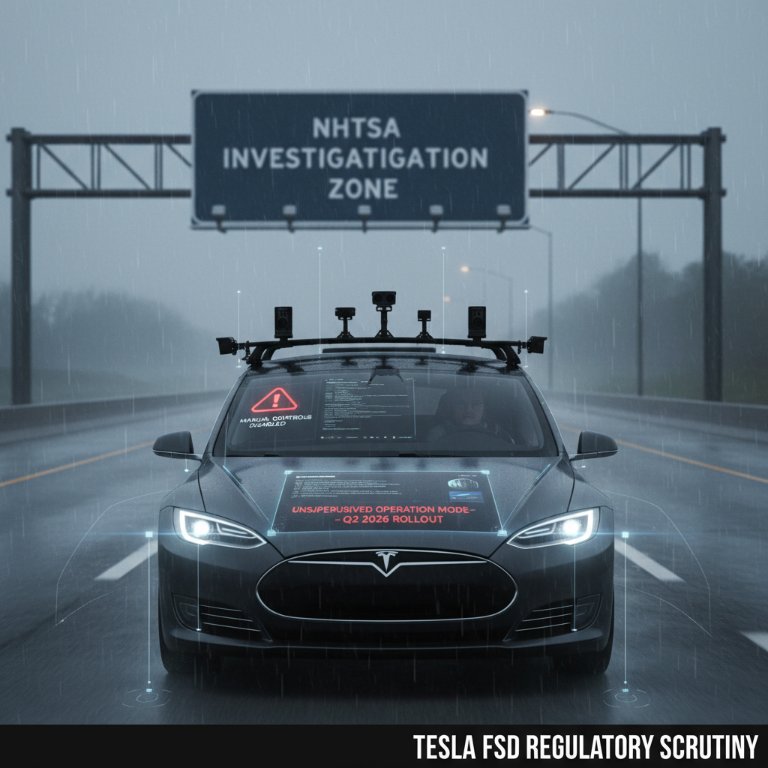
In a bold move that could redefine the trajectory of autonomous driving, Tesla's Full Self-Driving (FSD) system has reportedly disabled manual steering and control inputs within a controlled test environment. This significant development, confirmed by CEO Elon Musk on April 2, signals a fundamental shift towards truly unsupervised operation, with a full public rollout optimistically targeted for Q2 2026. For years, FSD has operated under a supervised model, requiring active driver attention and intervention. This latest evolution, if successful, could usher in an unprecedented era of hands-off, eyes-off driving for Tesla owners, pushing the boundaries of what consumers expect from their vehicles.
However, this audacious leap into unsupervised autonomy arrives amidst escalating scrutiny from federal regulators. The National Highway Traffic Safety Administration (NHTSA) has intensified its investigation into FSD, specifically probing its ability to detect and alert drivers in reduced visibility conditions. This comprehensive probe now encompasses an estimated 3.2 million Tesla vehicles, raising critical concerns not only about FSD's real-world performance under common roadway conditions but also potential under-reporting of crashes involving the system. The timing of these developments sets the stage for a high-stakes confrontation between cutting-edge innovation and the paramount need for public safety and regulatory oversight.
The Path to Driverless Ambition
Tesla's ambition for a truly driverless experience is hardly new, but the reported disablement of manual controls represents a tangible step forward. While previous FSD iterations have progressively taken more control, the explicit removal of driver input in a test environment marks a philosophical departure. This move underscores Tesla's confidence in its neural network and sensor suite to handle complex driving scenarios without human intervention. The Q2 2026 public rollout target, though ambitious, indicates Tesla's intent to rapidly accelerate the deployment of advanced autonomous capabilities to its wider customer base.
- Key Shift: FSD reportedly disables manual steering and control inputs in a limited test environment.
- Confirmation: Elon Musk confirmed the development on April 2.
- Public Target: Full public rollout aimed for Q2 2026.
- Implication: Suggests a fundamental shift towards unsupervised operation, moving beyond the traditional 'supervised' autonomy model.
NHTSA's Intensified Oversight
Simultaneously, the NHTSA's escalated investigation injects a dose of sobering reality into Tesla's autonomous aspirations. The agency's focus on FSD's performance in reduced visibility conditions highlights critical gaps that could undermine public trust and safety. This isn't just about minor glitches; it's about the system's foundational ability to perceive and react reliably in everyday scenarios like rain, fog, or low light. The inclusion of 3.2 million vehicles in the probe also signals the seriousness and scale of the regulatory concerns, particularly regarding the accurate reporting of incidents involving FSD.
- Scope: NHTSA investigation escalated, covering 3.2 million Tesla vehicles.
- Focus: FSD's ability to detect and alert drivers in reduced visibility conditions.
- Concerns: Performance under common roadway conditions and potential under-reporting of crashes.
Why This Matters:
This confluence of Tesla's aggressive push for unsupervised autonomy and NHTSA's heightened scrutiny represents a pivotal moment for the entire EV and autonomous driving industry. For Tesla, this is a do-or-die juncture for FSD. If the system can prove its safety and reliability under unsupervised conditions, it could be a massive competitive advantage, catapulting Tesla even further ahead in the race for true self-driving. However, failure to satisfy regulatory concerns, especially regarding fundamental safety in challenging conditions, could lead to significant setbacks, costly recalls, and a severe blow to public confidence.
Who Wins? If Tesla's unsupervised FSD proves safe and robust, consumers could gain unprecedented convenience and accessibility, and Tesla's valuation and market leadership in autonomy would solidify. The broader industry might also benefit from clearer pathways for regulatory approval of advanced autonomous systems.
Who Loses? Should NHTSA's investigation uncover systemic flaws or unsafe practices, Tesla faces substantial reputational damage, financial penalties, and potentially a mandatory scaling back of FSD capabilities. This would represent a major setback for the company's long-stated vision of a fully autonomous fleet and could cool investor enthusiasm for the entire self-driving sector, making other companies' paths to autonomy even more challenging. This moment signals that regulators are not merely observers but active participants in shaping the future of autonomous vehicles, emphasizing that safety will ultimately dictate the pace of innovation.
As the Q2 2026 target approaches, all eyes will be on Tesla's ability to demonstrate that its ambitious vision of unsupervised driving can meet the stringent safety requirements demanded by regulators and the public alike. The outcome of this delicate balance between innovation and regulation will undoubtedly shape the future of autonomous mobility.