Tesla's Flagship Farewell: Model S and Model X Production Halts as Robotaxi and Optimus Take Center Stage
The automotive world is witnessing a seismic shift as Tesla officially begins phasing out production of its iconic Model S sedan and Model X SUV in th...
Editorial Team
World Of EV
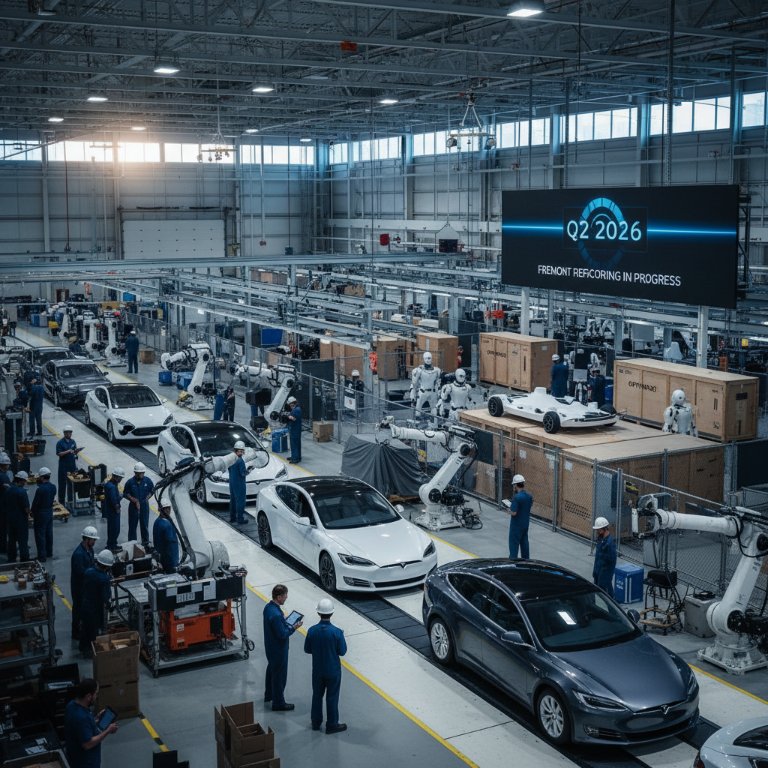
The automotive world is witnessing a seismic shift as Tesla officially begins phasing out production of its iconic Model S sedan and Model X SUV in the United States. In an email to owners on March 27, 2026, the EV pioneer confirmed that these long-running models, instrumental in defining the luxury electric vehicle segment, are nearing the end of their production cycle. This strategic decision, expected to culminate in a full wind-down by Q2 2026, frees up critical factory floor space at the company's venerable Fremont, California plant, signaling Tesla's aggressive pivot towards next-generation manufacturing, including Optimus humanoid robots and the highly anticipated Robotaxi platform.
The End of an Electric Era
For over a decade, the Model S and Model X have stood as Tesla's vanguard, showcasing the potential of electric propulsion in performance, luxury, and technological innovation. The Model S, launched in 2012, was Tesla's first ground-up EV and proved that electric cars could be both desirable and high-performance, earning critical acclaim and dispelling doubts about EV viability. The Model X, introduced in 2015, pushed boundaries with its distinctive Falcon Wing doors and SUV practicality, albeit with its share of manufacturing complexities.
Despite their historic importance and numerous refreshes, sales of these higher-cost, aging platform models have dwindled in recent years, eclipsed by the mass-market appeal and higher volumes of the Model 3 and Model Y. This gradual decline in sales volume and higher production costs made them less central to Tesla's immediate automotive revenue goals.
Fremont's Next Chapter: Robots and Autonomy
The rationale behind this bold move extends far beyond mere product lifecycle management. Tesla CEO Elon Musk has described the retirement as an "honorable discharge," emphasizing a profound shift towards autonomy, robotics, and future technology. The freed-up space at the Fremont factory, where both models have been built since their inception, will be repurposed for the mass production of Optimus humanoid robots. Tesla aims to produce up to one million Optimus units annually in the retooled facility, with a third-generation prototype designed for mass production expected in early 2026.
This retooling is not just about physical space; it's a fundamental change in manufacturing focus. Musk has indicated that the existing automotive supply chain for the S and X has little in common with what's needed for Optimus, implying a complete reimagining of the factory's operations and workflows to suit its ambitious robotics goals. Concurrently, this move also supports the acceleration of Tesla's Robotaxi platform, positioning the company as a leader in autonomous transportation.
Why This Matters:
- Tesla's Existential Pivot: This isn't just a product discontinuation; it's an existential pivot. Tesla is consciously moving beyond being primarily an automotive manufacturer to positioning itself as an AI and robotics company. The company is sacrificing a premium, albeit low-volume, segment to double down on highly speculative but potentially exponentially larger markets in robotics and autonomous services. This is a "do-or-die" bet on Elon Musk's long-term vision.
- Rethinking the Luxury EV Landscape: The departure of the Model S and Model X leaves a gaping void in the premium electric sedan and SUV market that Tesla once dominated. Competitors like Lucid Air, Mercedes-Benz EQS, and Porsche Taycan are poised to capitalize on this, intensifying competition for luxury EV buyers. This could lead to increased innovation and feature sets from rivals eager to capture this high-margin segment.
- The Rise of Robotics in Manufacturing: Tesla's commitment to converting a significant portion of its flagship automotive factory into an Optimus production hub is a powerful statement. It underscores the company's belief that humanoid robots will not only revolutionize its own manufacturing processes but also become a massive product category in themselves, potentially exceeding the value of its vehicle business. This move could accelerate the adoption and development of industrial and general-purpose robotics across various sectors.
- Impact on Current Owners and Resale Value: While Tesla has promised continued service, parts, and software support for existing Model S and X owners indefinitely, the discontinuation of production can create uncertainty. While demand for these foundational EVs might see a short-term spike from collectors, the long-term impact on depreciation and parts availability for specific components remains to be seen.
- A Shift in Tesla's Brand Identity: Tesla's brand, once synonymous with cutting-edge electric cars, is deliberately being broadened to encompass AI, robotics, and full autonomy. This shift reflects a strategy to move beyond the cyclical nature of automotive sales towards potentially more scalable and recurring revenue streams from robotaxis and robot services.
In essence, Tesla is trading the proven, albeit slower, growth of its legacy flagships for the high-risk, high-reward potential of unproven, transformational technologies. This move is a clear indicator that the company sees its future not just on roads, but across industries, powered by AI and robotics.
Conclusion: A Vision of the Future, or a Leap of Faith?
Tesla's decision to cease Model S and Model X production is a bold, uncompromising step that underscores its long-term vision. It's a clear signal that the company is fully committed to a future dominated by AI, robotics, and autonomous services, even if it means retiring the very vehicles that built its initial reputation. While this strategic pivot carries significant risks, particularly given the nascent stages of Optimus and Robotaxi development, it also positions Tesla to potentially capture immense new markets. The coming quarters will reveal whether this is a stroke of genius, or a miscalculation in the race for automotive and technological supremacy.
" } ```