Tesla's European Sales Plummet: A Steep Decline Signals Deepening Market Challenges
Tesla, once the undisputed titan of electric vehicle sales in Europe, is facing an increasingly dire situation. Preliminary new-vehicle registration d...
Editorial Team
World Of EV
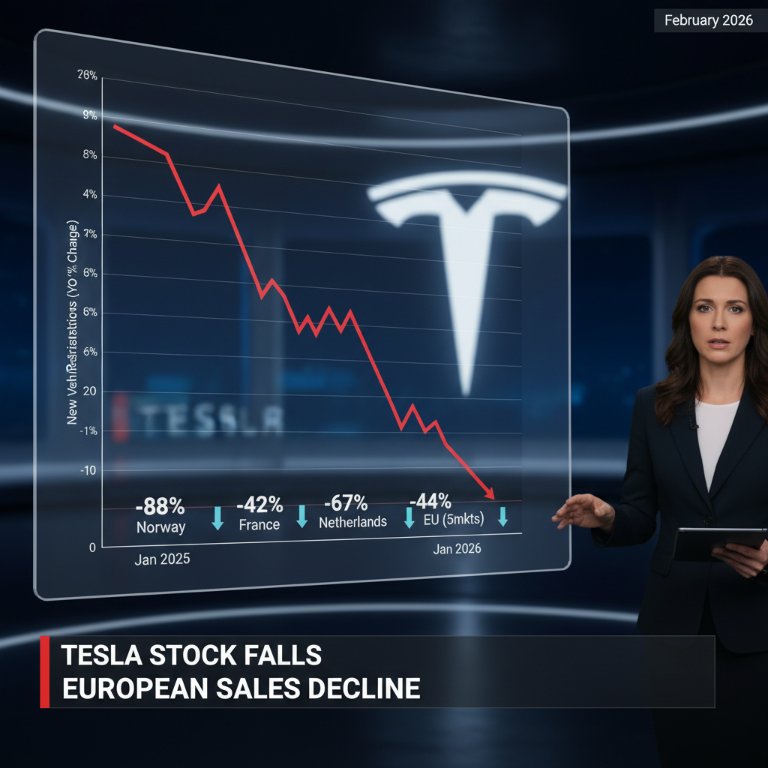
Tesla, once the undisputed titan of electric vehicle sales in Europe, is facing an increasingly dire situation. Preliminary new-vehicle registration data for January 2026 reveals a precipitous year-over-year decline across key European markets, sending ripples through the financial markets and sparking renewed concerns about the automaker's strategy on the continent. This isn't merely a blip; it's an acceleration of a troubling, two-year continuous slide that demands immediate and decisive action from Palo Alto.
The latest figures paint a stark picture: Tesla registrations in Norway plummeted by a staggering 88% compared to January 2025. France saw a significant 42% drop, while the Netherlands experienced a nearly 67% contraction. Across five major European markets, overall Tesla registrations were down a shocking 44% year-over-year. This comes on the heels of a challenging 2025, where Tesla’s sales in the EU, UK, and EFTA collective fell by almost 29%, marking a concerning pattern of sustained underperformance.
Europe's Faltering Demand
The January 2026 data underscores a dramatic erosion of Tesla's market presence in what was once a bastion of EV adoption. The specifics are alarming:
- Norway: Registrations down 88% year-over-year. This Nordic nation, known for its high EV penetration and early adoption of Tesla vehicles, signals a profound shift in consumer preference or market saturation.
- France: A 42% decrease in registrations. As one of Europe's largest automotive markets, France's significant downturn points to broader struggles beyond smaller, more saturated markets.
- Netherlands: Registrations fell by nearly 67%. Another historically strong market for Tesla, the Netherlands' steep decline suggests intense competition is taking its toll.
- Overall Europe (5 Major Markets): A collective 44% year-over-year drop. This composite figure highlights a systemic issue rather than isolated market anomalies.
A Troubling Trend Deepens
This isn't Tesla's first rodeo with European headwinds. The January 2026 numbers extend a two-year continuous decline on the continent, with 2025 sales across the EU, UK, and EFTA dropping almost 29%. For years, Tesla enjoyed a relative lack of direct competition, particularly in premium EV segments. However, the European landscape has evolved dramatically. Legacy automakers like Volkswagen Group, Stellantis, and Mercedes-Benz have unleashed a torrent of compelling, locally tailored EV models, often benefiting from established dealer networks and brand loyalty. Asian contenders such as BYD and MG are also aggressively entering the market with competitively priced and well-equipped vehicles.
Tesla's comparatively limited model lineup, coupled with fluctuating pricing strategies and the absence of a smaller, more European-centric vehicle, appears to be costing them dearly. While the Cybertruck and the long-awaited 'next-generation' platform promise innovation, their immediate impact on European volume sales remains uncertain and likely distant.
Why This Matters:
This dramatic sales slump is more than just a bad month for Tesla; it signals a critical juncture for the company's European ambitions. For industry professionals, it highlights the brutal reality of a maturing EV market where early mover advantage is no longer sufficient. Localized product strategies, robust supply chains, and established sales infrastructures are proving increasingly vital.
- Who Wins? European incumbents like Volkswagen, Stellantis, and Mercedes-Benz, alongside aggressive Asian brands such as BYD and Nio, stand to gain significant market share. Their increasingly diverse and regionally focused EV portfolios are resonating with European consumers, who value choice and a tailored approach. For prospective buyers, this means more options, potentially better deals, and greater innovation as competition intensifies.
- Who Loses? Primarily Tesla and its investors, who have long banked on uninterrupted, exponential growth. The continued underperformance in a crucial global market undermines the narrative of unassailable dominance and puts pressure on profitability. It also signals a potential missed opportunity to consolidate its lead before the competition fully caught up.
- What Does This Signal? This decline is a clear indicator that the European EV market has matured beyond its nascent phase. It's no longer enough to simply offer an electric vehicle; the market now demands competitive pricing, diverse body styles, advanced features, and comprehensive service networks. For Tesla, this is a do-or-die moment for its current European strategy. Without a significant shift in approach – potentially involving new, smaller models, a more stable pricing structure, or even localized production of European-specific vehicles – Tesla risks being relegated to a niche player in a market it once led.
Tesla's once-unshakeable position in Europe is clearly under severe pressure. The January 2026 registration data serves as an urgent wake-up call, demanding a profound reassessment of its strategy to regain momentum. The coming months will reveal whether the EV pioneer can adapt to the continent's rapidly evolving competitive landscape or continue to cede ground to hungry rivals.