Tesla's European FSD Demos Hint at a More Transparent, Regulator-Friendly UI Future
During recent official demonstration rides of its Full Self-Driving (Supervised) software in Europe, Tesla has inadvertently revealed significant upda...
Editorial Team
World Of EV
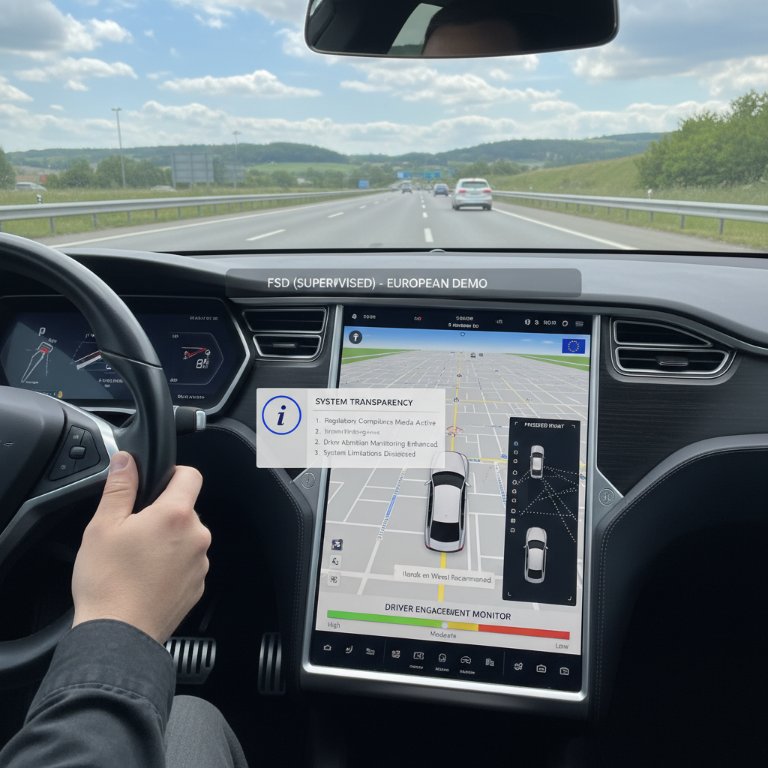
During recent official demonstration rides of its Full Self-Driving (Supervised) software in Europe, Tesla has inadvertently revealed significant updates to its user interface. Observers noted the presence of three previously unseen UI elements, changes that, while not yet included in public release notes, strongly suggest a strategic shift towards a more communicative and transparent FSD experience. This move appears poised to address the stringent regulatory demands of the European market, potentially foreshadowing a global evolution in how Tesla's advanced driver-assistance systems interact with users and external oversight.
For years, Tesla's FSD journey has been characterized by iterative development and a uniquely American approach to feature rollout. However, Europe presents a different landscape, one where regulators scrutinize every aspect of autonomous and assisted driving systems with an emphasis on clarity, driver responsibility, and system predictability. These newly observed UI elements indicate Tesla is actively adapting, moving beyond simply demonstrating capability to clearly communicating system status and intent—a critical step for broader acceptance and regulatory approval across the continent.
A Glimpse into Tesla's European FSD Future
The demo rides, a crucial step in Tesla's ongoing efforts to expand FSD (Supervised) to European territories, offered an early look at what users and regulators might expect. The changes point directly to an enhanced focus on driver understanding and system transparency, a necessary evolution for a technology often criticized for its complexity and the perceived lack of insight into its decision-making processes. Tesla, known for its minimalist design philosophy, seems to be adding layers of information precisely where it matters most for safety and regulatory compliance.
Beyond the Release Notes: What We Saw
While specific details of the three new UI elements remain under wraps, their collective implication is clear: a more verbose and informative FSD interface. Based on observations and industry trends, these elements likely include:
- Enhanced System Status Indicators: More granular visual cues indicating precisely what FSD is perceiving, planning, and executing. This could mean clearer demarcation of detected objects, predicted trajectories, and the system's confidence levels, moving beyond the current relatively abstract visualizations.
- Proactive Driver Prompts and Explanations: Instead of simple alerts, the system might now offer brief, on-screen explanations for specific driving maneuvers or decisions, such as why it's changing lanes or adjusting speed in certain conditions. This would empower drivers with immediate context and understanding.
- Regulatory Compliance Overlays: Potentially, new visual elements that confirm the system's adherence to local speed limits, no-passing zones, or other region-specific traffic laws, offering a direct visual assurance to both the driver and potential observers (like regulatory bodies) that the software is operating within legal parameters.
Why This Matters:
This unannounced UI overhaul is more than just a cosmetic refresh; it signals a fundamental shift in Tesla's strategy for FSD. This is a clear response to the unique demands of the European regulatory environment, which has historically been more cautious and prescriptive regarding advanced driving systems than North America. By proactively building in greater transparency and communicative capabilities, Tesla is laying the groundwork for smoother regulatory reviews and, ultimately, wider deployment. This benefits not only European prospective buyers, who gain a clearer, more understandable system, but also global users, as features developed for stringent markets often propagate worldwide. For Tesla, success in Europe with FSD is a critical gateway to further global expansion, and this UI evolution could be the key to unlocking that potential. Who wins? Drivers gain confidence and understanding. Regulators gain a clearer oversight mechanism. Tesla gains a credible path to market expansion. Who loses? Competitors who have underestimated the importance of transparent communication in ADAS systems might find themselves playing catch-up, as Tesla demonstrates a more sophisticated, albeit necessary, approach to user interaction and regulatory engagement.
These subtle yet significant UI alterations during European FSD demos paint a compelling picture of Tesla's future ambitions. They underscore the company's commitment to adapting its cutting-edge technology to diverse global markets, prioritizing clear communication and regulatory alignment. As Tesla continues its journey toward truly autonomous driving, expect these transparency-focused UI elements to become standard, fostering greater trust and accelerating the adoption of FSD worldwide.