Tesla's European FSD Ambitions Face Imminent Dutch Reckoning: March 20th Looms as Regulatory Gauntlet Tightens
Tesla's ambitious Full Self-Driving (FSD) software, a cornerstone of its technological leadership claims, is once again at a critical juncture in its ...
Editorial Team
World Of EV
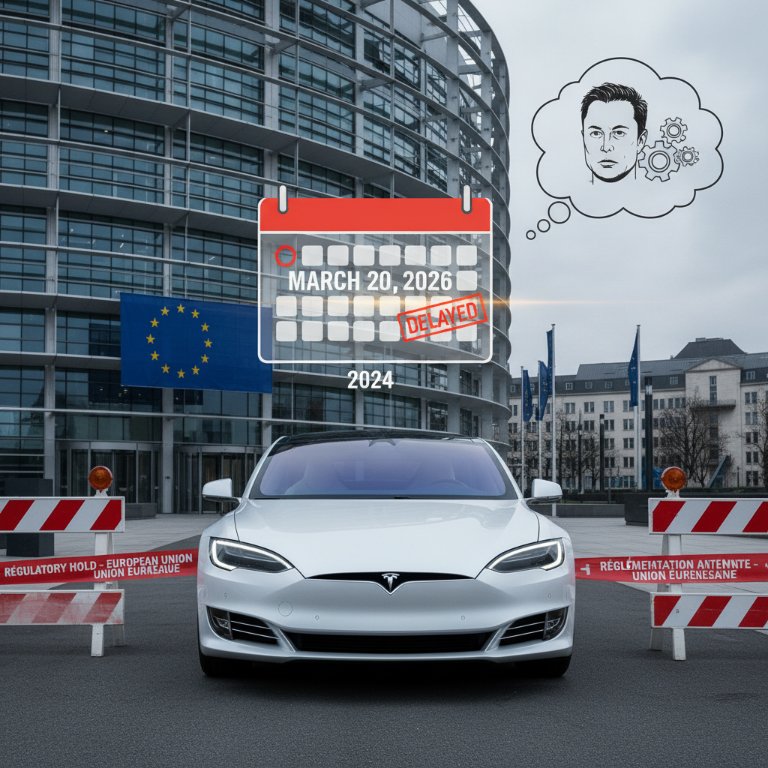
Tesla's ambitious Full Self-Driving (FSD) software, a cornerstone of its technological leadership claims, is once again at a critical juncture in its quest for European deployment. After years of incremental rollouts and regulatory friction across North America, the continent's notoriously stringent regulatory bodies have kept Tesla's most advanced driver-assistance system largely sidelined. With a general expectation for European approval by 2026 already a tight timeline, the spotlight has intensely focused on a specific, imminent date: March 20, 2026, for potential approval in the Netherlands.
The Dutch Crossroads: March 20th and Past Friction
Elon Musk recently indicated that Dutch authorities have provided March 20, 2026, as the date for potential regulatory approval of FSD (Supervised) in the Netherlands. This statement, made during an interview at Giga Berlin, positions the Netherlands as a critical gateway for Tesla's European FSD strategy. The Dutch vehicle authority, RDW, acts as the type approval body for the entire European Union, meaning a green light here could theoretically accelerate broader EU adoption.
However, this isn't Tesla's first tango with the RDW. In November 2025, a public disagreement emerged after Tesla's social media claims of a “committed” February 2026 approval were swiftly refuted by the RDW, who clarified it was merely a demonstration schedule for compliance with safety standards. This history underscores the cautious approach of European regulators and the potential for miscommunication or differing interpretations of progress.
Europe's Unyielding Regulatory Labyrinth
The challenges for FSD in Europe extend far beyond a single nation's approval. The continent presents a complex tapestry of diverse national regulations, stringent data privacy laws like GDPR, and robust safety protocols mandated by bodies like the United Nations Economic Commission for Europe (UNECE). These frameworks often conflict with Tesla's “supervised autonomy” model, which has allowed for hands-free driving under specific conditions in other markets.
Unlike the more permissive environments where FSD has amassed billions of miles of real-world data, European regulators limit unsupervised autonomous testing and demand comprehensive, feature-level approvals. Concerns over liability ambiguities and public skepticism, sometimes fueled by FSD-related incidents in other regions, further slow the process. Even with recent progress, such as Ireland establishing its first legal framework for Level 2 and Level 2+ autonomous vehicles in early March 2026, the RDW's overarching approval remains the critical hurdle for continental deployment.
Why This Matters:
-
For Tesla: The approval of FSD in a major European market like the Netherlands is more than just a sales opportunity; it's a validation of Tesla's long-term vision. FSD is a central pillar of Tesla's valuation, positioning the company as an AI and robotics leader rather than just an automaker. Continued delays in Europe directly impact potential revenue from FSD subscriptions, dampen brand perception of technological superiority, and hinder the vital collection of diverse real-world driving data crucial for further FSD development. Elon Musk's public frustrations highlight the strategic importance of this market. If March 20th sees another postponement or a more limited approval than anticipated, it would further test investor patience and potentially allow competitors to narrow the perceived technological gap.
-
For the European Market and Consumers: This regulatory saga signals the immense scrutiny any advanced autonomous driving system will face on the continent. European regulators are prioritizing safety, data privacy, and a clear legal framework over speed of deployment. This approach, while slower, aims to build public trust and ensure robust, harmonized standards. For prospective EV buyers, this means that while the promise of full self-driving is alluring, they should expect a more gradual rollout with significant driver supervision, classified as SAE Level 2, for the foreseeable future. It also means that European automakers, who have often taken a more incremental approach to ADAS, might find their cautious strategies implicitly validated by these ongoing delays for a more aggressive competitor.
-
The Broader Industry: The outcome in the Netherlands will set an important precedent for how AI-driven vehicle systems are evaluated and deployed globally. It’s a crucial test case for the balance between technological innovation and regulatory caution, influencing how other regions might approach similar approvals.
As March 20, 2026, rapidly approaches, all eyes in the automotive world turn to the Netherlands. While Elon Musk expresses confidence, the past has shown that regulatory approvals are complex and not guaranteed. The coming days will be definitive for Tesla's FSD aspirations in Europe, underscoring that even for an industry disruptor, navigating the continent's demanding regulatory landscape remains the ultimate, non-negotiable challenge for unlocking its full market potential.