Tesla's European Credit Bonanza Ends: Toyota and Stellantis Exit Emissions Pool for 2026
In a seismic shift for the European automotive market, industry giants Toyota and Stellantis are officially withdrawing from Tesla's lucrative CO2 emi...
Editorial Team
World Of EV
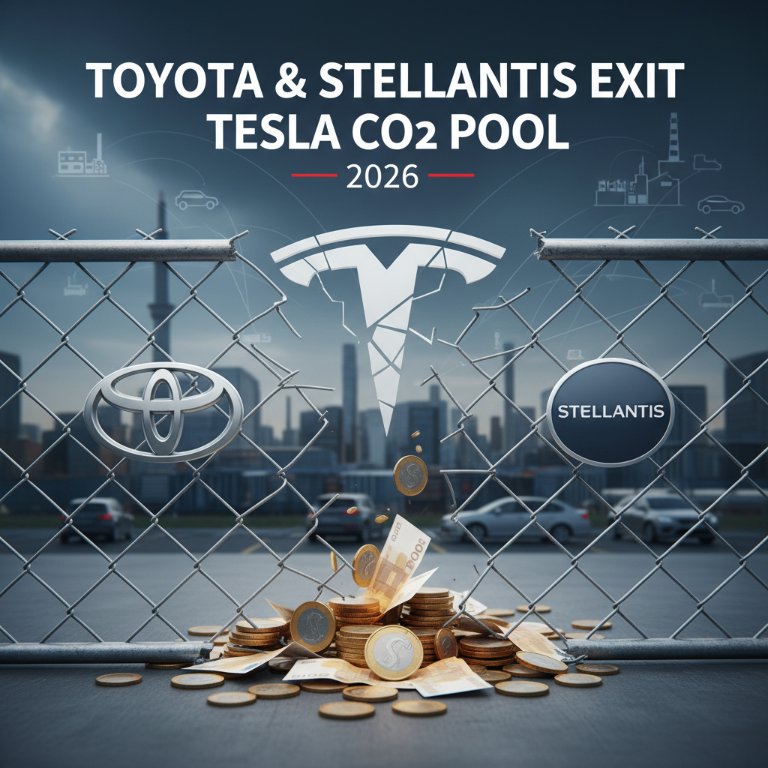
In a seismic shift for the European automotive market, industry giants Toyota and Stellantis are officially withdrawing from Tesla's lucrative CO2 emissions pooling arrangement for 2026, according to recent EU regulatory filings. This strategic departure signals a significant maturation of the European EV landscape and is poised to dramatically impact Tesla's highly profitable regulatory credit revenue stream. For years, these two automakers stood as among the largest contributors to Tesla's coffers through this unique regulatory mechanism, effectively subsidizing a direct competitor while navigating their own transitions to electrification.
The End of a Lucrative Alliance
Tesla, as a pure-play electric vehicle manufacturer, has long benefited from the European Union's stringent CO2 emissions regulations. Manufacturers failing to meet fleet-wide emissions targets independently have the option to join a ‘pooling system’ with companies like Tesla, whose zero-emission vehicle sales bring down the overall average. This allowed legacy automakers to avoid hefty fines by paying Tesla for the right to count its emissions performance against their own. Toyota and Stellantis's exit for the 2026 compliance year marks the end of an era, forcing Tesla to increasingly rely on vehicle sales rather than regulatory arbitrage for its profitability in Europe.
Significant Revenue Reduction: Tesla has historically generated hundreds of millions, if not billions, globally from the sale of regulatory credits. While the precise figures from the Toyota and Stellantis contributions are not public, their long-standing participation underscores their substantial value to Tesla's bottom line. Their withdrawal represents a considerable loss of guaranteed, high-margin income.
Shifting Landscape: This move follows similar departures, such as Honda's earlier exit, further demonstrating a trend of legacy automakers gaining confidence in their own EV strategies and a reduced need for external pooling solutions.
Legacy Automakers Forge Their Own EV Path
For Toyota and Stellantis, this withdrawal is a powerful statement of intent. Both companies, while having different approaches to electrification, have been aggressively ramping up their EV strategies and product pipelines. Toyota, often criticized for its slower initial EV rollout, has recently unveiled ambitious plans for next-generation electric vehicles and battery technology. Stellantis, under CEO Carlos Tavares, has committed significant investments to its multi-brand EV offensive, with numerous new electric models across its Peugeot, Fiat, Opel, and Chrysler brands, among others, slated for release in the coming years. Their departure from the pooling arrangement strongly suggests an internal forecast projecting compliance with EU CO2 targets through their own burgeoning EV sales, eliminating the need to pay a competitor.
Why This Matters:
Who Wins? Toyota and Stellantis emerge as clear winners. They not only save substantial sums of money previously paid to Tesla but also demonstrate a tangible commitment to and progress in their own electrification efforts. This signals to investors and consumers alike that these companies are increasingly capable of standing on their own two feet in the EV race. Consumers also win through increased competition and a wider array of compelling EV options.
Who Loses? Tesla faces the immediate challenge of replacing a significant, high-margin revenue stream. While Tesla's core business remains strong, the diminishing income from regulatory credits will place greater scrutiny on vehicle delivery growth and direct vehicle profitability. It underscores the imperative for Tesla to innovate and scale its production to maintain its financial performance without the regulatory safety net.
Market Signals: This move sends an unmistakable signal across the industry: the days of relying on regulatory credits as a significant profit driver for EV pioneers are waning. Legacy automakers are catching up, and the competitive field is leveling. It forces all players to focus intensely on compelling EV products, efficient manufacturing, and attractive pricing to capture market share.
In conclusion, the exit of Toyota and Stellantis from Tesla's European CO2 emissions pool for 2026 marks a pivotal moment. It signifies not only a changing financial landscape for Tesla but, more importantly, a testament to the accelerating electrification strategies of established automakers. The European EV market is entering a new, fiercely competitive chapter where self-sufficiency in emissions compliance will be the new benchmark for success.