Tesla's Energy Ascendancy: Record Profits and 50 GWh Megapack Expansion Redefine the Future Grid
While the spotlight often fixates on its electric vehicles, Tesla's energy division has quietly, yet decisively, emerged as a financial powerhouse, sh...
Editorial Team
World Of EV
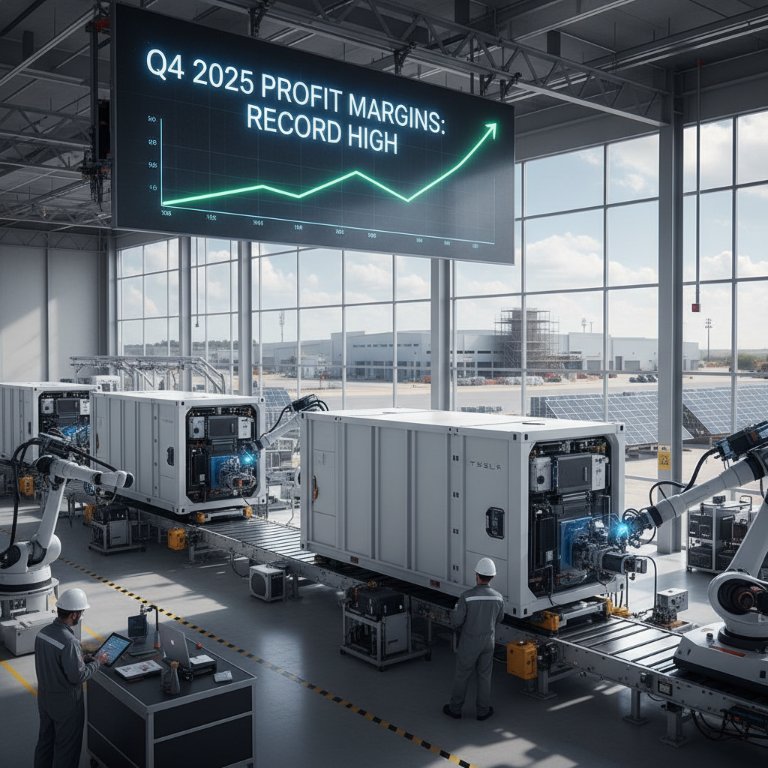
While the spotlight often fixates on its electric vehicles, Tesla's energy division has quietly, yet decisively, emerged as a financial powerhouse, shattering expectations with its fifth consecutive quarter of record profit margins in Q4 2025. This remarkable performance underscores a critical shift: Tesla is not just an automotive giant; it is a full-spectrum energy solutions provider poised to revolutionize global power infrastructure.
This unprecedented profitability stems directly from robust demand across both its Powerwall home battery and the industrial-scale Megapack grid storage systems. For years, Tesla's energy endeavors have been viewed by some as a complementary business; now, they are undeniably a primary growth engine, delivering consistent, high-margin revenue that diversifies the company's financial profile beyond the often-volatile automotive sector.
The Profit Surge: A Deeper Look
The consistency of five consecutive quarters of record profit margins is a testament to the maturity and scalability of Tesla's energy offerings. The Powerwall, a familiar name to many EV enthusiasts, provides crucial home energy storage, enabling solar self-consumption and resilient backup power. Its surging popularity reflects a global trend towards energy independence and localized grid stability.
Even more impactful on the profit margins, however, is the Megapack. These massive battery installations are designed for utility-scale applications, stabilizing grids, integrating renewable energy sources, and preventing blackouts. Unlike the consumer-facing Powerwall, Megapack sales represent significant, high-value contracts that directly address the burgeoning need for robust grid infrastructure worldwide.
Megapack 3: Fueling the Future Grid
Looking ahead, Tesla is dramatically accelerating its commitment to grid-scale storage with ambitious expansion plans. The company is set to commence Megapack production at an entirely new facility near Houston in 2026. This isn't merely an incremental increase; the plant targets an astounding annual capacity of up to 50 GWh of Megapack 3 systems. To put this into perspective, 50 GWh could power tens of millions of homes for short durations or provide critical stability for numerous large cities, representing a monumental leap in global energy storage capability.
This dedicated Megapack factory signifies a strategic move to vertically integrate and scale production, mirroring the success of its Gigafactories for EV and battery cell production. It allows Tesla to control costs, optimize manufacturing, and rapidly deploy these essential systems to meet the exploding global demand for grid modernization. CEO Elon Musk himself reaffirmed Tesla's continued, vigorous investment in solar PV production, forecasting “very high growth” for the entire energy sector, clearly indicating that generation and storage are two sides of the same coin in Tesla’s long-term vision.
Why This Matters:
This news holds profound implications for Tesla, the energy sector, and consumers worldwide.
- Tesla's Strategic Re-definition: This solidifies Tesla's identity as a diversified energy titan, not just an automotive innovator. Its financial stability is now bolstered by a highly profitable, rapidly expanding energy arm, insulating it from potential slowdowns in the EV market.
- Acceleration of the Energy Transition: The 50 GWh Megapack capacity is a game-changer for renewable energy adoption. It directly addresses one of the biggest bottlenecks—intermittency. More storage means more solar and wind can be integrated reliably into the grid, accelerating the transition away from fossil fuels.
- Grid Resilience and Consumer Impact: For everyday consumers, this translates to more reliable power grids, fewer outages, and potentially lower long-term energy costs as renewable sources become more efficient and stable. Countries and utilities investing in Megapack systems will significantly enhance their energy security.
- Market Leadership and Competition: Tesla's aggressive scaling of Megapack production sets a new benchmark for the industry. While other players exist in the grid storage market, few can match Tesla’s vertical integration, manufacturing prowess, and brand recognition. This move puts immense pressure on competitors to innovate and scale rapidly.
- Who Wins? Renewable energy developers, utilities committed to decarbonization, and ultimately, anyone who benefits from a stable, clean energy grid. Tesla, of course, is a massive winner, securing a dominant position in a critical growth market.
- Who Loses? Traditional fossil fuel generators and energy companies slow to adapt to the distributed, renewable energy paradigm face increased pressure and potential obsolescence as battery storage becomes ubiquitous.
Tesla's energy business is no longer merely an adjunct to its automotive operations; it is a central pillar of its long-term strategy, demonstrating explosive growth and profitability. The expansion of Megapack production, coupled with continued investment in solar, positions Tesla at the forefront of the global energy transition. This isn't just about selling batteries; it's about building the infrastructure for a sustainable, electrified future, ensuring that Tesla remains a pivotal player in shaping the world's energy landscape for decades to come.