Tesla's Enduring Power: A Model S Battery Hits 200,000 Miles, Redefining EV Longevity
For years, the specter of costly battery degradation loomed large over the nascent electric vehicle market, a primary deterrent for many prospective b...
Editorial Team
World Of EV
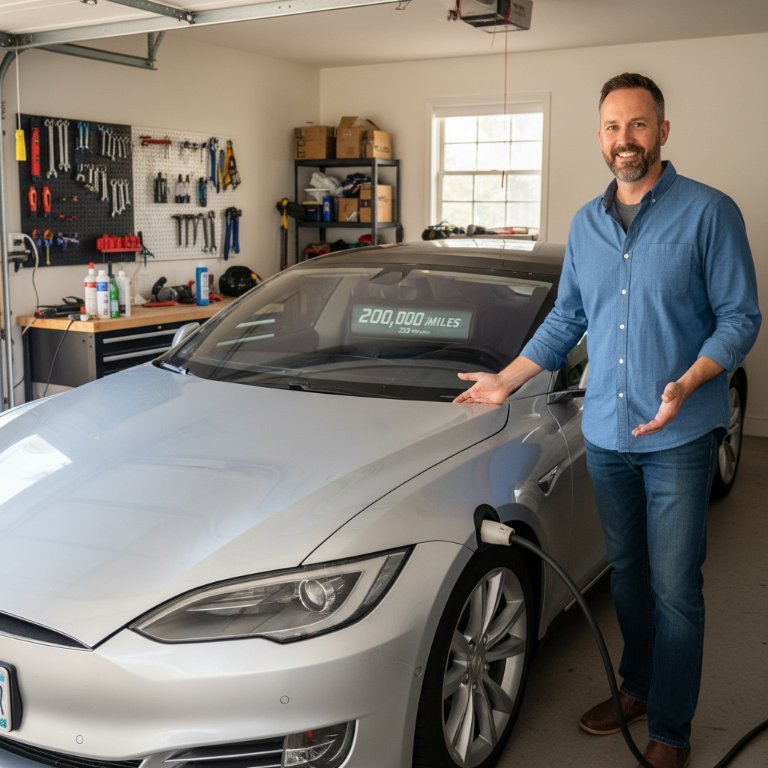
For years, the specter of costly battery degradation loomed large over the nascent electric vehicle market, a primary deterrent for many prospective buyers. Skeptics often painted a picture of EVs as disposable commodities with short lifespans, plagued by rapid battery fade and exorbitant replacement costs. However, a recent milestone achieved by a dedicated Tesla Model S owner shatters these myths, offering compelling evidence that EV batteries, even from the earliest generations, are built to last far beyond conventional expectations.
This extraordinary case comes from Hajjar, a Tesla Model S owner whose vehicle, powered by its second battery pack, has now accumulated an astonishing 200,000 miles over 12 years. This particular battery was installed in 2014 under warranty, replacing the original unit. Far from showing significant signs of aging, this long-serving pack continues to defy conventional wisdom about battery lifespan and performance.
Remarkable Endurance and Minimal Degradation
Hajjar’s experience stands as a powerful testament to the inherent durability of Tesla’s early battery technology and advanced thermal management systems. The data speaks for itself:
- Mileage Milestone: The battery has powered the Model S for approximately 200,000 miles.
- Operational Span: This impressive mileage was accumulated over 12 years of active service since its installation in 2014.
- Retained Range: The battery currently retains about 83% of its original 265-mile range, delivering approximately 220 miles on a full charge.
- Owner's Verdict: Despite its age and immense mileage, Hajjar enthusiastically describes his Model S as 'a monster,' highlighting its continued speed and quick acceleration capabilities.
This negligible degradation rate, especially for a battery pack from over a decade ago, significantly outperforms the fears and predictions of many early EV detractors. It underscores that robust engineering and sophisticated battery management systems can yield truly exceptional longevity, a factor often overlooked in the broader EV conversation.
Why This Matters:
This isn't just an interesting anecdote; it's a critical data point that fundamentally shifts the narrative around EV battery longevity and ownership costs. This case study from Hajjar sends a powerful message across the industry and to consumers alike.
- Boosting Consumer Confidence: For prospective EV buyers, particularly those considering used EVs, this real-world example provides immense reassurance. The fear of rapid battery decay and expensive replacements, a major psychological barrier, is directly confronted and debunked.
- Validating Early EV Investments: This milestone validates the pioneering efforts of Tesla and early EV adopters. It proves that the substantial investment in early electric vehicles was not a gamble on short-lived technology but rather a sound decision in durable, long-lasting assets.
- Reshaping the Used EV Market: Strong battery longevity will significantly bolster the value and appeal of older EVs. A vehicle with 200,000 miles and 83% range retention is a far more attractive proposition than one with a severely degraded battery, making quality used EVs a more viable and sustainable option for a wider audience.
- Challenging ICE Preconceptions: This performance directly challenges internal combustion engine (ICE) proponents who often highlight powertrain longevity as an advantage. Demonstrating that EV batteries can outlast or match the lifespan of many conventional engines removes a key argument against electrification. The Model S's sustained performance also highlights that the driving experience doesn't diminish drastically over time.
- Industry Benchmarking: While today's batteries, like Tesla's own 4680 cells or BYD's Blade batteries, boast even greater energy density and potentially longer lifespans, Hajjar's Model S sets a formidable benchmark for real-world durability that new technologies must now strive to surpass.
Hajjar's 200,000-mile Tesla Model S is more than just a car; it's a rolling testament to the enduring power and underappreciated longevity of electric vehicle technology. This remarkable journey should lay to rest many of the long-held anxieties surrounding EV battery life, ushering in an era of greater confidence for both manufacturers and consumers. As EV technology continues its rapid evolution, the groundwork laid by these early, robust vehicles promises a future where electric mobility is not only cleaner and faster but also remarkably long-lasting.