Tesla's Cybercab Production Surge at Giga Texas Signals Imminent Robotaxi Revolution
Tesla is making an aggressive push into the autonomous ride-hailing market, with significant preparations underway at its Gigafactory Texas for the ma...
Editorial Team
World Of EV
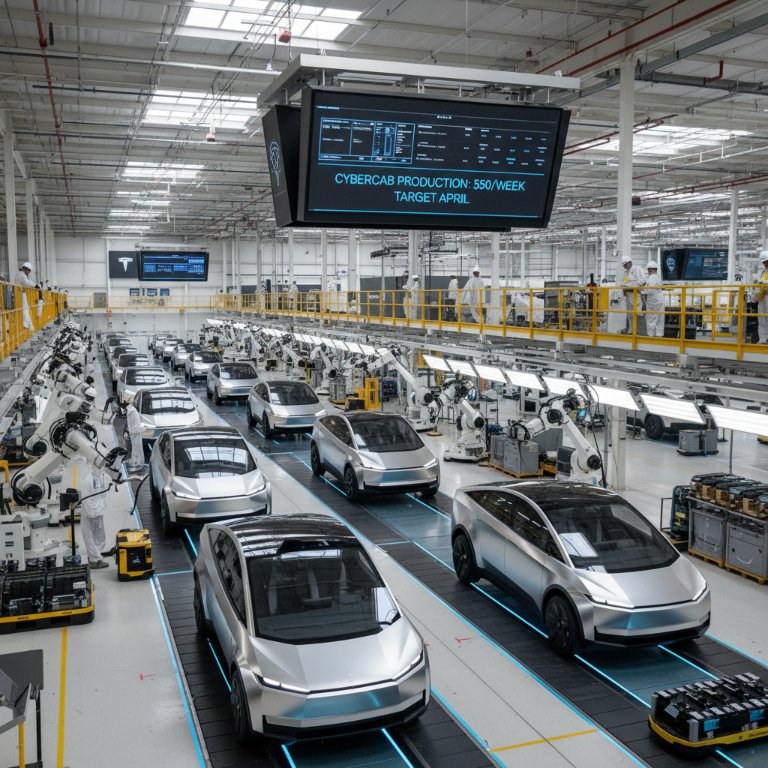
Tesla is making an aggressive push into the autonomous ride-hailing market, with significant preparations underway at its Gigafactory Texas for the mass production of the Cybercab. Reports, initially from The Wall Street Journal, indicate a rapid scaling of staff and equipment, with the ambitious goal of manufacturing hundreds of these purpose-built autonomous vehicles weekly, potentially commencing as early as April. This move underscores Tesla's commitment to realizing its long-promised robotaxi vision, a strategic pivot that could fundamentally reshape urban mobility and the automotive landscape.
For years, CEO Elon Musk has championed the concept of a vast, autonomous ride-hailing network powered by Tesla's Full Self-Driving (FSD) system. While FSD has seen continuous development and incremental rollouts in existing Tesla vehicles – initially with human safety monitors and more recently with limited unsupervised operation – the Cybercab represents the dedicated hardware designed from the ground up for this service. This isn't merely an incremental update; it's a foundational shift towards a new business model, positioning Tesla as a direct competitor to traditional ride-hailing giants and, ultimately, a potential disruptor of personal car ownership.
Gigafactory Texas: The Crucible of Autonomy
The heart of this accelerated push lies within Gigafactory Texas. Tesla is actively expanding its workforce and installing specialized equipment to accommodate the unique manufacturing requirements of the Cybercab. The company aims for a substantial weekly output, a critical factor for achieving economies of scale and establishing a viable, widespread autonomous service. While early production might be slow, the long-term vision involves a rapid ramp-up to potentially millions of units annually, leveraging innovative manufacturing processes like the 'Unboxed' method.
The Cybercab's Disruptive Potential and FSD's Evolution
The Cybercab itself is a two-seater vehicle designed without a steering wheel or pedals, relying entirely on Tesla's FSD software for navigation. This audacious design choice emphasizes its sole purpose: autonomous ride-hailing. With a suggested price point under $30,000 for consumers, who could then integrate their vehicles into Tesla's ride-hailing network to generate income during idle hours, the Cybercab offers a compelling economic proposition. This low cost per mile is a stark contrast to the higher operational costs of many competitors in the autonomous vehicle space.
Tesla's FSD system, the intelligence behind the Cybercab, has evolved significantly. From its early beta stages requiring constant driver supervision, FSD (now 'FSD (Supervised)') has progressed to offer more active guidance and assisted driving. Tesla's strategy has been to gather billions of miles of real-world driving data from its existing fleet, an unparalleled advantage in training its AI. The Cybercab’s launch signifies a pivotal moment where this software is transitioning from an advanced driver-assistance system to the sole operational control of a purpose-built vehicle.
Why This Matters:
- Disruption of Traditional Ride-Hailing: Companies like Uber and Lyft face an existential threat. Tesla's vertically integrated approach – designing and manufacturing the vehicle, developing the autonomous software, and operating the network – could allow for significantly lower operating costs and, consequently, more competitive pricing. The potential for individual owners to contribute to the network further decentralizes the model, creating a 'money-making tool that everyone can participate in'.
- Redefining Personal Transportation: A truly affordable and ubiquitous robotaxi service could reduce the need for personal car ownership, particularly in urban environments. Why own a depreciating asset with parking woes and insurance costs when an autonomous, on-demand solution is readily available at a lower per-mile cost?
- Validation of Tesla's AI and FSD: The success of the Cybercab will serve as a crucial validation of Tesla's vision-only FSD approach, which eschews lidar and radar in favor of cameras and AI. Despite skepticism and regulatory scrutiny over FSD's current capabilities, mass deployment in a purpose-built, driverless vehicle will be the ultimate test.
- Market Signal and Investment Strategy: This accelerates Tesla's transformation from a pure EV manufacturer to a mobility-as-a-service (MaaS) provider, fundamentally changing its revenue model. Analysts forecast that Tesla's robotaxi business could generate hundreds of billions in annual revenue, significantly increasing its market capitalization. This signals a 'do-or-die moment' for Tesla's long-term strategy, demonstrating its commitment to unlocking new, high-margin service revenues, especially as its core automotive business faces increasing competition.
Tesla's ambitious Cybercab production timeline, targeting hundreds of units weekly as early as April, suggests the company is moving with unparalleled speed to seize the autonomous ride-hailing market. While challenges remain in regulatory approvals, software readiness, and scaling manufacturing, the sheer pace of development at Gigafactory Texas indicates a company on the cusp of a revolutionary, albeit risky, new chapter.
As the first Cybercabs roll off the line, the industry will be watching closely to see if Tesla can translate its manufacturing prowess and FSD advancements into a truly transformative urban mobility solution. The future of transportation may indeed be just around the corner, rolling silently on four wheels, without a driver in sight.