Tesla's Cybercab Production Set for April 2026: A High-Stakes Bet on a Driverless Future
Tesla CEO Elon Musk has once again asserted an aggressive timeline for the production of the radical Tesla Cybercab, reiterating that initial manufact...
Editorial Team
World Of EV
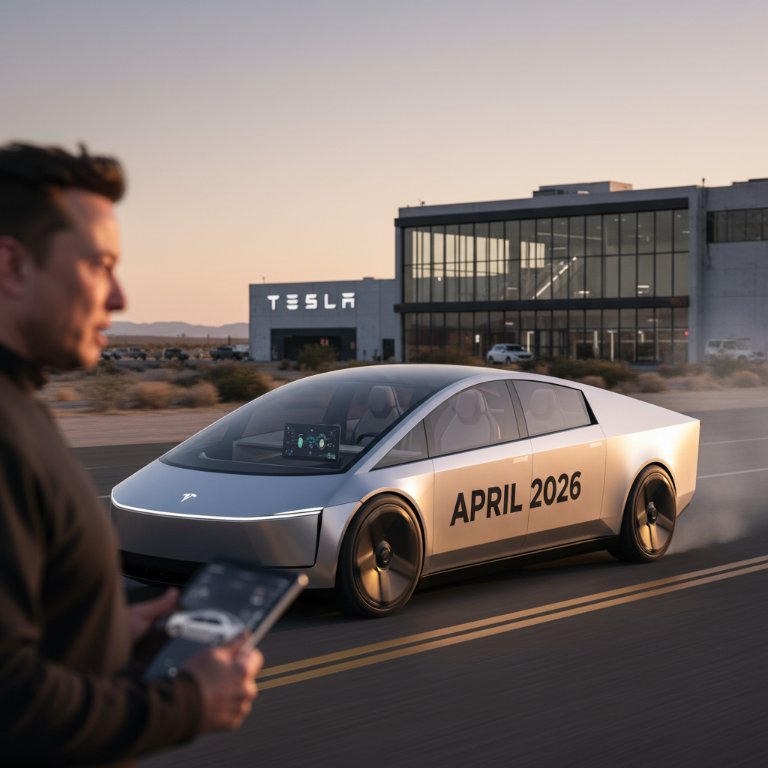
Tesla CEO Elon Musk has once again asserted an aggressive timeline for the production of the radical Tesla Cybercab, reiterating that initial manufacturing is slated to commence in April 2026. This marks the third time in the past six months that Musk has explicitly committed to this date, signaling a firm, albeit ambitious, resolve to bring this truly driverless vehicle to market. The Cybercab, famously envisioned without traditional pedals or a steering wheel, represents a monumental leap into a fully autonomous, robotaxi-centric future.
The Audacious Vision Behind Cybercab
Musk's consistent pronouncements underscore Tesla's unwavering focus on its autonomous driving ambitions, a journey that has spanned over a decade with the development of its Full Self-Driving (FSD) software. Unlike conventional vehicles featuring advanced driver-assistance systems, the Cybercab is designed from the ground up to operate without human intervention, embodying a pure Level 5 autonomous experience. This fundamentally reshapes the concept of personal transportation, moving beyond mere driver assistance to a complete removal of human controls.
Tesla's 'pure vision' approach to autonomy, relying solely on cameras and machine learning, starkly contrasts with many industry competitors who integrate LiDAR and other sensors. While this approach promises cost efficiencies, it also presents significant challenges, particularly in complex driving environments and adverse lighting conditions. The Cybercab is the ultimate proving ground for this vision, demanding near-flawless performance from a system that has, at times, faced scrutiny for its real-world capabilities and regulatory compliance.
Navigating a Complex Regulatory Landscape
The move to produce a vehicle entirely devoid of driver controls also thrusts Tesla into a rapidly evolving and often ambiguous regulatory environment. Federal Motor Vehicle Safety Standards (FMVSS) have historically mandated components like steering wheels and pedals, though the National Highway Traffic Safety Administration (NHTSA) has been working to update these rules to accommodate truly autonomous vehicles. While NHTSA has streamlined exemption processes for vehicles without human controls, capping exemptions at 2,500 per automaker initially, the broad deployment of Cybercabs will require robust federal legislation and a clear liability framework, which are currently lacking. The patchwork of state-level regulations further complicates the path to widespread adoption for vehicles of this nature.
Why This Matters:
This aggressive Cybercab timeline is a pivotal moment for Tesla and the broader automotive industry. It signals a doubling down on what many consider Tesla's most ambitious and riskiest venture yet:
- Revolutionizing Urban Mobility: If successful, the Cybercab could fundamentally disrupt the ride-hailing and personal transportation sectors. Offering significantly lower costs per mile than human-driven services, it promises to make convenient, on-demand mobility accessible to a wider demographic, potentially rendering personal vehicle ownership less compelling for many urban dwellers.
- Validating Tesla's AI-First Strategy: The Cybercab’s existence hinges entirely on the perfection of Tesla’s FSD technology. This is a do-or-die moment for Tesla’s camera-only, AI-centric approach, putting years of research and billions in investment to the ultimate test. A failure here could be a significant setback, while success would solidify Tesla's leadership in AI and autonomy.
- Musk's 'Aggressive Timelines' Playbook: Elon Musk is notorious for setting ambitious, often seemingly impossible, deadlines, which historically have been subject to delays (e.g., Cybertruck, earlier FSD promises). However, this strategy also pushes his teams to achieve extraordinary feats. The consistent repetition of the April 2026 date for Cybercab manufacturing suggests an internal conviction and external pressure that could either catalyze unprecedented innovation or lead to another significant deferment. The market and regulatory bodies are watching closely to see if this time, the timeline holds.
- Intensifying Robotaxi Competition: While Tesla aims for a truly driverless experience, other players like Waymo have been deploying robotaxi services with human safety drivers and in geo-fenced areas for years, often using a multi-sensor approach. The Cybercab represents Tesla's direct challenge to these established players, with its unique design potentially giving it a cost and operational advantage, assuming the technology and regulation align.
Tesla's commitment to an April 2026 production start for the Cybercab, a vehicle that boldly eliminates traditional controls, marks a profound statement of intent. It is a high-stakes gamble that could either redefine personal transportation and validate Tesla's full self-driving vision or prove to be another ambitious target that shifts with the complexities of cutting-edge technology and regulatory realities. The next 12 to 18 months will be critical in determining whether this audacious vision translates into a tangible reality on our roads.