Tesla's Bold Bet: Full Self-Driving Goes Subscription-Only, Reshaping Ownership and Revenue
In a pivotal strategic shift, Tesla has officially ceased offering its coveted Full Self-Driving (FSD) suite as a one-time outright purchase in North ...
Editorial Team
World Of EV
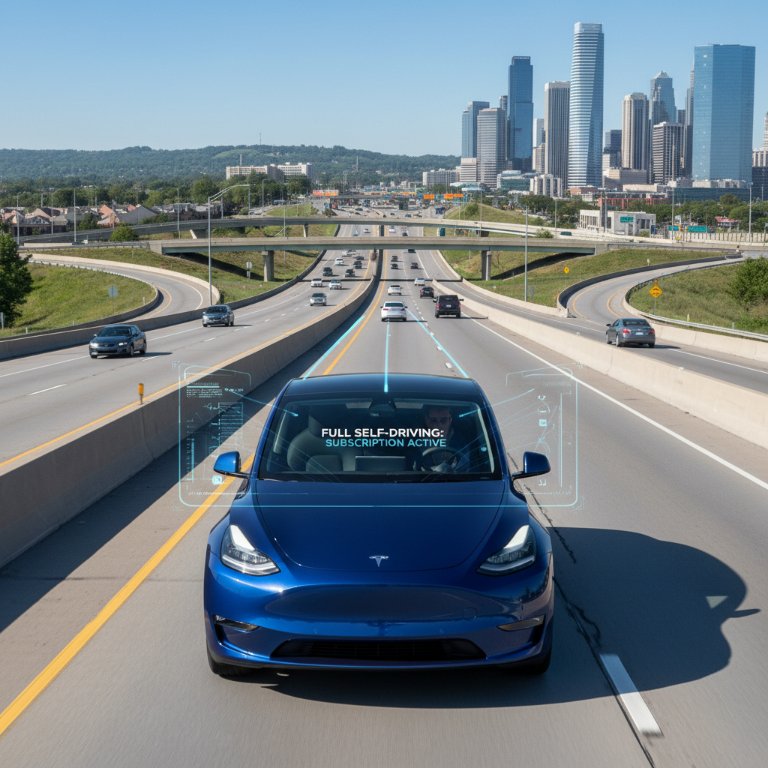
In a pivotal strategic shift, Tesla has officially ceased offering its coveted Full Self-Driving (FSD) suite as a one-time outright purchase in North America, transitioning exclusively to a subscription model. This change takes effect today, February 14, 2026. For buyers in Australia and New Zealand, the deadline for outright purchase extends slightly to March 31, 2026, after which the subscription-only paradigm will also apply there.
This move marks a significant evolution in how Tesla monetizes its advanced driver-assistance system (ADAS), signaling a strong push towards predictable recurring revenue and fundamentally altering the value proposition for current and prospective owners. For years, FSD has been a lightning rod of discussion, evolving from an ambitious promise to a sophisticated, albeit still 'supervised,' system requiring continuous driver attention. Its upfront cost has fluctuated dramatically, peaking at an eye-watering $15,000 before settling more recently at $8,000 in North America. Now, that lump sum option is off the table.
The End of Upfront FSD Ownership
Effective today, North American customers considering FSD will no longer have the option to purchase it for a one-time fee. Instead, they must opt for a monthly subscription, currently priced at $99 per month, or $999 annually. A notable exception exists for owners who have previously purchased Enhanced Autopilot (EAP), for whom the FSD subscription can be as low as $49 per month. Australian and New Zealand buyers have until the end of March 2026 to make an outright purchase, with the subscription currently set at AU$149 per month in those markets.
Key changes for consumers include:
- New Buyers: No longer able to buy FSD outright; subscription is the sole option.
- Existing Owners with FSD: Those who previously purchased FSD outright will retain their access.
- FSD Transfers: The program allowing transfer of FSD to a new Tesla is also ending by March 31, 2026, eliminating a key perk for long-term owners looking to upgrade their vehicles.
- Hardware 4 Owners: Existing Hardware 4 (HW4) vehicle owners in Australia can purchase FSD (Supervised) via the app as a post-purchase upgrade until March 31, 2026.
This strategic pivot, initially hinted at by CEO Elon Musk, underscores Tesla's commitment to transforming FSD into a software-as-a-service (SaaS) offering.
Why This Matters: An Expert Analysis
This decisive move by Tesla is far more than a simple pricing adjustment; it's a profound strategic recalibration with significant implications for Tesla's business model, market perception, and the broader automotive industry. For Tesla, the immediate upside is a shift towards a more stable and predictable revenue stream. Wall Street often favors recurring subscription revenue over fluctuating one-time sales, potentially bolstering Tesla's valuation as it increasingly positions itself as a technology and software company, not just an automaker. This aligns with Musk's long-term vision of a software-driven future for Tesla.
From a consumer standpoint, the impact is two-fold. For those hesitant to commit over $8,000 upfront for a system still in active development, the $99 monthly fee lowers the barrier to entry, potentially increasing the FSD 'take rate' which has hovered around 12%. This could expose more drivers to the system, gathering invaluable data for Tesla's neural network training. However, for long-term owners, this represents a substantial financial commitment over time, potentially exceeding the original outright purchase cost within a few years. The loss of FSD transferability, a previously available perk that added resale value to the vehicle, further diminishes the long-term investment appeal for outright ownership.
This also signals a growing confidence within Tesla regarding FSD's capabilities and its perceived value. Elon Musk has repeatedly stated that FSD subscription prices are likely to increase as the system approaches true unsupervised autonomy, positioning the current rates as temporary for a 'supervised' offering. This incentivizes earlier adoption but also primes the market for higher costs as the technology matures.
In the competitive landscape of advanced driver-assistance systems, Tesla's bold move forces competitors offering bundled ADAS features to reconsider their own monetization strategies. While many offer subscription-like services for connectivity or specific features, mandating a subscription for a flagship semi-autonomous driving suite is a distinctive step.
Conclusion
Tesla's transition to a subscription-only model for Full Self-Driving marks a calculated and confident step towards solidifying its position as a software leader in the automotive world. While it streamlines revenue for the company and potentially lowers initial adoption hurdles for some, it fundamentally alters the ownership proposition for consumers. The industry will be closely watching whether this strategic pivot accelerates FSD's development and adoption, or if it creates new friction points with a customer base accustomed to outright software ownership.