Tesla's Bold Bet: Flagship EV Production Yields to Optimus Robotics at Fremont
In a seismic shift that underscores Tesla's relentless pursuit of its long-term vision, the company is reportedly halting production of its iconic Mod...
Editorial Team
World Of EV
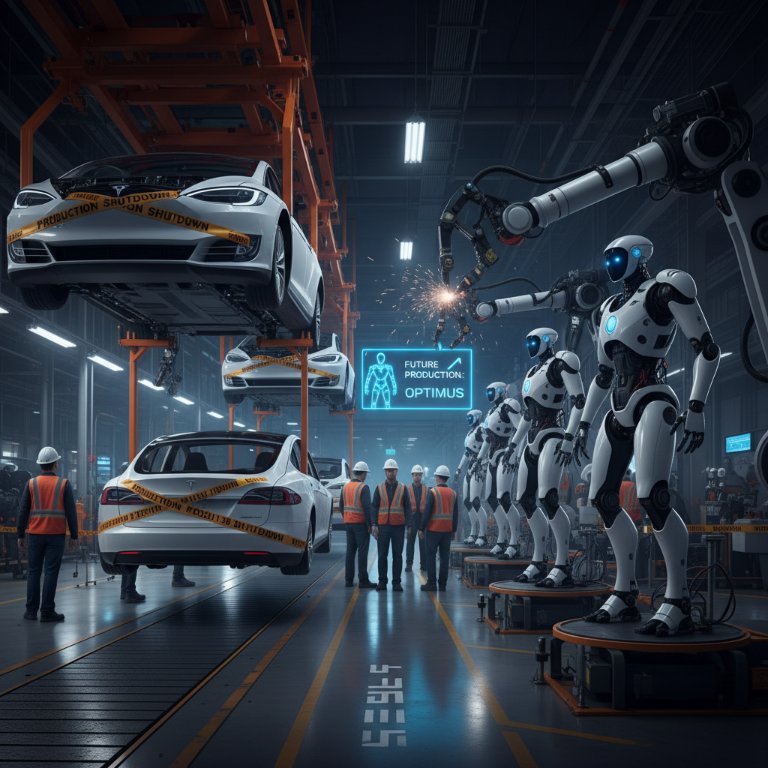
In a seismic shift that underscores Tesla's relentless pursuit of its long-term vision, the company is reportedly halting production of its iconic Model S and Model X vehicles at the historic Fremont factory. This isn't merely a production adjustment; it's a strategic pivot, as Tesla plans to retool these very manufacturing lines for the mass production of its Optimus humanoid robots. This move signals a profound re-prioritization, pushing robotics and artificial intelligence to the forefront of the company’s manufacturing might.
The End of an Era for Automotive Pioneers
For many, the Model S and Model X represent the genesis of Tesla's mainstream success, vehicles that defied skepticism and established electric vehicles as legitimate contenders in the luxury segment. The Model S, launched in 2012, redefined performance and range for EVs, while the Model X, with its ambitious falcon-wing doors, showcased Tesla’s willingness to innovate boldly, even if it meant navigating production complexities. Their cessation at Fremont marks the sunset of an era where these flagship vehicles were the primary output of Tesla's original, and most symbolic, automotive factory. While it's yet to be seen if production will continue elsewhere or cease entirely, the reallocation of Fremont's resources is a clear indicator of Tesla's shifting internal priorities.
Fremont's Robotic Future: The Rise of Optimus
The decision to dedicate Model S and Model X lines to Optimus production is a testament to CEO Elon Musk's long-held belief in the transformative power of AI and robotics. Optimus, a general-purpose humanoid robot, has been under development for several years, evolving from initial conceptual reveals to demonstrating increasingly complex tasks. By converting existing high-volume automotive lines, Tesla is betting on:
- Scalability: Utilizing established, albeit reconfigured, automotive manufacturing infrastructure suggests Tesla is preparing for significant volume production of Optimus.
- Efficiency: Leveraging existing factory footprints and potentially transferring automation expertise from vehicle production to robot manufacturing could accelerate Optimus's rollout.
- Strategic Commitment: This move elevates Optimus from a research project to a core manufacturing focus, signaling Tesla’s intent to bring humanoid robots to market sooner rather than later.
This isn't just about building robots; it's about Tesla's vision of a future where human-like robots can perform dangerous, repetitive, or mundane tasks, fundamentally reshaping industries and potentially society itself.
Why This Matters:
This dramatic shift is arguably the most significant strategic maneuver by Tesla since its initial public offering, and it carries profound implications across multiple sectors:
- For Tesla: This is a high-stakes gamble. Should Optimus achieve commercial viability and scale, Tesla's valuation could skyrocket, transforming it from an automotive and energy company into a dominant AI and robotics powerhouse. However, the commercialization of humanoid robots presents unprecedented technical and logistical challenges. Success here could cement Tesla's future; failure could represent a colossal misallocation of resources.
- For the Luxury EV Market: The vacuum left by the potential scaling back or cessation of Model S and Model X production, particularly in North America, presents an opportunity for competitors. Brands like Lucid, Mercedes-Benz with its EQS, Porsche with the Taycan, and even BMW's i7 now have an even clearer runway to capture discerning luxury EV buyers seeking established performance and premium amenities.
- For the Robotics Industry: Tesla's commitment to dedicating significant manufacturing capacity to Optimus injects a jolt of energy and credibility into the broader humanoid robotics sector. It signals that a major global player sees a clear path to commercialization, potentially attracting more investment and talent into the field.
- For Automotive Manufacturing: This move sets a precedent. It demonstrates that advanced manufacturing facilities, even those purpose-built for vehicles, can be rapidly re-tasked for entirely different, cutting-edge technologies. It highlights the growing convergence of automotive production principles with advanced robotics and AI development.
Tesla's decision to pivot so decisively towards Optimus at its foundational Fremont plant is a bold statement, reflecting a future-forward strategy that prioritizes revolutionary technological advancements over immediate market share in established segments. This isn't merely a company evolving; it's a company attempting to redefine its very identity and, in doing so, potentially redefine the world.
Conclusion:
The curtain falls on the Model S and Model X at Fremont, marking the dawn of a new, robotic era for the factory. Tesla’s strategic redirection is a clear indicator of its unwavering focus on a future powered by artificial intelligence and embodied by Optimus. While the immediate impact on the luxury EV market will be observed closely, the long-term implications for Tesla's trajectory and the broader technological landscape are monumental. The world watches as Tesla builds not just cars, but potentially, its next generation of intelligent machines.