Tesla's Bold Bet: A $2.9 Billion Push to Dominate U.S. Solar Manufacturing
Tesla is poised to make a monumental leap in its renewable energy ambitions, reportedly embarking on a massive expansion of solar manufacturing within...
Editorial Team
World Of EV
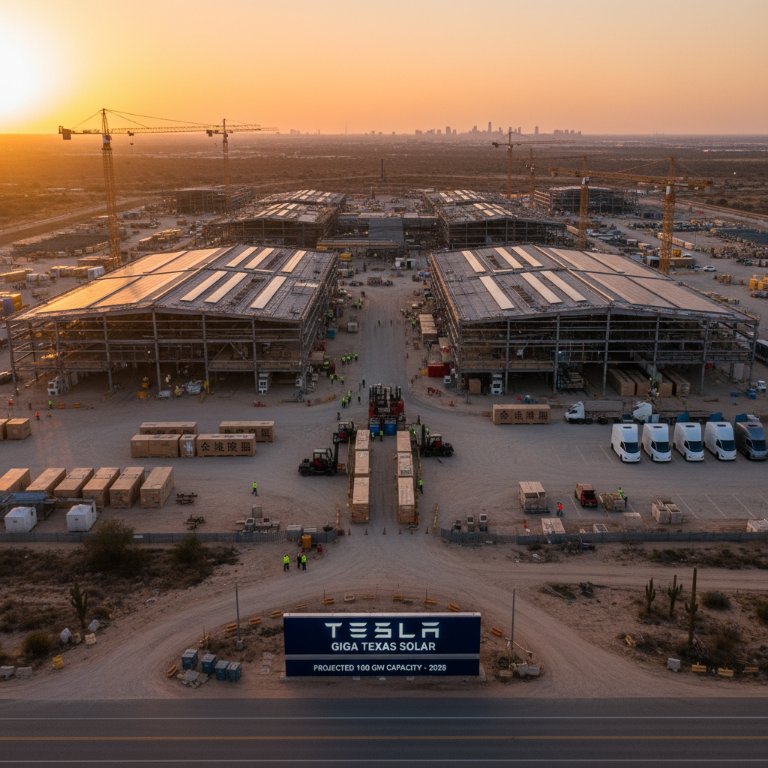
Tesla is poised to make a monumental leap in its renewable energy ambitions, reportedly embarking on a massive expansion of solar manufacturing within the United States. This strategic pivot, revealed through insights from Reuters, involves an estimated $2.9 billion investment in equipment from Chinese suppliers, signaling Tesla's intent to rapidly scale up its domestic production capabilities. The implications for the U.S. clean energy landscape and Tesla's long-term vertical integration strategy are profound.
For years, Tesla's solar endeavors have been a study in ambitious vision meeting complex execution. Following its controversial 2016 acquisition of SolarCity, the company aimed to revolutionize residential solar with its innovative Solar Roof tiles, manufactured at Gigafactory 2 in Buffalo, New York. While the vision for seamlessly integrated solar generation was compelling, the actual rollout and scaling of production proved challenging, often leaving the solar division overshadowed by its automotive juggernaut. This new investment, however, suggests a renewed, aggressive focus on establishing a formidable presence in solar cell and panel manufacturing on American soil.
Tesla's Ambitious Solar Resurgence in the U.S.
The core of this reported expansion centers on a colossal goal: establishing up to 100 gigawatts (GW) of solar cell and panel manufacturing capacity in the United States by the close of 2028. Such a capacity would represent a significant fraction of global solar production and dwarfs current U.S. manufacturing outputs. The destination for this substantial equipment influx is highly anticipated to be Texas, a state already home to Tesla's automotive Gigafactory and a burgeoning clean energy sector.
This move is not merely about increasing output; it's a strategic response to evolving geopolitical and economic landscapes. By securing a domestic manufacturing base, Tesla aims to mitigate supply chain vulnerabilities, reduce reliance on international components, and, critically, capitalize on the robust incentives offered by the U.S. government through legislation like the Inflation Reduction Act (IRA). The IRA provides substantial tax credits and benefits for clean energy products manufactured within the United States, making domestic production significantly more attractive and financially viable. This investment positions Tesla to directly benefit from these provisions, bolstering its energy division's profitability and competitive edge.
Why This Matters:
Tesla Wins: This move enables Tesla to achieve deeper vertical integration across its energy ecosystem, from generation (solar) to storage (Powerwall, Megapack) to consumption (EVs). It reduces external dependencies, potentially lowers costs through economies of scale, and strengthens its position as a comprehensive energy company, not just an automaker. Furthermore, domestic manufacturing allows Tesla to tap into significant U.S. incentives, directly impacting its bottom line and competitiveness in the energy sector.
The U.S. Clean Energy Sector Wins: A 100 GW manufacturing capacity by 2028 would be a game-changer for American energy independence. It would create thousands of high-paying jobs, foster innovation, and significantly accelerate the transition to renewable energy by providing a massive domestic supply of solar panels. This directly supports the U.S. government's goals for a greener economy and energy security.
Traditional Solar Manufacturers Face Pressure: While the overall market will grow, existing solar manufacturers, especially those heavily reliant on imported components, will face intensified competition. Tesla's aggressive scale and potential cost advantages could reshape market dynamics, forcing others to innovate, consolidate, or also invest heavily in domestic production.
A Clear Signal to the Market: This move signals Tesla's unwavering commitment to its long-term vision of sustainable energy. It demonstrates that the company views its energy division as a core pillar of future growth, moving beyond the perceived challenges of its earlier solar ventures. It also underscores the magnetic pull of U.S. industrial policy and the efficacy of incentives like the IRA in attracting significant clean energy investments.
This isn't just about making solar panels; it's about Tesla cementing its role as a vertically integrated energy giant. The aggressive timeline and substantial investment suggest a company determined to control its destiny in the rapidly expanding clean energy landscape. While the path to 100 GW will undoubtedly present engineering and logistical hurdles, the potential rewards — for Tesla, for American manufacturing, and for the global energy transition — are immense. This marks a pivotal moment, potentially setting the stage for Tesla to become as dominant in solar energy as it aims to be in electric vehicles.