Tesla's Autonomy Apex: FSD v14.3 Approaches Amidst Critical Transfer Deadline and Intensified Scrutiny
Tesla stands at a pivotal juncture in its relentless pursuit of autonomous driving, with the highly anticipated Full Self-Driving (FSD) v14.3 internal...
Editorial Team
World Of EV
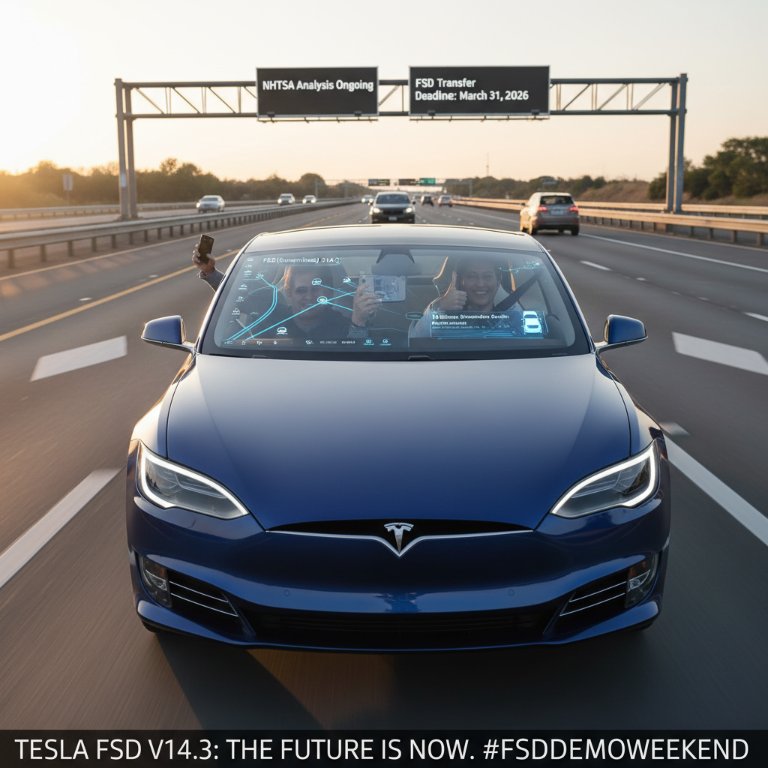
Tesla stands at a pivotal juncture in its relentless pursuit of autonomous driving, with the highly anticipated Full Self-Driving (FSD) v14.3 internally testing and slated for a widespread rollout in early-to-mid April 2026. This next iteration promises a significant leap in reasoning and logic for FSD decisions, potentially revolutionizing navigation capabilities. The impending update arrives as the Tesla community rallies to boost public acceptance of autonomous driving through demonstration rides, all while a critical FSD transfer deadline of March 31, 2026, looms large for owners and the National Highway Traffic Safety Administration (NHTSA) continues its engineering analysis of the system.
This confluence of events underscores a make-or-break period for Tesla's FSD ambitions. The company's commitment to a camera-only approach, despite ongoing regulatory questions, continues to shape the narrative around its advanced driver-assistance systems (ADAS). As of February 2026, FSD (Supervised) has already amassed an astounding 13 billion kilometers of real-world driving data, a testament to its vast training dataset and widespread adoption.
FSD v14.3: Elevating Autonomous Reasoning
The forthcoming FSD v14.3 is not merely an incremental update; it targets fundamental improvements in the system's underlying intelligence. Tesla aims to introduce enhanced reasoning and logic into FSD's decision-making process, a critical step toward more robust and human-like autonomous navigation.
Improved Reasoning and Logic: This update is designed to imbue FSD with a deeper understanding of complex driving scenarios, moving beyond reactive responses to more proactive and intelligent navigation.
Enhanced Navigation: A key focus of v14.3 is to address longstanding feedback regarding navigation, promising a smoother and more intuitive experience for drivers.
Tesla's FSD (Supervised) system has accumulated over 13 billion kilometers (more than 8.2 billion miles) of real-world driving data, a figure that dwarfs most competitors and forms the backbone of its neural network training. This extensive data pool is crucial for refining the system's ability to handle diverse and complex driving environments. In an effort to accelerate public acceptance and showcase the current capabilities of FSD, the Tesla community is actively organizing demonstration rides this weekend. This grassroots advocacy seeks to bridge the gap between perceived limitations and actual performance, directly addressing the often-misunderstood nature of Level 2+ driver-assistance systems.
Critical FSD Transfer Deadline and Regulatory Oversight
The March 31, 2026, FSD transfer deadline adds significant pressure for many existing FSD owners. Originally, the policy allowed transfers if a new vehicle was ordered by this date. However, Tesla quietly revised the terms in late February, now requiring delivery of the new vehicle by March 31, 2026, to qualify for the FSD transfer. This sudden change has put thousands of buyers, particularly those awaiting Cybertruck AWD deliveries, in a precarious position, potentially negating thousands of dollars in previously invested FSD value.
Simultaneously, the NHTSA's engineering analysis of FSD continues, a high-stakes investigation covering approximately 3.2 million Tesla vehicles. This probe escalated from a preliminary evaluation and focuses on the system's ability to detect roadway conditions when visibility is reduced and to provide adequate warnings to drivers. The agency has identified incidents where FSD reportedly failed to detect degraded visibility, raising concerns about its camera-centric approach.
Beyond FSD, Tesla's 2026.2.9.3 software update, now in its eighth wave of rollout, introduces notable enhancements.
Automatic HOV Lane Routing: Navigation now includes an option to automatically use high-occupancy vehicle lanes based on time, passenger count, and local restrictions.
Autopilot Terminology Updates: In response to regulatory pressure and a drive for clearer communication, Tesla has initiated a significant rebranding of its driver-assistance features. 'Navigate on Autopilot' is now 'Navigate on Autosteer,' the 'FSD Computer' is rebranded as the 'AI Computer,' and the 'Autopilot' menu has become 'Self-Driving.' These changes, while primarily textual, aim to reinforce a more accurate understanding of the systems' supervised nature.
Why This Matters:
For Tesla's Autonomy Vision: FSD v14.3's focus on improved reasoning is paramount. If Tesla can demonstrate a significant leap in the system's ability to handle complex, unpredictable scenarios, it will bolster confidence in its camera-only approach and accelerate the path toward true unsupervised autonomy. Conversely, any perceived stagnation could invite further skepticism and regulatory hurdles.
Impact on Current and Prospective Owners: The FSD transfer deadline is a high-stakes game for loyal Tesla customers. Those who purchased FSD outright, often for a significant sum, now face the risk of losing that investment if their new vehicle delivery falls outside the tightened window. This move could generate frustration and potentially impact brand loyalty, especially for Cybertruck buyers already facing extended wait times. For prospective buyers, the community's push for demo rides offers a valuable, unvarnished look at the current state of FSD, influencing purchase decisions.
Regulatory Pressure and Public Trust: NHTSA's escalated engineering analysis is a serious development. Findings that highlight FSD's limitations in degraded visibility conditions could lead to mandatory recalls or further restrictions, directly impacting Tesla's rollout timelines and public perception. The company's ongoing efforts to clarify terminology through software updates are a direct response to this regulatory scrutiny, signaling a shift toward more responsible communication, yet the actual capabilities remain under intense observation. The industry watches closely to see if Tesla can navigate these regulatory waters without stifling innovation.
Competitive Landscape: As other automakers and tech companies invest heavily in their own autonomous driving solutions, Tesla's progress with FSD v14.3 will be keenly observed. A genuine breakthrough could widen Tesla's lead, while missteps could provide an opening for rivals, particularly those embracing multi-sensor approaches (lidar, radar, cameras). Tesla's accumulation of 13 billion kilometers of data is an undeniable advantage, but its effective utilization and safe application are what truly matter.
Tesla's advancements with FSD v14.3 and the rollout of broader software enhancements demonstrate its continuous commitment to evolving its vehicle technology. However, the immediate pressure from the FSD transfer deadline and the ongoing NHTSA engineering analysis underscore the immense challenges and scrutiny inherent in leading the autonomous driving revolution. How Tesla navigates these converging forces in the coming weeks will undoubtedly shape its trajectory in the rapidly evolving world of electric vehicles and self-driving technology.