Tesla's Autonomous Reckoning: Feature Names Shift Amidst Intensifying Legal Scrutiny
Tesla is rolling out a significant software update, versions 2026.2.9.1 and 2026.2.9, that includes a pivotal change: the renaming of key driver assis...
Editorial Team
World Of EV
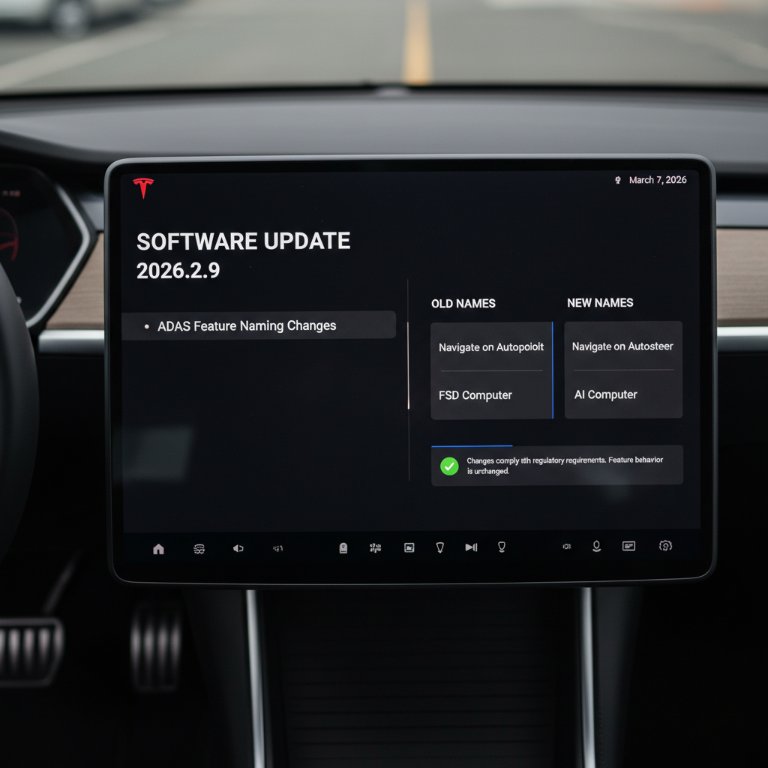
Tesla is rolling out a significant software update, versions 2026.2.9.1 and 2026.2.9, that includes a pivotal change: the renaming of key driver assistance features. This isn't merely a cosmetic tweak; it's a direct response to a California lawsuit challenging the company's long-standing marketing practices surrounding its advanced driver assistance systems (ADAS). In a move signaling a grudging acknowledgment of regulatory pressure, 'Navigate on Autopilot' is now 'Navigate on Autosteer,' and the 'FSD Computer' is rebranded as the 'AI Computer.'
This development arrives after years of debate and increasing scrutiny from both regulators and safety advocates concerning the evocative, some would say misleading, nomenclature Tesla has employed for its ADAS offerings. The California Department of Motor Vehicles (DMV) has been at the forefront of this pushback, having previously threatened to suspend Tesla's ability to sell cars in the state if it did not address concerns about false advertising.
The Latest Software Refresh and Its Origins
The 2026.2.9 software update, which began deploying around March 5, 2026, across various Tesla models and regions, carries the immediate impact of these name changes. Owners receiving the update will notice the new terminology reflected in their vehicle's interface. Tesla, in its release notes, asserts that these alterations are strictly confined to the names and text, explicitly stating that the behavior or functionality of the features remains unchanged.
Key changes within the update include:
- 'Navigate on Autopilot' officially becomes 'Navigate on Autosteer.'
- The internal hardware previously known as the 'FSD Computer' is now referred to as the 'AI Computer.'
While Tesla claims no functional changes, the timing and nature of these rebrandings are undeniably linked to the legal challenges it has faced. An administrative law judge sided with the California DMV in December 2025, ruling that Tesla's use of "Autopilot" and "Full Self-Driving" constituted false advertising. The DMV had given Tesla a deadline to rectify its marketing language or face a 30-day sales suspension in California.
The Shadow of Regulatory Scrutiny
For years, Tesla has been criticized for marketing its ADAS features with names like 'Autopilot' and 'Full Self-Driving' (FSD), implying a level of autonomy that the systems, classified as Level 2, do not possess. Level 2 systems require the driver to remain attentive and ready to take control at all times, a crucial distinction often blurred by Tesla's branding. This has led to a protracted battle with regulatory bodies like the California DMV, which launched an investigation in 2021 due to concerns over misrepresentation. The DMV's stance was that the names themselves were a form of deceptive advertising, especially given claims in past marketing materials suggesting vehicles could undertake trips "with no action required by the person in the driver's seat."
While Tesla has since sued the California DMV to reverse the ruling, arguing the claim of false advertising is "baseless" and that consumers were not actually confused, the company has still implemented the changes to comply with the state's demands. This legal tug-of-war highlights the growing pressure on manufacturers to be more transparent about the capabilities and limitations of their advanced driver assistance technologies.
Why This Matters:
- Increased Transparency for Consumers: The shift from 'Autopilot' to 'Autosteer' and 'FSD Computer' to 'AI Computer' helps to demystify features that, despite their advanced capabilities, still require active driver supervision. This reduces the potential for dangerous misuse or over-reliance, a critical concern highlighted by safety advocates and accident data.
- Regulatory Victory: This move represents a notable victory for regulators, particularly the California DMV, which has aggressively challenged Tesla's marketing. It signals that regulatory bodies are prepared to enforce stricter standards for ADAS nomenclature, potentially influencing how other automakers brand their own semi-autonomous systems.
- Industry Precedent: While Tesla is fighting the ruling in court, its compliance with the name changes sets a precedent. Other manufacturers developing sophisticated ADAS may now adopt more conservative and precise terminology to avoid similar legal and reputational entanglements. This could lead to a more standardized and transparent approach to describing vehicle autonomy across the industry.
- Tesla's Brand Evolution: For Tesla, this marks a subtle but significant adjustment to its long-held, aspirational branding strategy. While the company maintains that functionality is unaltered, the rebranding acknowledges the legal and public relations vulnerabilities of overpromising. It suggests a forced maturation in Tesla's communication, driven by external pressure rather than internal choice.
This shift, though seemingly minor on the surface, underscores a maturing landscape where the marketing of advanced vehicle technology is increasingly subject to rigorous legal and ethical scrutiny. The days of ambiguous, futuristic branding for systems that are not yet fully autonomous may be drawing to a close.
Brief Conclusion:
The recent software update, with its mandated renaming of key driver assistance features, is a clear indication that regulatory bodies are no longer content with aspirational marketing in the realm of autonomous technology. While Tesla continues to develop its advanced systems, this forced pivot towards more transparent language serves as a crucial reminder for both manufacturers and consumers: true full self-driving capabilities remain a future endeavor, and accurate representation of current technology is paramount for safety and consumer trust.