Tesla's Autonomous Ambitions Accelerate: Samsung Tapped for 2nm AI6 Chip Production
Tesla is set to take a monumental leap in its autonomous driving capabilities, with Samsung Electronics confirming it will commence mass production of...
Editorial Team
World Of EV
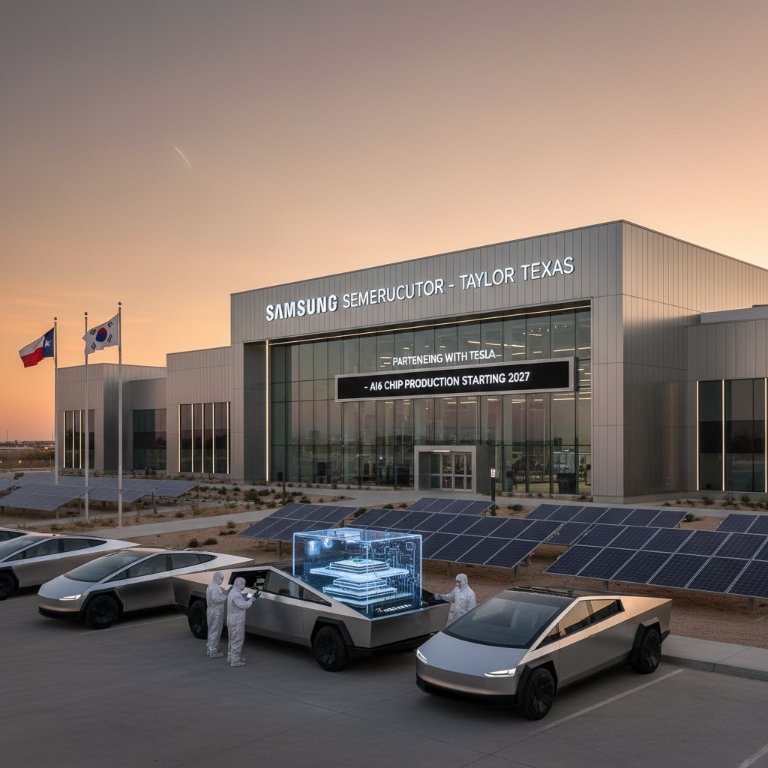
Tesla is set to take a monumental leap in its autonomous driving capabilities, with Samsung Electronics confirming it will commence mass production of Tesla’s next-generation AI6 chips at its state-of-the-art Taylor, Texas plant. This pivotal manufacturing initiative, slated for the second half of 2027, stems from a formidable $16.5 billion multiyear deal inked in July 2025. This move isn't just a supply chain decision; it’s a strategic declaration in the high-stakes race for true autonomy.
The Powerhouse Partnership: A New Era for Tesla's AI Hardware
The deal with Samsung isn't merely about procuring components; it signifies a deeper strategic alliance. For years, Tesla has been a pioneer in developing bespoke AI silicon, notably with its Hardware 3 (HW3) and more recently, the more powerful Hardware 4 (HW4) chips, which power its Full Self-Driving (FSD) beta software. However, the AI6 represents a new generation, purpose-built to handle the escalating computational demands of increasingly complex autonomous systems and potentially, Tesla's broader AI ambitions beyond just its vehicle fleet. This colossal $16.5 billion commitment underscores Tesla's unwavering belief in its in-house AI architecture and its strategy to secure a dedicated, high-volume production pipeline for this critical technology. The decision to produce these chips in Taylor, Texas, also strengthens Tesla's domestic supply chain resilience, a lesson learned globally from recent geopolitical and logistical challenges.
2nm: The Next Frontier in Automotive AI Performance
At the heart of this announcement is the adoption of Samsung's cutting-edge 2nm process technology for the AI6 chips. To put this into context, current leading-edge chips in many applications typically utilize 5nm or 3nm processes. The move to 2nm represents a significant advancement, promising:
- Vastly improved computational density: Packing more transistors into a smaller area, leading to greater processing power within the same footprint.
- Enhanced energy efficiency: Crucial for electric vehicles where every watt of power impacts range and thermal management.
- Reduced latency: Essential for real-time decision-making in autonomous driving, where milliseconds can make a difference.
This generational leap in semiconductor technology is expected to unlock unprecedented levels of performance for Tesla's electric vehicles and, critically, for its autonomous driving systems. While specific performance metrics remain under wraps, the shift to 2nm signals a fundamental upgrade far exceeding the incremental improvements seen between previous hardware iterations. This positions Tesla to process exponentially more data from its vehicle sensors, improve neural network inference, and potentially accelerate the development of true generalized AI for FSD.
Beyond the Vehicle: Powering Tesla's Holistic AI Ecosystem
While the primary stated purpose for the AI6 chips is Tesla's electric vehicles and autonomous driving systems, the implications stretch further. Tesla's AI ambitions are expansive, encompassing its Dojo supercomputer for AI training, robotics projects, and potentially even future energy management systems. The development and mass production of such advanced custom silicon suggests that these AI6 chips could become the foundational compute layer across a wider array of Tesla's burgeoning AI-driven enterprises. This vertical integration, from chip design to vehicle integration and AI software, remains a core differentiator for Tesla against traditional automakers who largely rely on third-party suppliers for key components of their ADAS (Advanced Driver-Assistance Systems).
Why This Matters:
This Samsung-Tesla partnership is more than just a supply deal; it’s a seismic event with profound implications for the automotive, technology, and semiconductor industries.
- For Tesla: This solidifies its long-term strategy of controlling its core technology stack, from battery cells to AI chips. It ensures a dedicated, state-of-the-art supply for its most critical component in achieving full autonomy, insulating it from the broader chip market's volatility. This investment in 2nm technology positions Tesla to maintain and potentially widen its lead in the autonomous driving race, potentially accelerating the realization of its robotaxi vision.
- For Samsung: This is a monumental win for Samsung Foundry. Securing a $16.5 billion multiyear contract for leading-edge 2nm production with a high-profile client like Tesla validates Samsung's ambitious investment in advanced process technology and strengthens its competitive standing against rivals like TSMC. It firmly establishes Samsung as a critical player in the high-growth automotive chip sector, diversifying its revenue streams beyond traditional consumer electronics.
- For the Autonomous Driving Landscape: This signals an intensifying arms race in custom AI silicon. Automakers relying on off-the-shelf solutions or less advanced processes will find it increasingly difficult to compete with the raw processing power and efficiency that a 2nm custom chip can offer. It pushes the boundaries of what's possible in real-time sensor fusion, prediction, and decision-making for autonomous vehicles, promising a future of safer, more capable self-driving cars.
- For EV Enthusiasts and Buyers: Ultimately, this means a more robust, reliable, and capable FSD system. While 2027 is still some time away, the promise of 2nm AI6 chips suggests a future where Tesla's autonomous driving systems will be significantly more sophisticated, potentially leading to faster feature deployment and a smoother, safer autonomous experience. This is a clear indicator that Tesla remains committed to pushing the envelope in autonomous technology, directly impacting the value proposition for future Tesla owners.
This strategic alliance between two industry titans is a clear signal that the future of mobility will be defined by advanced AI and the silicon that powers it. As 2027 approaches, all eyes will be on Taylor, Texas, as Samsung gears up to forge the brains of Tesla's next generation of autonomous machines, irrevocably shaping the trajectory of self-driving technology and the EV market as we know it.