Tesla's Austin Robotaxi Price Surge Signals Strategic Shift Towards Profitability and Demand Management
Tesla's highly scrutinized Robotaxi pilot program in Austin is undergoing a significant pricing adjustment, effective March 7, 2026. The move sees the...
Editorial Team
World Of EV
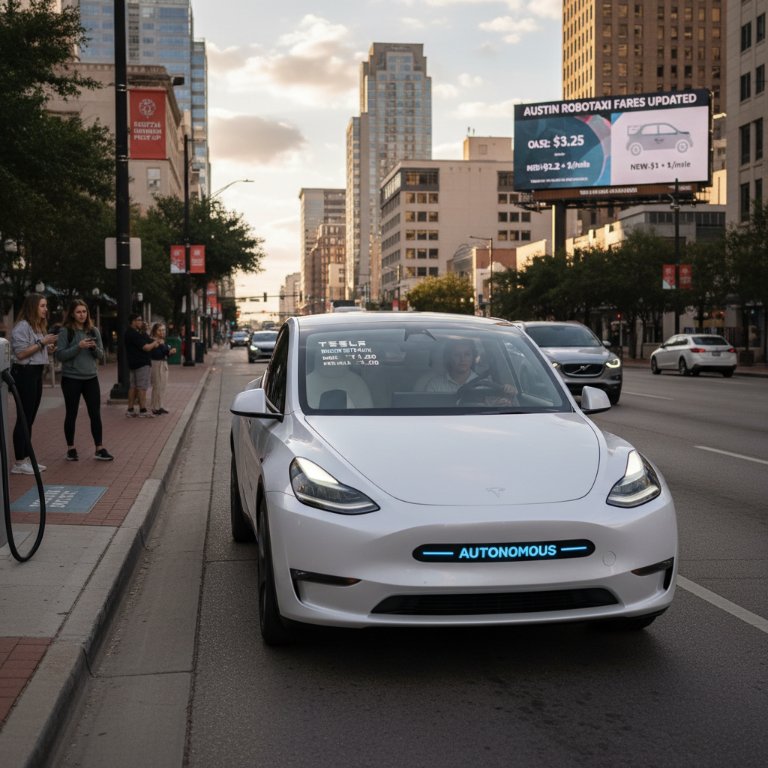
Tesla's highly scrutinized Robotaxi pilot program in Austin is undergoing a significant pricing adjustment, effective March 7, 2026. The move sees the base fare jump from a nominal $1 to a more substantial $3.25, while the per-mile rate holds steady at $1. This recalculation drastically impacts the cost of shorter trips, transforming a previous $6, 5-mile journey into an $8.25 fare. This isn't merely a tweak; it's a clear signal from Tesla, a company often more focused on groundbreaking technology than immediate profit, that the Austin Robotaxi service is maturing beyond its experimental phase and into a more commercially optimized operation.
Austin Robotaxi Fares Jump Significantly
The most immediate impact for Austin residents utilizing the nascent Robotaxi service is the notable increase in ride costs. The new fare structure, which triples the base charge while maintaining the per-mile rate, means that passengers will feel the brunt of the increase on shorter distances. For instance, a quick 5-mile trip, a common urban journey, now costs $8.25, up from the previous $6. This marks a substantial 37.5% increase for such a ride, demonstrating Tesla's willingness to re-evaluate its market positioning in the face of operational realities.
Addressing Demand and Wait Times
Tesla's rationale behind this price hike is straightforward: managing high demand and mitigating persistent wait times. The Austin Robotaxi service has reportedly experienced average wait times ranging between 10 and 15 minutes, indicating that the current fleet struggles to meet user demand. By increasing fares, Tesla likely aims to balance the supply of its autonomous vehicles with the surging user interest, theoretically reducing congestion and improving service efficiency for those willing to pay the higher price. This strategy is a common tactic in the ride-hailing industry to optimize network utilization during peak periods.
The Austin Pilot: A Closer Look
Launched in June 2025, the Austin Robotaxi pilot has served as a critical proving ground for Tesla's ambitious autonomous driving technology. The service operates a fleet of approximately 89 Model Y vehicles, though earlier reports suggested figures ranging from 29 to 42 vehicles in Austin, with Elon Musk initially promising 500 by the end of 2025. Many of these Model Ys still employ safety monitors, even as Tesla pushes for unsupervised autonomy in other regions and for its Full Self-Driving (FSD) software in general. This dual approach highlights the cautious, iterative development process inherent in achieving true Level 4 or 5 autonomy, especially in a live urban environment. The pilot began as an invite-only system for Early Access riders, primarily FSD beta testers, within a geofenced area.
Why This Matters:
This pricing adjustment is far more than a simple fare increase; it represents a significant strategic pivot for Tesla's Robotaxi ambitions and its broader Full Self-Driving (FSD) monetization strategy. For years, Elon Musk has championed FSD as a future trillion-dollar business, with robotaxis forming a core component of that vision. This move in Austin suggests a shift towards optimizing for immediate profitability and operational efficiency rather than solely focusing on market penetration through aggressive low pricing. While Tesla's robotaxi rides in San Francisco were previously noted for significantly undercutting competitors like Waymo, averaging around $8.17 per trip, the Austin changes bring Tesla's pricing closer to traditional ride-hailing services for shorter journeys.
- Who Wins? Tesla's bottom line stands to benefit, potentially turning the Austin pilot into a more self-sustaining or even profitable venture. Reduced wait times could also improve the experience for customers willing to pay the higher fare, enhancing service quality and retention among a key demographic. This also signals confidence in the underlying FSD technology to command a premium. Tesla's recent move to a subscription-only model for FSD further underscores its focus on recurring, high-margin software revenue.
- Who Loses? Budget-conscious consumers, particularly those relying on the service for short, frequent trips, will undoubtedly feel the pinch. This could also deter some curious users who were drawn in by the initially low base fare, potentially slowing wider adoption among the general public in Austin.
- What Does This Signal? This adjustment reinforces Tesla's long-term play in the autonomous driving space: it's not just about technological prowess, but also about building a viable, profitable business model. It indicates that Tesla is assessing the elasticity of demand for its autonomous service and is prioritizing operational viability over simply accumulating ride data at any cost. This data-driven approach, combined with increased FSD subscriptions, forms a 'software flywheel' that continuously enhances Tesla's AI models. The move could also be a precursor to a broader pricing strategy for future Robotaxi rollouts, setting a precedent for how Tesla plans to monetize its autonomous fleet on a larger scale. With some analysts projecting the robotaxi market to reach trillions, and costs potentially falling to $0.25 per mile at scale, Tesla's current moves are critical steps in defining its share of this future.
In conclusion, Tesla's price hike for its Austin Robotaxi service is a pragmatic, profit-oriented decision. It underscores the challenges and realities of scaling autonomous ride-hailing and signals Tesla's strategic evolution from pure innovation to commercial optimization. As the company continues to refine its FSD software and expand its autonomous ambitions, market-driven pricing will undoubtedly play a crucial role in its journey towards a fully realized robotaxi network.