Tesla's 8 Billion FSD Miles: A Critical Juncture in the Race for Unsupervised Autonomy
Tesla drivers have collectively surpassed an astounding 8 billion miles using the company's Full Self-Driving (Supervised) suite, a monumental achieve...
Editorial Team
World Of EV
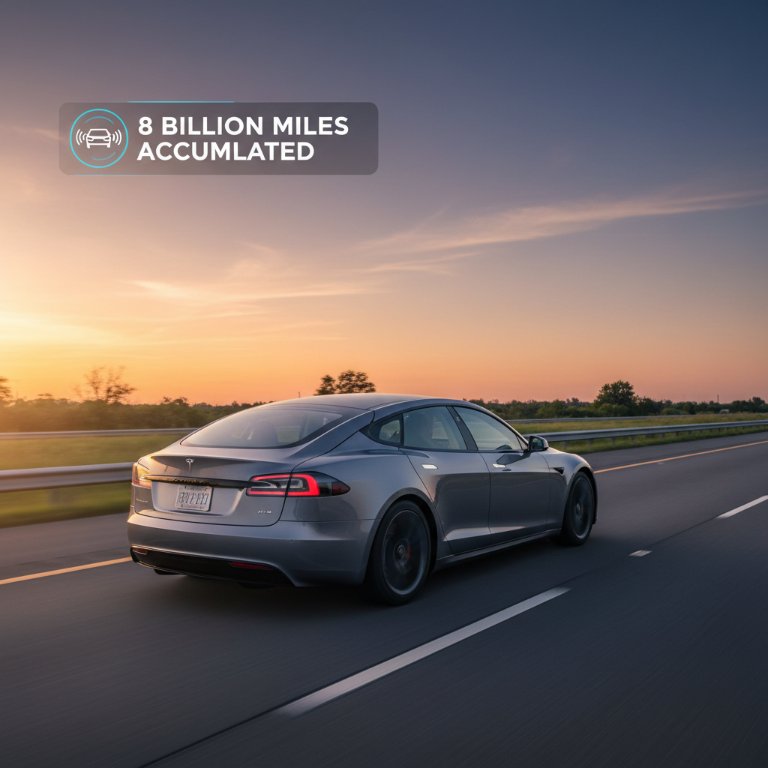
Tesla drivers have collectively surpassed an astounding 8 billion miles using the company's Full Self-Driving (Supervised) suite, a monumental achievement in data collection that brings the EV giant closer to its ambitious goal of achieving truly unsupervised autonomous driving. This milestone underscores Tesla's unique, data-centric approach to self-driving technology, yet it simultaneously highlights the formidable challenges remaining in the quest for full autonomy.
For years, Tesla's Full Self-Driving (FSD) has been a focal point of both fervent anticipation and skeptical scrutiny. Marketed as a premium option, FSD (Supervised) currently operates as a Level 2 advanced driver-assistance system (ADAS), requiring constant driver attention and readiness to intervene. This latest data haul is crucial for training the neural networks that power FSD, providing real-world scenarios essential for refining the system's ability to navigate complex and unpredictable environments.
The Data Avalanche: Nearing the 10 Billion-Mile Threshold
The 8-billion-mile figure represents an exponential increase in real-world driving data, a core tenet of Tesla's strategy for developing its vision-only FSD system. With over 3 billion of these miles accumulated specifically on challenging city streets, the fleet provides an invaluable dataset for tackling urban complexities. This accelerated pace of data collection is directly tied to CEO Elon Musk's updated target: roughly 10 billion miles of training data are needed to achieve 'safe unsupervised self-driving.'
This 10-billion-mile benchmark is a significant recalibration from Musk's earlier estimate of 6 billion miles, a stark acknowledgment of the immense 'super long tail of complexity' inherent in real-world driving scenarios. As of early 2026, the fleet had gathered approximately 7.1 billion miles, meaning Tesla could conceivably hit the 10-billion-mile mark as early as mid-2026, or within the next six months, given current growth rates. While a staggering number, this volume of data is deemed essential for training FSD's AI to handle the myriad of rare and unpredictable 'edge cases' that simulations alone cannot fully replicate.
Beyond Level 2: The Unsupervised Frontier
Tesla aggressively touts the current safety metrics of FSD (Supervised), claiming it drastically reduces collision likelihood. The company reports seven times fewer major and minor collisions compared to the national average, alongside a fivefold decrease in off-highway collisions when the system is actively engaged and supervised. These statistics, while compelling, pertain to a system that still relies on an attentive human behind the wheel.
However, the ultimate prize is Level 4 or 5 autonomy – true unsupervised self-driving – where the vehicle handles all driving tasks under most, if not all, conditions. The current FSD (Supervised) is explicitly not this. The transition from a highly capable driver-assistance system to a truly autonomous one is not merely a matter of accumulating more miles; it requires the system to possess advanced 'reasoning' capabilities to generalize and make human-like decisions in unforeseen circumstances.
Why This Matters:
Validation of Tesla's Data-Driven Strategy: Tesla's unique approach, leveraging its massive customer fleet for real-world data collection, stands in stark contrast to competitors like Waymo and Cruise, which primarily operate smaller, geofenced robotaxi fleets with dedicated safety drivers. Reaching 10 billion miles will undoubtedly provide an unprecedented dataset for training AI, potentially giving Tesla a distinct advantage in scale and variety of scenarios. However, questions persist whether volume alone will be enough to achieve true generalization for all edge cases.
The 'Moving Goalpost' and Regulatory Hurdles: Elon Musk's history of revised timelines for FSD, from early promises of full autonomy to the recent increase from 6 billion to 10 billion miles, underscores the profound complexity of the challenge. This continuous adjustment signals that even with billions of miles, the 'long tail of complexity' in autonomous driving is far more intricate than initially conceived. Moreover, hitting the 10-billion-mile data target is only the first step; extensive AI training (using supercomputers like Dojo), rigorous validation testing, and debugging millions of potential edge cases will follow. Regulatory approval, still a patchwork globally, presents another immense hurdle.
Impact on Consumer and Investor Confidence: For the savvy EV enthusiast and prospective buyer, this milestone offers a glimmer of hope that true FSD is on the horizon. However, the repeated delays and the persistent 'supervised' label mean that the promise of robotaxi-like functionality remains elusive for the everyday owner. The financial implications are also substantial; FSD is a critical component of Tesla's long-term valuation, and delivering on this promise is paramount for maintaining investor confidence. Continued shifts in goals could lead to further market skepticism, as industry experts already predict a slip in overall AV adoption timelines.
In conclusion, Tesla's accumulation of over 8 billion miles on FSD (Supervised) is a testament to its relentless pursuit of autonomous driving, furnishing its AI with an invaluable trove of real-world data. While the 10-billion-mile target for unsupervised autonomy appears within reach in the coming months, the journey does not end there. The true test lies in transcending the 'supervised' limitations, navigating the regulatory labyrinth, and ultimately delivering a system that instills absolute public trust, reshaping the future of mobility for good. The industry watches closely to see if Tesla can finally turn its unprecedented data advantage into true, widespread, unsupervised autonomy.