Tesla's 2026.8.3 Update: Subtlety Meets Substance in Critical Quality-of-Life Enhancements
Tesla has unleashed the second wave of its 2026.8.3 software update, pushing it to a broader swath of its formidable vehicle fleet. This isn't a headl...
Editorial Team
World Of EV
Tesla has unleashed the second wave of its 2026.8.3 software update, pushing it to a broader swath of its formidable vehicle fleet. This isn't a headline-grabbing, revolutionary overhaul, but rather a strategic deployment of refined features and crucial quality-of-life enhancements that underscore Tesla’s relentless pursuit of software-defined vehicle excellence. For an industry often plagued by stagnant user interfaces and infrequent updates, Tesla continues to set the benchmark for iterative improvement, directly impacting the daily experience of its owners.
2026.8.3: What's Under the Hood?
This latest software iteration introduces a suite of targeted improvements, demonstrating Tesla's commitment to polishing its core offerings and expanding its in-car technological prowess. Key additions include:
- Smoother Braking for Model Y Juniper Owners: A specific optimization designed to enhance the braking feel and performance for the latest iteration of the highly popular Model Y, known internally as 'Juniper.' This addresses a critical aspect of driver comfort and confidence.
- Cybertruck Parked Blind Spot Warning: A new safety feature tailored for the distinctive Cybertruck, providing warnings for potential obstacles in blind spots specifically when the vehicle is parked.
- Enhanced Spotify Integration: General improvements to the in-car Spotify application, promising a more fluid and reliable music streaming experience.
- New Grok 'Leo' Voice Option: Tesla's AI assistant, Grok, gains a new voice with a British accent, offering users more personalization.
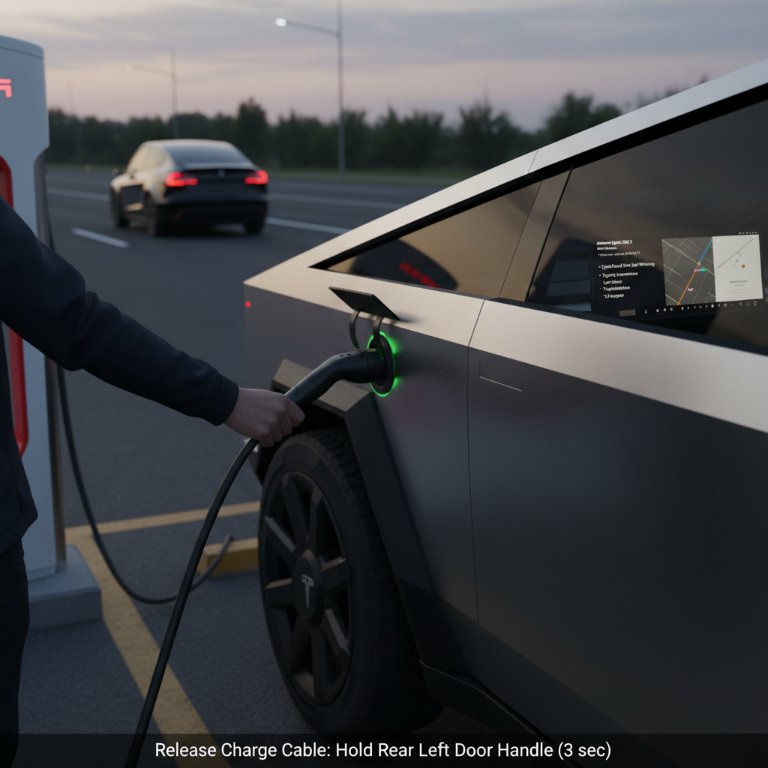
- Charge Cable Release via Door Handle: A clever new convenience feature allowing owners to release the charge cable by simply pulling and holding the rear left door handle for three seconds.
Evolving Nomenclature: 'AI Computer' and 'Autosteer'
Beyond the tangible features, Tesla is also refining its internal and external terminology, a move that subtly but significantly redefines how users perceive its advanced systems. The update rebrands 'Navigate on Autopilot' to 'Navigate on Autosteer' and, perhaps more tellingly, 'FSD Computer' to 'AI Computer.'
This shift from 'Autopilot' to 'Autosteer' clarifies the system's primary function—assisted steering—and aligns better with current regulatory discussions around autonomous driving capabilities. The rebranding of the 'FSD Computer' to 'AI Computer' is even more profound. It reflects Tesla's broader ambition to leverage its powerful in-car hardware for a wide array of artificial intelligence tasks, far beyond just Full Self-Driving. This isn't merely a naming convention; it's a statement about the versatility and computational power embedded in every new Tesla vehicle.
Why This Matters:
This 2026.8.3 update, while seemingly minor on the surface, speaks volumes about Tesla's strategic direction and its impact on the EV landscape. For Tesla owners, these are direct quality-of-life improvements. The smoother braking in the Model Y Juniper indicates Tesla's continuous tuning of specific hardware variants, ensuring an optimized experience for newer vehicles and potentially addressing feedback from early adopters. The Cybertruck's new blind spot warning, especially when parked, is a pragmatic safety enhancement for a vehicle whose unique form factor might present specific visibility challenges. The door handle charge release? A delightful, small convenience that eliminates an extra step and reinforces the 'frictionless' user experience Tesla strives for.
From an industry perspective, the renaming of the 'FSD Computer' to 'AI Computer' is a significant signal. It underscores Tesla's commitment to developing general artificial intelligence capabilities within its vehicles, positioning the car not just as a mode of transport, but as a mobile AI platform. This move could hint at future applications, from advanced predictive maintenance to personalized in-cabin AI experiences, potentially setting a new standard for what a vehicle's compute power can achieve. It also implicitly acknowledges the ongoing scrutiny around the 'FSD' moniker, opting for a more technically accurate and broader term for the underlying hardware.
Competitors, many of whom are still grappling with basic OTA updates, must take note. Tesla’s ability to rapidly deploy targeted improvements, even for specific vehicle trims like the Model Y Juniper, showcases an unparalleled software agility. This iterative development model ensures that Tesla vehicles constantly evolve, retaining and even gaining features long after purchase, a stark contrast to the largely static software experience offered by most traditional automakers.
This update reinforces the idea that Tesla doesn't just sell cars; it sells an evolving technology platform. Each software release, no matter how granular, is a testament to this philosophy, continuously enhancing the value proposition for its users and pushing the boundaries of what consumers expect from their vehicles. The race isn't just about hardware anymore; it's about the intelligence that powers it, and Tesla is clearly doubling down on its AI advantage.
Conclusion:
Tesla's 2026.8.3 update might not be revolutionary in scope, but its precise refinements and strategic nomenclature changes are profoundly important. These enhancements cement Tesla's lead in software-defined vehicles, prioritizing user experience and hinting at a broader AI-driven future. As the automotive world rapidly electrifies, Tesla continues to demonstrate that the true battleground lies in the silicon and code that bring these machines to life, ensuring that every drive is not just a journey, but an evolving technological experience.