Tesla's $20 Billion Terafab: A Colossal Gamble to Seize AI Hardware Dominance
On March 21, 2026, Tesla will officially launch its Terafab project, a monumental $20 billion AI chip fabrication facility poised to fundamentally res...
Editorial Team
World Of EV
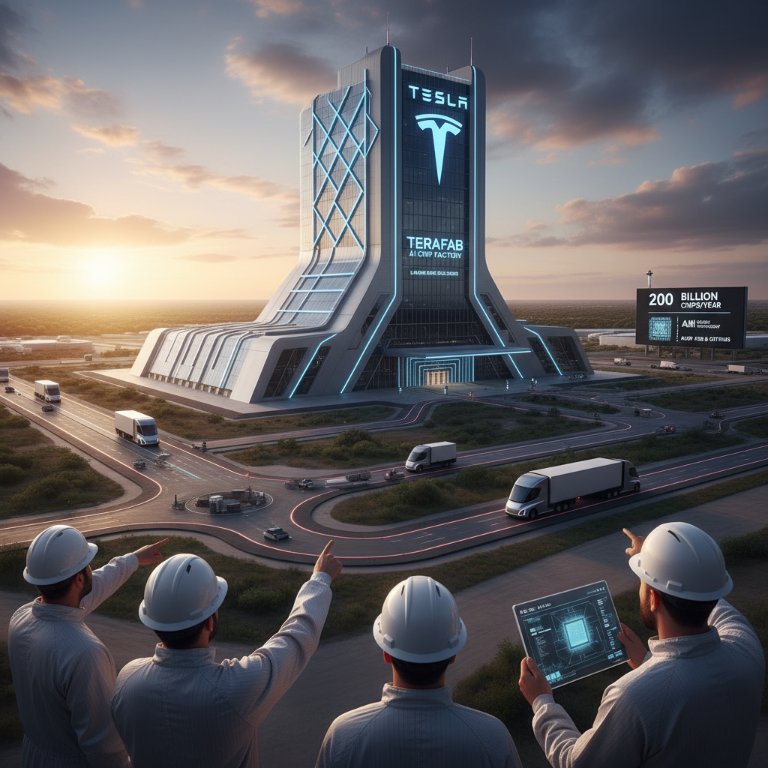
On March 21, 2026, Tesla will officially launch its Terafab project, a monumental $20 billion AI chip fabrication facility poised to fundamentally reshape the company's trajectory and the broader tech landscape. This move signifies Tesla's most ambitious push yet into vertical integration, aiming to bring the production of critical AI hardware in-house and decouple itself from the fluctuating supply chains of external foundries like TSMC and Samsung. For a company that has long designed its own advanced silicon, this represents a decisive leap into the incredibly complex world of semiconductor manufacturing, mirroring, in scale, past bold endeavors such as its 4680 battery cell production.
The Terafab's Audacious Scale and Ambition
Tesla's Terafab is no ordinary factory; it is a declaration of intent. Located at the Giga Texas North Campus in Austin, this facility is projected to churn out an astounding 100-200 billion AI and memory chips annually, utilizing cutting-edge 2-nanometer process technology. This targeted output, potentially reaching 100,000 wafer starts per month, is on par with, and in some aspects aims to surpass, the capabilities of the industry's largest giga-fabs. This vertically integrated effort will combine logic processing, memory, and advanced packaging under one roof, positioning Tesla as a primary producer of the world's most advanced silicon.
AI5: The Brains for Tesla's Autonomous Future
The facility's initial focus will be the next-generation AI5 chip, meticulously designed to power Tesla's Full Self-Driving (FSD) capabilities, the upcoming Cybercab robotaxi fleet, and the rapidly evolving Optimus humanoid robots. This chip promises a transformative leap in performance, offering 40 to 50 times more compute and 9 times more memory compared to its predecessor, the AI4. Elon Musk has lauded the AI5 as potentially the 'most epic chip ever,' specifically engineered as a 'half reticle' design, which enables superior efficiency and power management by streamlining its architecture and removing legacy components. This bespoke design ensures optimal alignment with Tesla's unique software and hardware stack, a critical advantage for highly specialized AI applications.
Strategic Imperative: Breaking Supply Chain Shackles
The strategic rationale behind Terafab is clear: secure critical supply. Musk has consistently voiced concerns about projected chip supply constraints within the next three to four years, as the demand for AI chips from Tesla's expanding FSD, Cybercab, and Optimus programs outstrips external foundry capacity. By bringing fabrication in-house, Tesla aims to eliminate its dependency on external suppliers, bypassing the intense global competition for advanced silicon that plagues every hyperscaler and AI company. This aggressive vertical integration strategy seeks to enhance quality control, accelerate innovation cycles, and grant Tesla unparalleled flexibility, lessons learned and applied from previous supply chain disruptions.
Why This Matters:
Tesla's Terafab project is more than just a new factory; it's a profound statement on the future of technology and a high-stakes gamble with far-reaching implications. The company's historic commitment to vertical integration, evident in its control over battery production, software development, and direct sales, has been a cornerstone of its competitive advantage. This enabled Tesla to adapt swiftly during past semiconductor shortages when competitors floundered.
However, the path to chip fabrication is fraught with monumental challenges. Unlike designing chips, manufacturing them at 2-nanometer scale requires unparalleled expertise, staggering capital investment, and notoriously long lead times for specialized equipment. Tesla, despite its engineering prowess in chip design, possesses zero prior experience in semiconductor manufacturing. This echoes the ambitious, yet significantly delayed and under-delivered, promises surrounding its 4680 battery cell production, where targets were missed by wide margins. Even industry giants like Intel and Samsung, with decades of experience and billions invested, continuously struggle with yield rates and advanced node production. The fact that Terafab's full cost is not yet fully incorporated into Tesla's record capital expenditure plan further underscores the scale of the undertaking.
- Who Wins? If Tesla can defy the odds and successfully ramp up Terafab, it gains unprecedented control over its most vital component: the brains of its AI systems. This vertical integration could secure a decisive lead in autonomous driving, robotics, and potentially, broader AI applications, offering unmatched performance, cost control, and supply security. The excess chip production could even be commercialized or diverted to other Musk ventures like xAI.
- Who Loses? External foundries, particularly TSMC and Samsung, could lose a significant, albeit challenging, client for Tesla's advanced AI chips, though Tesla still relies on them for current AI5 production. More critically, competitors in the EV and robotics space who continue to rely on external, generic, or less optimized silicon might find themselves at a severe disadvantage, struggling to match Tesla's pace of innovation and cost efficiency.
- What Does This Signal? This is Tesla asserting its identity as a full-stack AI and robotics company, not just an automotive manufacturer. It's an all-in bet on controlling the foundational bottleneck of the AI era: custom, high-performance silicon. This strategic pivot signals a relentless pursuit of end-to-end control, a 'do-or-die' moment in the race for AI dominance that could redefine Tesla's market position for decades to come.
Conclusion
The Terafab project, launching this week, represents an audacious leap into the core of the AI revolution. While the challenges are immense and Tesla's manufacturing track record carries cautionary tales, the potential rewards – unparalleled control over its AI destiny, accelerated innovation in FSD and robotics, and a dominant position in the burgeoning AI hardware market – are equally monumental. The world will be watching closely as Tesla embarks on what could be its most transformative, and riskiest, venture yet, pushing the boundaries of what a single company can vertically integrate in the pursuit of an autonomous future.