Tesla Unleashes FSD (Supervised) v14.2.2.5: A Quantum Leap for Vision and HW4 Vehicles
Tesla's Full Self-Driving (Supervised) system is once again making headlines, not just with an incremental update, but with a profound architectural o...
Editorial Team
World Of EV
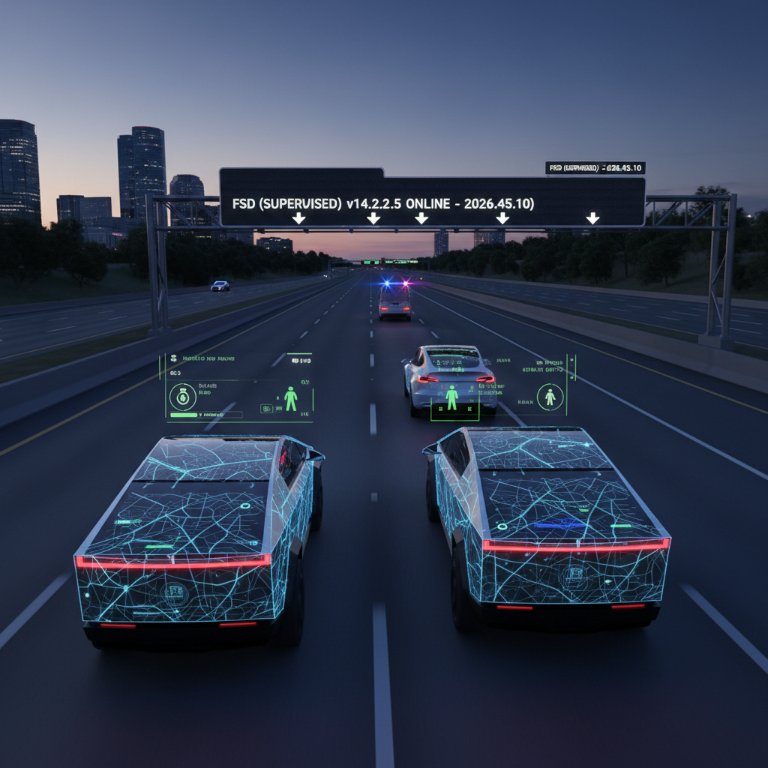
Tesla's Full Self-Driving (Supervised) system is once again making headlines, not just with an incremental update, but with a profound architectural overhaul. The company has begun rolling out software version 2025.45.10, featuring FSD (Supervised) v14.2.2.5, a release that fundamentally redefines the system's perception and decision-making capabilities. This isn't merely a bug fix; it represents a substantial evolution in Tesla's vision-first autonomous driving strategy.
For years, Tesla's ambitious pursuit of full autonomy has captivated and, at times, frustrated its ardent user base and industry observers. From early iterations promising 'robotaxis' to the current 'Full Self-Driving (Supervised)' moniker, the journey has been marked by continuous, data-driven improvement. This latest wave, kicking off around February 15-18, 2026, marks a pivotal moment, primarily leveraging the enhanced processing power and improved camera suite of Hardware 4 (HW4) vehicles, including the Model Y, Model 3, and the formidable Cybertruck.
What's New in FSD (Supervised) v14.2.2.5
- Upgraded Core Neural Network Vision Encoder: This is arguably the most critical improvement. The 'vision encoder' is the brain's visual cortex for the car, responsible for interpreting raw camera data into a coherent understanding of the environment. A substantial upgrade here means the vehicle can perceive and understand its surroundings with greater fidelity, accuracy, and nuance. This lays the groundwork for more reliable and safer navigation in complex scenarios.
- Enhanced Emergency Vehicle Logic: Addressing a crucial safety and compliance aspect, the system now boasts improved logic for detecting, pulling over for, and yielding to emergency vehicles. This is a vital capability for real-world driving and a key indicator of increasing autonomy maturity.
- Integrated Navigation and Routing Data into Vision: In a game-changing move, FSD now directly integrates its planned navigation and routing data into the core vision-based neural network. This allows the vehicle to not just react to its immediate environment but to proactively anticipate and plan based on its destination and and route, leading to smoother, more human-like decision-making and trajectory planning.
- New Speed Profiles (SLOTH and MAD MAX): Tesla is introducing two distinct speed profiles, 'SLOTH' and 'MAD MAX.' While official definitions are pending, 'SLOTH' likely denotes a more conservative, cautious driving style, ideal for adverse conditions or for drivers who prefer a gentler ride. Conversely, 'MAD MAX' is anticipated to offer a more assertive and confident driving profile, maximizing efficiency and speed where safe and appropriate, signaling Tesla's intent to cater to diverse driving preferences within FSD.
- Refined Obstacle and Gate Handling: This improvement targets complex urban and suburban environments, enabling FSD to better identify, predict the movement of, and navigate around various static and dynamic obstacles, including more sophisticated handling of gates and other barriers.
The Hardware 4 Advantage
The initial targeting of Hardware 4 (HW4) equipped vehicles is a clear strategic decision by Tesla. HW4, with its significantly more powerful compute capabilities and higher-resolution cameras, provides the essential computational horsepower to fully leverage the advancements in FSD v14.2.2.5. This rollout underscores Tesla's commitment to optimizing its software for its most advanced hardware platform, potentially creating a noticeable performance gap between older HW3 and newer HW4 vehicles in the FSD experience. Owners of new Model 3, Model Y, and especially the Cybertruck, are the immediate beneficiaries, gaining access to a more capable and refined autonomous driving experience.
Why This Matters:
This FSD (Supervised) v14.2.2.5 update is far more than just another version number; it signals a critical inflection point in Tesla's autonomous driving development. The upgraded vision encoder and the direct integration of navigation data into the neural network represent a profound shift towards a more holistic, predictive, and intelligent driving system. This moves Tesla's FSD closer to true cognitive driving, where the vehicle understands not just what it sees, but also its broader mission and context. Early adopters with HW4 vehicles will likely experience a significant leap in the system's reliability and comfort, reinforcing their investment in the latest hardware. For the broader industry, this update further solidifies Tesla's audacious vision-only approach, potentially compelling competitors to re-evaluate their own sensor suites and AI development strategies. This is not a 'do-or-die' moment in isolation, but rather a powerful demonstration that Tesla continues to push the boundaries of what's possible with camera-based autonomy, setting a higher bar for the entire self-driving sector and signaling to the market that consistent, fundamental improvements are still achievable within its existing paradigm.
Looking ahead, this foundational upgrade suggests a rapid acceleration in FSD's capabilities. With a more intelligent perception system and enhanced planning, future updates could unlock even more complex driving scenarios, bringing the long-promised robotaxi future incrementally closer. For savvy EV enthusiasts and prospective buyers, the performance differential between HW3 and HW4 FSD is likely to become a critical decision factor, making HW4 vehicles an increasingly attractive proposition for those prioritizing cutting-edge autonomous features.