Tesla Unleashes FSD Subscription-Only Model and Stealthy 'Hardware 4.5' Upgrade: A Pivotal Shift for Autonomy
Tesla is fundamentally recalibrating its Full Self-Driving (FSD) strategy, ushering in a subscription-only era for its controversial driver-assistance...
Editorial Team
World Of EV
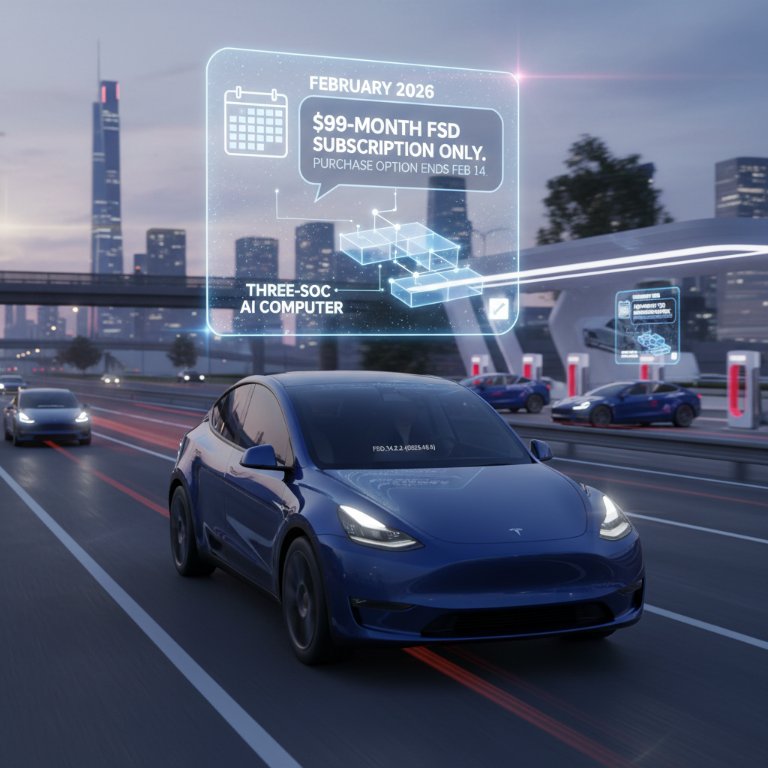
Tesla is fundamentally recalibrating its Full Self-Driving (FSD) strategy, ushering in a subscription-only era for its controversial driver-assistance suite while simultaneously rolling out an unannounced 'Hardware 4.5' computer in new vehicles. These dual moves signal an urgent push to accelerate FSD adoption and bolster the computational backbone of its autonomous ambitions.
FSD Shifts to Subscription-Only, Drawing a Line in the Sand
Starting February 2026, the era of purchasing Full Self-Driving outright concludes. Tesla will sunset the lucrative, albeit often debated, upfront purchase option for FSD after February 14, 2026. This marks a dramatic pivot for a feature that, depending on the market and time of purchase, has commanded prices upwards of $12,000 to $15,000. Going forward, FSD will exclusively be available via a monthly subscription model priced at $99.
Currently, the FSD v14.2.2.4 (2025.45.9) software update continues its rollout, reaching approximately 3% of Tesla's FSD-enabled fleet as of late January 2026. This iteration follows a series of updates as Tesla refines its autonomous capabilities, a journey that has seen numerous promises and incremental improvements, maintaining FSD in a persistent beta state.
The Silent Arrival of 'Hardware 4.5': Bridging the Compute Gap
In a move characteristic of Tesla's rapid, often unannounced, innovation cycles, new Model Y owners taking deliveries in late December and January have reportedly discovered their vehicles equipped with a new 'Hardware 4.5' (AI4.5) computer. This unannounced hardware update is believed to feature a three-System-on-Chip (SoC) design, a departure from the dual-SoC architecture of the previous HW4.
This 'AI4.5' is not just a minor tweak; it appears to be a crucial interim solution. Industry analysts interpret this as a strategic move to bridge a potential compute power gap before the much-anticipated AI5 chip reaches volume readiness. For context, Tesla's hardware evolution has always been critical to its FSD ambitions, with each generation (HW2, HW2.5, HW3, HW4) promising the necessary processing power for full autonomy. The introduction of HW4.5 suggests that even HW4, while powerful, might not be entirely sufficient for the immediate next steps in FSD's development, or that the timeline for AI5 is longer than originally projected.
Why This Matters:
Monetization Reinvention: The move to a subscription-only FSD fundamentally changes Tesla's revenue stream. It trades a large, one-time payment for predictable, recurring monthly income. This could significantly boost FSD adoption by lowering the barrier to entry (from over $12,000 to just $99/month), potentially bringing more users into the FSD ecosystem and generating invaluable data for further development. For Tesla, this creates a stable, recurring revenue stream essential for long-term valuation. For consumers, it offers flexibility but also means FSD becomes an ongoing operational cost, potentially exceeding the original purchase price over many years of ownership.
Hardware Urgency and Iteration: The stealthy deployment of 'Hardware 4.5' underscores Tesla's relentless pursuit of computational supremacy for FSD. This interim solution suggests a recognition that the demands of true self-driving are immense and constantly evolving. It implies that even the relatively new HW4 may not fully meet the current or near-future computational needs, or that AI5 is still some distance away. This iterative hardware approach highlights the immense engineering challenge of delivering Level 4/5 autonomy and suggests Tesla is not willing to wait for a perfect solution if an immediate upgrade can accelerate progress. For owners, this raises questions about hardware parity and the long-term 'future-proofing' of their vehicles.
Market Signal to Competitors: Tesla is doubling down on its full-stack approach to autonomy – designing both the software and the custom hardware. The subscription model could become a blueprint for other automakers developing advanced driver-assistance systems, though few have the same level of vertical integration. The rapid hardware iteration also demonstrates the capital and R&D commitment required to compete in the autonomous driving space.
In essence, these strategic maneuvers are not merely updates; they are a clear indication that Tesla is entering a critical phase in its FSD journey. The company is actively addressing both the financial accessibility of its autonomous software and the underlying computational power required to deliver on its ambitious promises. This could be a make-or-break moment for FSD, determining its ultimate viability and widespread acceptance.
The coming months will reveal whether this twin strategy of subscription accessibility and iterative hardware upgrades will finally propel Full Self-Driving from its perpetual beta state into the fully autonomous future Tesla has long envisioned.