Tesla Unleashes Cybercab Production: A Dedicated Robotaxi's Dawn Signals Major EV Market Shift
Tesla is dramatically accelerating the test manufacturing of its eagerly anticipated dedicated autonomous robotaxi, the Cybercab, at its expansive Gig...
Editorial Team
World Of EV
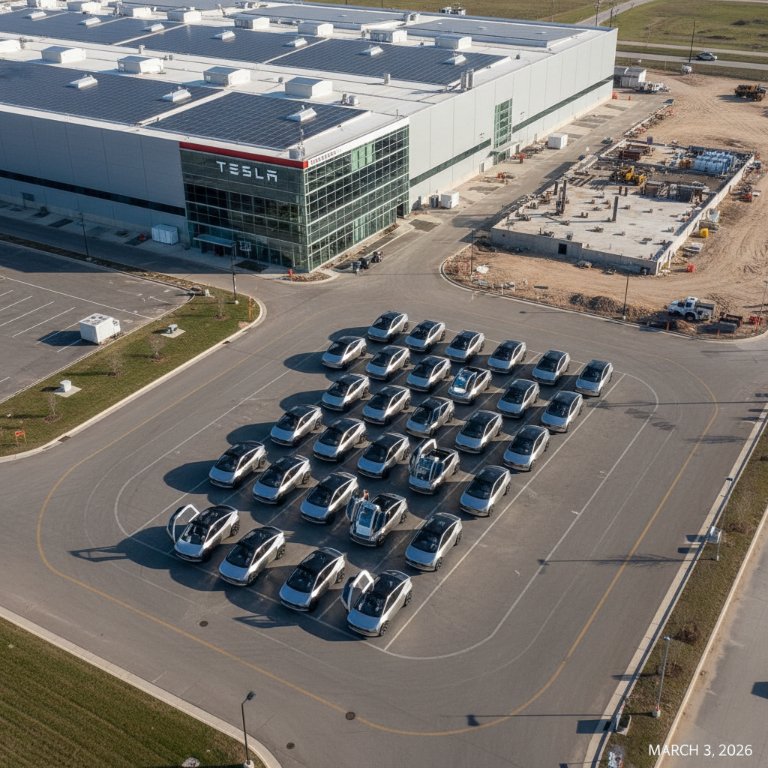
Tesla is dramatically accelerating the test manufacturing of its eagerly anticipated dedicated autonomous robotaxi, the Cybercab, at its expansive Gigafactory Texas facility. Drone footage captured on March 3, 2026, provided the clearest indication yet of Tesla's advanced progress, revealing an unprecedented 25 Cybercab units strategically arrayed across the factory grounds. This significant increase in visible inventory transcends mere test runs; it powerfully signals that Tesla is rapidly refining its revolutionary 'unboxed' manufacturing process and stands on the precipice of full-scale volume production for this game-changing, sub-$30,000 two-seater autonomous vehicle.
This aggressive timeline positions Tesla for a potentially massive disruption in urban mobility. With volume production anticipated within a mere four to eight weeks, aligning precisely with Elon Musk's ambitious pronouncements, the company is unequivocally preparing for a broad public robotaxi service expansion throughout 2026. After years of promising a fully autonomous future largely built upon adapting its consumer vehicles, the dedicated Cybercab represents a pivotal strategic pivot, signaling a no-compromise approach to delivering true autonomous transportation.
Refining the 'Unboxed' Vision
The sighting of 25 Cybercab units is more than just an inventory count; it's a direct window into the advanced stages of Tesla's 'unboxed' manufacturing process. Unlike traditional automotive assembly lines that build vehicles sequentially, 'unboxed' manufacturing involves simultaneous, modular assembly of large sub-assemblies. This approach promises unprecedented efficiency and significantly reduced production costs, crucial for a low-cost robotaxi service. Key implications of this manufacturing innovation include:
- Dramatic Cost Reduction: The inherent efficiencies of 'unboxed' are designed to make the Cybercab's sub-$30,000 price point feasible at scale.
- Faster Scalability: Modular assembly allows for quicker ramp-up to high-volume production, essential for meeting aggressive deployment targets.
- Optimized Design for Autonomy: Developing the Cybercab from the ground up as an autonomous vehicle eliminates the compromises inherent in retrofitting traditional cars with self-driving hardware.
The Sub-$30,000 Imperative
The Cybercab's projected sub-$30,000 price tag is a critical detail often overlooked in the excitement of autonomy. While many competitors are focused on high-end, limited-deployment autonomous services, Tesla is clearly aiming for mass market adoption. This price point, combined with a two-seater configuration, suggests a deliberate strategy to:
- Target Urban Commuters: Ideal for single riders or couples needing efficient, low-cost transport in dense urban environments.
- Undercut Ride-Hailing Competitors: A low acquisition cost for the vehicle itself translates to potentially far lower per-mile operating costs than human-driven services.
- Expand EV Accessibility: Democratizing access to electric, autonomous transportation beyond traditional car ownership.
Why This Matters:
This moment is nothing less than a watershed for Tesla and the broader automotive and mobility industries. For years, the dream of a widely available robotaxi service remained just that—a dream, perpetually 'two weeks away.' Now, with visible production scaling and a dedicated platform, Tesla is putting tangible assets behind its boldest autonomy promises. This shift is profound:
- Tesla's Autonomy Credibility: The Cybercab is the ultimate litmus test for Tesla's Full Self-Driving (FSD) capabilities. A purpose-built, mass-produced robotaxi fundamentally validates—or refutes—years of development. Failure to deliver a robust, safe service at scale would be a significant blow to their long-term vision.
- Reimagining Urban Mobility: If successful, the Cybercab could fundamentally alter urban planning, vehicle ownership models, and public transportation. Imagine a world where personal car ownership in cities becomes a niche, replaced by ubiquitous, on-demand autonomous taxis.
- Intensified Competitive Pressure: This move places immense pressure on rival autonomous vehicle developers like Waymo and Cruise, who have largely focused on more limited geographic rollouts with adapted consumer vehicles or bespoke, but more expensive, platforms. Tesla's 'unboxed' manufacturing and aggressive price point could leave competitors scrambling to match cost efficiencies and scalability.
- Who Wins? Consumers seeking affordable, convenient, and environmentally friendly urban transport stand to gain immensely. Tesla, if it executes flawlessly, could capture an entirely new, multi-trillion-dollar market segment. Cities grappling with congestion and pollution could also find a powerful ally. Who Loses? Traditional ride-hailing services, especially those reliant on human drivers, face an existential threat. Automakers not investing heavily in dedicated autonomous platforms could find themselves marginalized in the future of urban transport.
- A Do-or-Die Moment? For Tesla's autonomy ambitions, this is arguably the most critical juncture. Moving from software development on consumer cars to deploying a dedicated, mass-produced robotaxi service means the stakes have never been higher. The successful rollout of the Cybercab is essential for Tesla to truly transition from a premium EV manufacturer to a comprehensive AI and robotics company.
The accelerating production of the Cybercab marks a defining moment in the evolution of autonomous vehicles. Tesla is not merely introducing a new vehicle; it is attempting to launch an entirely new paradigm for transportation. The coming months will undoubtedly prove crucial in determining whether the Cybercab will live up to its revolutionary promise, reshaping our cities and our relationship with personal mobility forever.