Tesla Unleashes Ambitious 100 GW Solar Manufacturing Drive, Signaling Major US Renewable Shift by 2028
Tesla, under the ambitious leadership of Elon Musk, is embarking on a monumental expansion into solar energy component manufacturing, with a declared ...
Editorial Team
World Of EV
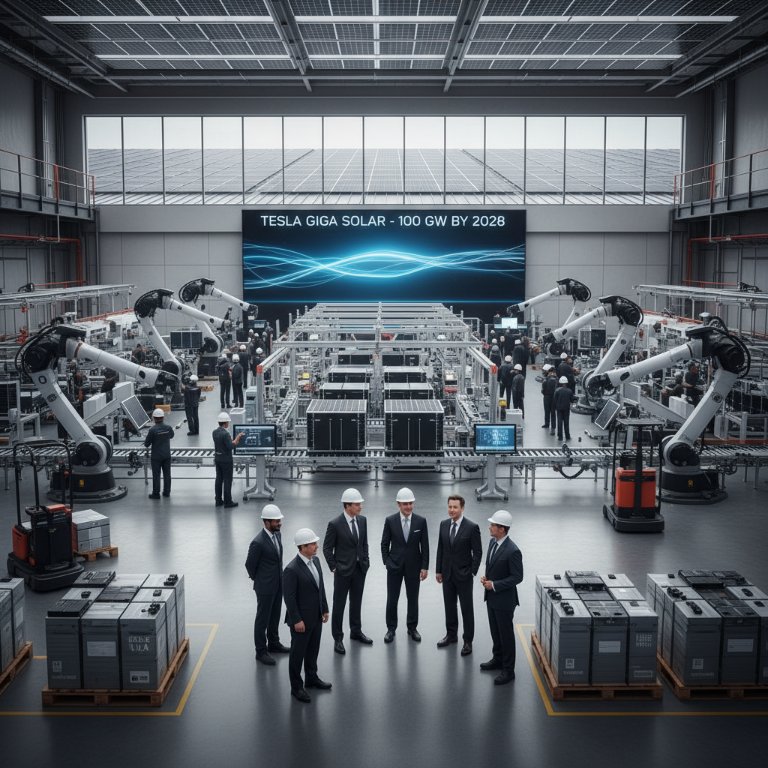
Tesla, under the ambitious leadership of Elon Musk, is embarking on a monumental expansion into solar energy component manufacturing, with a declared goal to become the largest US producer by the end of 2028. This bold move, confirmed by senior executives actively recruiting for the initiative, signifies a dramatic pivot to establish an astounding 100 gigawatts (GW) of domestic solar production capacity.
For years, Tesla's energy division, encompassing products like the Powerwall and Solar Roof, has operated somewhat in the shadow of its high-profile automotive ventures, despite silently becoming its most profitable segment in recent quarters. While Tesla acquired SolarCity in a controversial deal in 2016, and has had a solar presence, large-scale domestic manufacturing of solar cells and modules has largely eluded the company at the predicted scale. This new announcement, however, signals a renewed and aggressive commitment to integrate solar production vertically, echoing Musk's vision of a holistic sustainable energy ecosystem.
Targeting Unprecedented Scale in Domestic Solar
Tesla's newly unveiled objective is nothing short of revolutionary for the US renewable energy landscape. The company aims to deploy 100 GW of solar manufacturing from raw materials on American soil by the close of 2028. To put this into perspective, this target is approximately 30 times the current entire U.S. solar cell manufacturing capacity, which stands at a modest 3.2 GW, even though the U.S. has a solar module capacity of 65 GW. This underscores the sheer scale of Tesla's ambition to onshore a critical part of the solar supply chain, which is currently dominated by China.
- Goal: Become the largest US manufacturer of solar energy components.
- Target: 100 GW of domestic solar production capacity.
- Timeline: By the end of 2028.
- Current Efforts: Active hiring for engineers and scientists, with job postings explicitly stating the 100 GW goal. Tesla is also evaluating multiple U.S. sites for solar cell manufacturing, including expanding its Buffalo, New York, factory and considering new facilities in New York, Arizona, and Idaho.
This aggressive push is further highlighted by recent developments, including the launch of Tesla's new self-developed solar modules (TSP-415/420) assembled at its Buffalo, NY facility, capable of scaling to over 300 MW per year initially. This forms a critical part of a fully integrated, domestically manufactured chain encompassing solar power, inverters, and energy storage systems.
Why This Matters:
For Tesla: This initiative serves multiple strategic purposes. Firstly, it diversifies Tesla's revenue streams, reducing its overwhelming reliance on the automotive segment, especially amidst recent declines in EV sales. The energy division has already shown impressive profitability, with gross margins of 30% in recent quarters, nearly double that of automotive. Secondly, it strengthens Tesla's narrative as a holistic sustainable energy company, seamlessly integrating generation (solar) with storage (Powerwall, Megapack) and consumption (EVs). However, it also represents a massive capital expenditure and significant execution risk, given Tesla's mixed track record with scaling solar manufacturing post-SolarCity acquisition.
For the US Renewable Market: If successful, Tesla's 100 GW target would be a game-changer. It would dramatically boost domestic solar manufacturing capacity, reducing reliance on foreign supply chains, particularly China, which currently controls over 80% of the global solar supply. This could accelerate the clean energy transition, create substantial high-tech manufacturing jobs, and enhance energy independence. The sheer scale would put immense pressure on existing US solar manufacturers to innovate and expand.
For Consumers and Industry: A robust domestic supply chain could lead to more competitive pricing and faster deployment of solar installations. The growing demand from energy-intensive AI data centers is also a key motivator for Musk, who sees solar as essential for powering future technological advancements. This signals a future where distributed and centralized renewable energy generation becomes even more accessible and critical.
In conclusion, Tesla's commitment to 100 GW of domestic solar manufacturing by 2028 is a colossal wager that could redefine its corporate identity and reshape the global energy landscape. While the path will undoubtedly be fraught with challenges, the potential impact — on Tesla's bottom line, US energy independence, and the acceleration of the clean energy transition — is immense and warrants close observation from every corner of the EV and renewable energy world.