Tesla Unleashes AI Ambitions: Samsung Chip Expansion Signals Major FSD and Optimus Acceleration
Tesla is poised to dramatically accelerate its artificial intelligence roadmap, reportedly engaging in discussions with Samsung Electronics to signifi...
Editorial Team
World Of EV
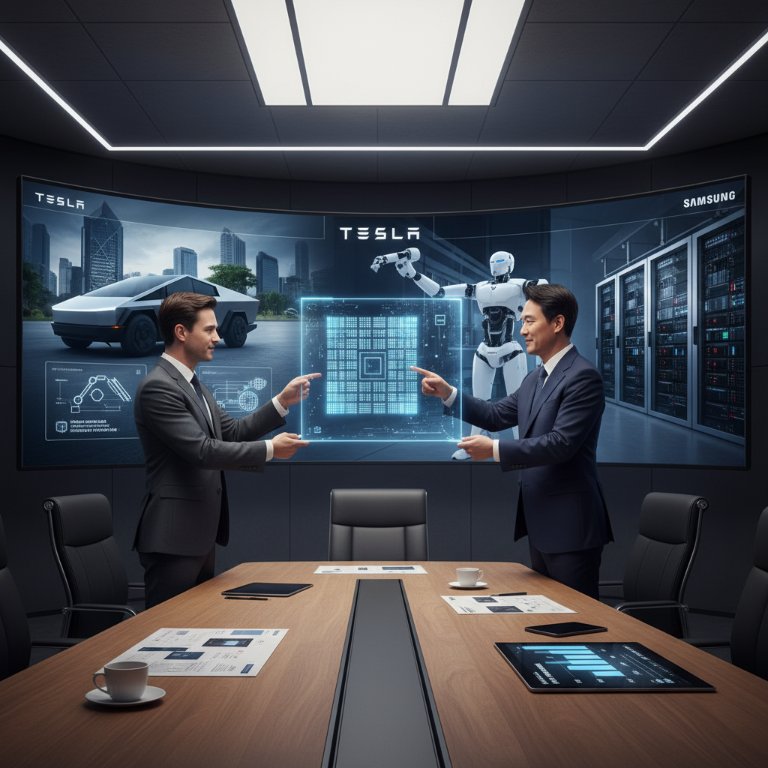
Tesla is poised to dramatically accelerate its artificial intelligence roadmap, reportedly engaging in discussions with Samsung Electronics to significantly expand its supply of the next-generation AI6 chip. This strategic move could see Tesla's total AI6 wafer production capacity with Samsung surge to approximately 40,000 wafers per month, a substantial increase from the current 16,000. This isn't merely an incremental upgrade; it's a profound commitment to vertical integration and a clear signal of Tesla's intent to dominate the future of autonomous driving, advanced robotics, and AI infrastructure.
The Samsung Partnership Deepens for AI6 Production
Tesla has reportedly requested an additional 24,000 wafers per month from Samsung, pushing the potential total to around 40,000 wafers monthly if the deal is finalized. This expanded partnership is crucial for Tesla's upcoming AI6 chip, also known as Hardware 6 (HW6), which industry sources indicate will be manufactured using Samsung's advanced 2-nanometer process. The existing long-term foundry agreement, signed last year and valued at approximately $16-17 billion (22.8 trillion won), runs through December 31, 2033, and positions Samsung's new fabrication plant in Taylor, Texas, as a central hub for this critical production.
Tesla's collaboration with Samsung isn't new; Samsung has been a long-standing partner, manufacturing Tesla's HW3 (AI3) chip on a 14-nanometer process and the current HW4 (AI4) chip on a 5-nanometer node. The decision to fully commit AI6 production to Samsung, rather than splitting it with other foundries like TSMC as was reportedly considered for the AI5, underscores the deepening strategic alliance between the two tech giants.
Powering Tesla's Ambitious AI Ecosystem
These high-performance AI6 chips are not designed for a singular purpose. Instead, they form a unified AI hardware platform crucial for supporting Tesla's most ambitious projects:
Full Self-Driving (FSD) System: The AI6 will be integral to the evolution of Tesla's FSD, which has transitioned to an end-to-end neural network architecture from camera pixel input to vehicle control output since version V12. More powerful, dedicated hardware is essential for running the increasingly complex multimodal large models that power FSD.
Optimus Humanoid Robot: The AI6 chip will serve as the 'brain' for the Optimus humanoid robot, a project Elon Musk has stated could eventually be more significant than Tesla's vehicle business. Dedicated AI processing power is paramount for Optimus's development, enabling advanced perception, balance, navigation, and interaction with the physical world.
Internal AI Data Centers: These chips are also vital for Tesla's internal AI data centers, which are the backbone for training the vast neural networks required for both FSD and Optimus. The report also indicates that AI6 clusters could potentially replace the role originally envisioned for Tesla's Dojo AI supercomputer, with multiple AI6 chips combining into server-level clusters.
Why This Matters:
This aggressive expansion of AI6 chip production with Samsung is a critical moment for Tesla, signaling an unwavering commitment to its audacious AI-driven future.
Unlocking FSD's Full Potential: Despite years of development and public scrutiny, Tesla's dedication to FSD has remained firm. This massive chip order suggests Tesla is bringing substantial compute power to bear on FSD, which could be the catalyst for the significant breakthroughs required to achieve true Level 5 autonomy. More powerful, custom silicon can accelerate the training and inference capabilities of Tesla's neural networks, potentially leading to more reliable and capable autonomous driving systems. For consumers, this could mean a faster path to a truly self-driving experience, enhancing vehicle safety and convenience.
Validating Optimus as a Core Business: Tesla's investment in dedicated hardware for Optimus underscores that the humanoid robot is far from a mere side project. With Musk's bold predictions about its economic impact, this chip deal provides tangible evidence that Tesla is pouring resources into making Optimus a reality. The ability to mass-produce powerful, energy-efficient AI chips at scale is fundamental to making Optimus commercially viable and deploying it across various industries and potentially even in homes. This signals a future where Tesla's influence extends far beyond electric vehicles.
Strengthening Vertical Integration and Competitive Edge: Tesla's strategy of designing its own custom silicon (like the AI6) and partnering with leading foundries like Samsung for manufacturing grants it unparalleled control over its hardware-software stack. This vertical integration, akin to Apple's approach, allows for maximum optimization, lower costs in the long run, and a significant competitive advantage over rivals relying on off-the-shelf solutions. It ensures that Tesla's AI systems are not bottlenecked by generic hardware, providing a crucial edge in a rapidly evolving AI landscape. For Samsung, this substantial, long-term contract provides a major boost to its foundry business, particularly at its new Taylor, Texas, plant, solidifying its position as a key player in advanced AI silicon manufacturing.
A Shift in AI Infrastructure Strategy? The reports suggesting AI6 clusters could supplement or even replace aspects of the Dojo supercomputer indicate a potential evolution in Tesla's approach to its AI training infrastructure. This flexibility could allow for more distributed, scalable, and potentially more efficient AI training operations, further accelerating Tesla's model development cycles.
Conclusion:
Tesla's reported push to more than double its AI6 chip production with Samsung is a definitive statement of intent. It underscores the company's aggressive pursuit of its AI-centric future across autonomous vehicles, robotics, and advanced data infrastructure. This substantial investment in bespoke silicon is critical to unlocking the next generation of FSD capabilities and bringing the Optimus robot closer to mass deployment. As these chips come online, the automotive world and beyond will be watching closely for the tangible advancements that such formidable computing power promises to deliver.