Tesla Semi Shifts into High Gear: Factory Nears Completion, 2026 Volume Production Looms
The long-anticipated Tesla Semi program is finally moving into an accelerated phase, with recent updates signaling a significant step towards full com...
Editorial Team
World Of EV
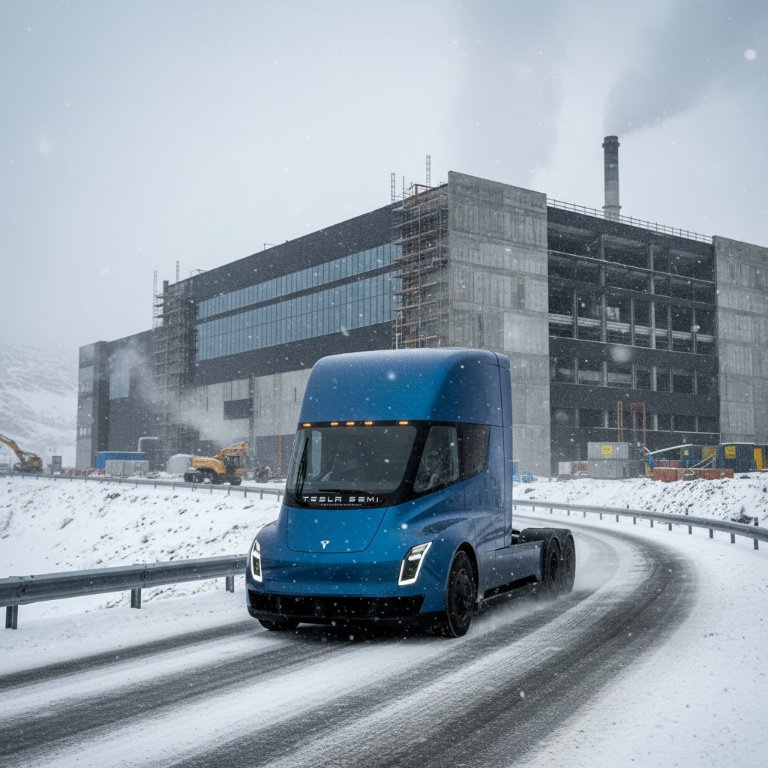
The long-anticipated Tesla Semi program is finally moving into an accelerated phase, with recent updates signaling a significant step towards full commercial deployment. Tesla has announced that its dedicated Semi factory is nearing completion, a crucial milestone for scaling production. Concurrently, new images of a design-refreshed Tesla Semi have emerged from rigorous winter and snow testing, underscoring the company's commitment to real-world performance. Crucially, Tesla now anticipates volume production of the electric heavy-duty truck to commence in 2026.
First unveiled with much fanfare in 2017, the Tesla Semi promised to revolutionize the trucking industry with unprecedented efficiency, performance, and a lower total cost of ownership. However, like many ambitious Tesla projects, the Semi’s journey to production has been protracted, with the company prioritizing the ramp-up of its more mainstream Model 3, Y, and later, the Cybertruck. This new announcement provides the clearest timeline yet for the Semi to transition from a limited deployment model, seen with early PepsiCo deliveries, to a widely available commercial product.
The Road to Volume Production
The completion of a dedicated manufacturing facility is paramount for any automotive OEM aiming for high-volume output. For the Tesla Semi, this means moving beyond pilot builds and into a scalable production environment. The nearing completion of the Semi factory suggests Tesla is establishing a robust manufacturing infrastructure capable of meeting the anticipated demand for its Class 8 electric truck. This dedicated capacity is vital for achieving economies of scale and driving down per-unit costs, which are critical for competitiveness in the commercial vehicle sector.
Refreshed Design & Winter Warrior
The recently shared images showcase a subtly refined Tesla Semi undergoing extensive winter and snow testing. This isn't merely a cosmetic update; successful performance in extreme cold and challenging weather conditions is non-negotiable for long-haul trucking. Key takeaways from these images and tests include:
- Design Refinement: While details are scarce, the refreshed design likely incorporates learnings from early production units and extensive real-world trials, optimizing aerodynamics, durability, and serviceability.
- All-Weather Capability: Rigorous winter testing demonstrates Tesla's focus on ensuring the Semi can operate reliably across diverse climates and terrains, directly addressing potential fleet operator concerns about performance limitations in adverse conditions.
- Durability and Reliability: Testing in harsh environments is critical for validating the vehicle's structural integrity, battery performance, and operational systems under stress, a vital step before full-scale deployment.
The 2026 Target: A Firm Commitment
Tesla’s official announcement of anticipated volume production in 2026 marks a significant shift from previous, more ambiguous timelines. While still two years away, this concrete target provides clarity for prospective buyers, investors, and the industry at large. It indicates that Tesla has largely de-risked the design and engineering challenges and is now focused squarely on manufacturing scale and supply chain optimization.
Why This Matters:
This renewed push for the Tesla Semi holds profound implications for several stakeholders:
- For Tesla: It signifies a critical expansion beyond passenger vehicles into the immense and lucrative commercial trucking market. Success here would cement Tesla's position as a multifaceted energy and transportation company, leveraging its battery technology and Supercharger network (with Megachargers) for a new frontier. It's a strategic move to diversify revenue streams and further its mission of accelerating the world's transition to sustainable energy.
- For Fleet Operators: The promise of a fully electric, long-haul truck with competitive range and reduced operating costs (lower fuel, less maintenance) is incredibly attractive. Early adopters stand to gain significant competitive advantages in operational efficiency and meeting sustainability mandates. The 2026 timeline allows fleets to plan their transition and infrastructure investments effectively.
- For the Commercial EV Industry: Tesla's volume production target will intensify pressure on traditional truck manufacturers like Daimler (Freightliner eCascadia) and Volvo (VNR Electric), as well as electric truck startups, to accelerate their own development and scaling efforts. Tesla's entry into high-volume production will likely set new benchmarks for performance, charging infrastructure, and total cost of ownership, driving innovation across the sector. This move signals that electric heavy-duty trucking is no longer a niche concept but a rapidly approaching reality.
- Who Wins? Fleet operators committed to decarbonization and cost savings, and potentially the environment. Tesla, if it can deliver on its ambitious promises and scale production efficiently.
- Who Loses? Traditional diesel truck manufacturers who are slow to electrify their offerings, and companies betting solely on internal combustion for their future commercial fleets.
Conclusion:
Tesla's latest updates regarding the Semi — a nearing factory, a battle-tested and refined design, and a firm 2026 volume production target — collectively underscore a pivotal moment for the program. After years of development, the Tesla Semi appears poised to shift into high gear, ready to significantly impact the logistics and transportation sectors. This move not only solidifies Tesla’s diversified portfolio but also marks a definitive acceleration in the broader adoption of electric heavy-duty vehicles, promising a greener and more efficient future for freight transportation.