Tesla Semi Charges Ahead: Million-Mile Battery and Megawatt Charging Signal Commercial EV Revolution
Tesla, long the vanguard of the passenger electric vehicle market, is now poised to redefine heavy-duty trucking. Dan Priestley, Tesla Semi program le...
Editorial Team
World Of EV
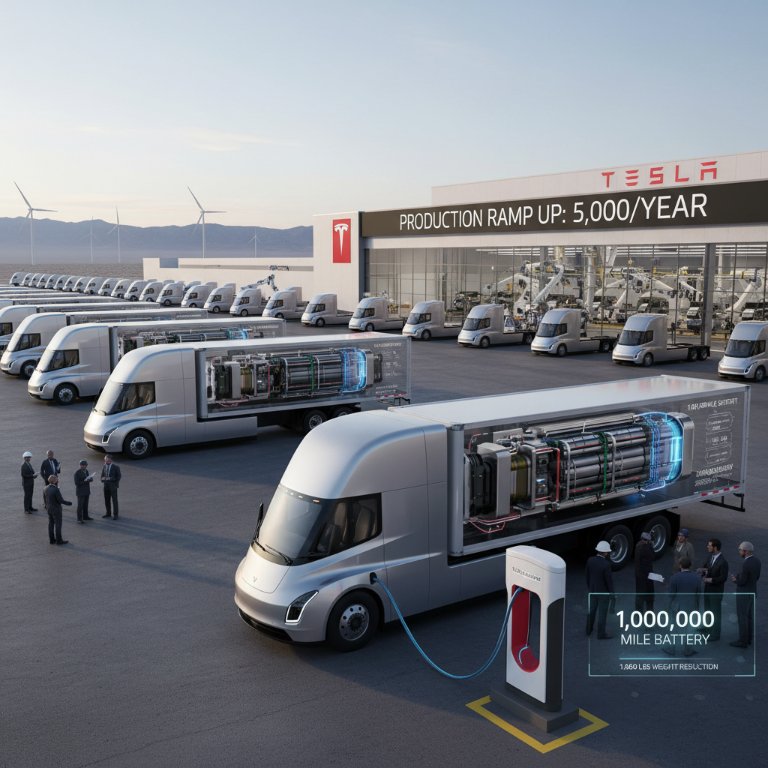
Tesla, long the vanguard of the passenger electric vehicle market, is now poised to redefine heavy-duty trucking. Dan Priestley, Tesla Semi program lead, has unveiled a suite of engineering breakthroughs that solidify the electric truck’s position as a serious contender against its diesel counterparts, culminating in a planned production ramp-up to 50,000 units annually. This isn't merely an incremental update; it's a declaration that the electric semi-truck is no longer a distant promise but an imminent reality ready to reshape global logistics.
Since its initial unveiling in 2017, the Tesla Semi has been a lightning rod for both excitement and skepticism. Critics questioned its feasibility, range, and cost-effectiveness compared to the established diesel giants. Yet, Tesla has quietly refined its revolutionary design, addressing core industry challenges with characteristic ambition. These latest revelations, particularly around battery longevity, payload capacity, and charging speed, demonstrate a commitment to not just electrifying trucks, but optimizing them for the demanding world of commercial transport.
Engineering Milestones Redefine EV Trucking
The heart of any electric vehicle is its battery, and Tesla is pushing the boundaries with a million-mile lifespan battery for the Semi. This far surpasses the typical lifespan expectations for passenger EVs and directly addresses a critical concern for fleet operators: total cost of ownership over many years of heavy use. For a vehicle expected to cover hundreds of thousands of miles annually, this longevity significantly enhances its economic viability, promising a substantially lower lifecycle cost compared to conventional diesel powertrains that often require major overhauls or replacements at far shorter intervals.
Equally impactful is a 1,000 lbs weight reduction, a feat of engineering that directly translates into payload parity with diesel trucks for the crucial 500-mile range version. This is a game-changer; previous electric truck iterations often faced a weight penalty due to their heavy battery packs, limiting cargo capacity and thus profitability. By achieving payload parity, the Semi eliminates a major competitive disadvantage, allowing fleet operators to haul the same amount of freight without compromising efficiency. Further bolstering its operational efficiency are improved aerodynamics, minimizing drag and maximizing range on long hauls.
Unprecedented Charging and Production Scale
Perhaps one of the most significant advancements for real-world application is the Semi’s 1.2 MW charging capability, enabling a 60% charge in just 30 minutes. To put this in perspective, this is nearly ten times faster than the fastest DC fast chargers available for passenger vehicles today and utterly essential for commercial operations where downtime directly impacts revenue. This rapid charging minimizes layovers and allows for quick turnarounds, mimicking the refueling speed of diesel trucks and effectively solving the 'range anxiety' dilemma for long-haul electric trucking.
Tesla isn't stopping at engineering; it's also gearing up for mass production. The company is preparing to significantly ramp up manufacturing at a dedicated factory in Reno, Nevada, with an ambitious target of 50,000 units per year. This aggressive production goal signals Tesla’s intent to move beyond pilot programs and deliver the Semi at a scale that can genuinely impact the commercial trucking industry, laying the groundwork for widespread adoption.
Why This Matters:
This latest wave of advancements for the Tesla Semi isn't just news; it's a seismic shift poised to disrupt the entire trucking and logistics industry. For Tesla, it validates their long-term vision and demonstrates their ability to leverage their battery and powertrain expertise to tackle some of the toughest challenges in transportation. A successful Semi program opens up a massive new revenue stream and solidifies Tesla's position as a multifaceted energy and mobility company, extending beyond passenger vehicles.
For the trucking industry, this means a viable, high-performance electric alternative to diesel is finally within reach. Fleet operators stand to gain significantly from reduced operational costs due to lower 'fuel' prices and dramatically less maintenance compared to complex internal combustion engines. This will accelerate the transition to sustainable logistics, driven by both environmental mandates and compelling economic incentives. Traditional truck manufacturers like Daimler Trucks, Volvo, and PACCAR, who have their own electric semi programs (e.g., Freightliner eCascadia, Volvo VNR Electric), will face intensified competition. While these incumbents have strong existing networks, Tesla’s integrated approach to vehicle, battery, and charging infrastructure could give them a considerable edge. For EV startups in the heavy-duty space, the bar has just been raised significantly.
Ultimately, this signals a pivotal moment for global decarbonization efforts. Heavy-duty trucking is a major contributor to global emissions, and the deployment of electric trucks at scale, especially with a million-mile lifespan, offers a tangible path towards cleaner air and a reduced carbon footprint for freight transport. The commitment to 1.2 MW charging also pushes the entire charging infrastructure industry forward, demanding faster, more robust solutions that will benefit all future heavy-duty EVs.
Conclusion:
With a million-mile battery, payload parity, megawatt charging, and a clear path to high-volume production, the Tesla Semi has moved from an intriguing concept to a formidable force ready to challenge the status quo. These advancements are not merely incremental improvements; they represent a fundamental re-engineering of commercial transport, promising a future where electric heavy-duty trucks are not just environmentally superior but economically compelling. The road ahead for trucking is undoubtedly electric, and Tesla is clearly in the driver's seat, accelerating towards a greener, more efficient logistics future.