Tesla Roadster: The Hypercar Returns – Unveiling Set for Spring 2026, Deliveries to Follow in 2027
After years of anticipation, speculative leaks, and an almost mythical status, the next-generation Tesla Roadster is finally poised to break cover. El...
Editorial Team
World Of EV
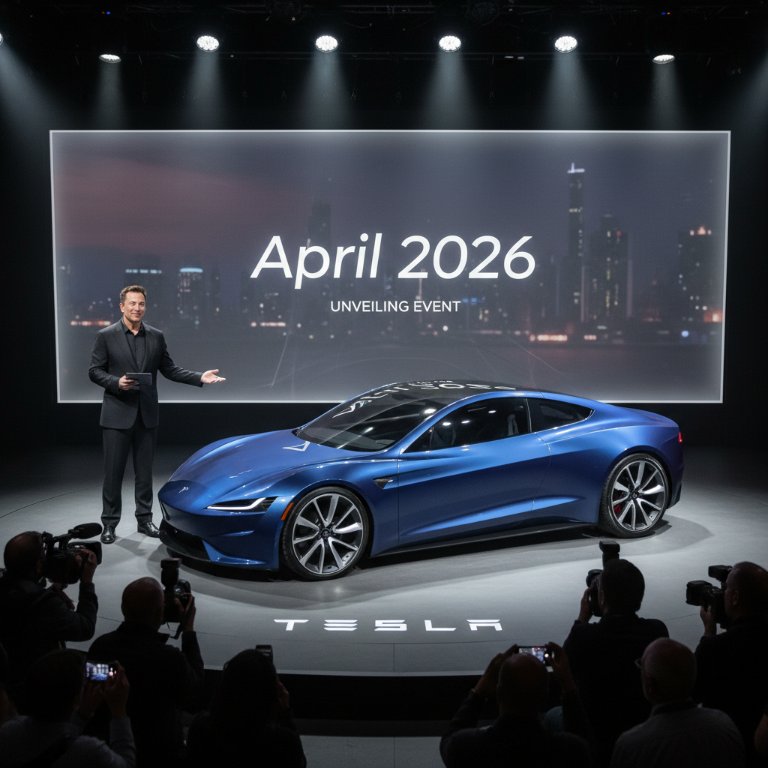
After years of anticipation, speculative leaks, and an almost mythical status, the next-generation Tesla Roadster is finally poised to break cover. Elon Musk has confirmed that the much-awaited electric hypercar will likely be unveiled in late April 2026. This announcement, made via social media, signals a significant step forward for a vehicle first revealed in 2017, promising to redefine performance boundaries in the automotive world.
The Long Road to Production
Musk's revelation puts a definitive timeline on the Roadster's journey from concept to reality. Following the late April 2026 reveal, Tesla projects production to commence approximately 12 to 18 months later. This aggressive schedule targets initial customer deliveries realistically between Q2 and Q4 2027. For many enthusiasts and early reservation holders, this news offers a concrete light at the end of a very long tunnel, where the Roadster has often been considered more a concept than a production vehicle since its initial shocking debut.
When Tesla first unveiled the Roadster in 2017, it sent shockwaves through the industry with audacious claims: 0-60 mph in a blistering 1.9 seconds, a top speed exceeding 250 mph, and an astounding 620 miles of range. These figures, unheard of at the time, cemented the Roadster's position as a vehicle designed not just to compete, but to comprehensively dominate the hypercar segment. The lengthy delay since then has seen the competitive landscape evolve, with other manufacturers also pushing the boundaries of EV performance, but the Roadster's original claims remain a benchmark for extreme electric performance.
Why This Matters:
This impending launch carries immense weight for Tesla and the broader EV market. Firstly, the Roadster serves as a critical halo product, showcasing Tesla's engineering prowess and pushing the boundaries of what's possible with electric propulsion. Successfully delivering on its outrageous performance claims, especially the 0-60 mph time and range, would solidify Tesla's reputation as an innovation leader, silencing critics who have labelled the project 'vaporware.'
Secondly, the Roadster's arrival will ignite fierce competition in the nascent electric hypercar segment. While vehicles like the Rimac Nevera have already set impressive benchmarks, the Roadster's potential combination of performance and a likely more 'mass-produced hypercar' approach (relative to ultra-low volume bespoke models) could disrupt the established order. It will challenge rivals to innovate further and push their own performance envelopes. The 'SpaceX package,' with its hinted rocket thrusters, if materialized, would represent an unprecedented leap in automotive technology and an unparalleled differentiator.
However, Tesla's history of optimistic timelines and production ramp-up challenges cannot be ignored. The Cybertruck's journey from unveil to delivery serves as a recent reminder of potential hurdles. While the 2027 delivery window is promising, prospective buyers and industry watchers will scrutinize every step of the production process. The success of the Roadster will hinge not just on its raw performance, but on Tesla's ability to consistently deliver a premium, high-quality product at scale.
The Roadster’s launch is more than just another vehicle release; it's a statement. It's a testament to the relentless pursuit of electric performance and a pivotal moment for Tesla to prove its long-term vision for extreme mobility. Who wins? Early adopters seeking unparalleled performance, and Tesla's brand, if they execute flawlessly. Who loses? Perhaps traditional hypercar manufacturers struggling to adapt, and those who have grown weary of waiting for the future to arrive.
As the automotive world turns its gaze to late April 2026, the stage is set for the Tesla Roadster to either finally claim its crown as the ultimate electric hypercar or face renewed skepticism if timelines falter. Its impact will undoubtedly ripple through the industry, pushing the boundaries of electric vehicle performance and shaping the future of high-speed mobility.