Tesla Refocuses Incentives: Cash Discounts Recede, FSD (Supervised) Takes Center Stage
Tesla is strategically recalibrating its customer incentive programs, phasing out direct cash discounts on its premium Model S, Model X, and certain C...
Editorial Team
World Of EV
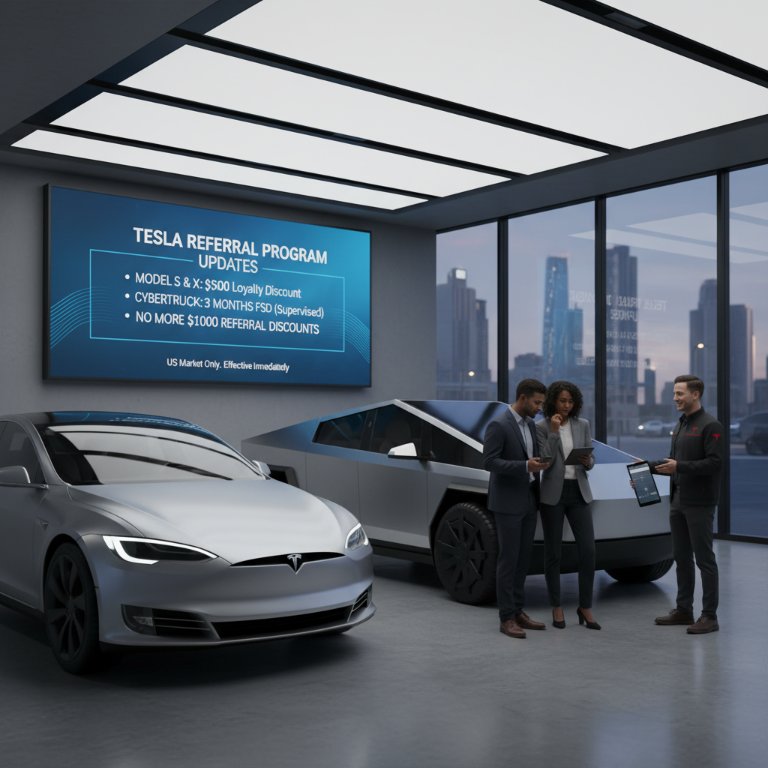
Tesla is strategically recalibrating its customer incentive programs, phasing out direct cash discounts on its premium Model S, Model X, and certain Cybertruck configurations in favor of promoting its advanced autonomous driving software. This significant pivot marks a clear move to optimize profit margins and accelerate the adoption of Full Self-Driving (Supervised).
The changes, impacting both new buyers and existing loyal customers, underscore Tesla's unwavering commitment to making FSD a core value proposition, signaling a potential shift in how the company structures its sales and revenue streams moving forward. This comes as Tesla has faced declining sales for its Model S and Model X, with combined sales for S, X, and Cybertruck only just breaking 50,000 units in 2025, representing a mere 3% of Tesla's total vehicle sales for the year.
Premium Models See Referral and Loyalty Cuts
For its long-standing luxury offerings, the Model S and Model X, Tesla has entirely removed them from the U.S. referral program. This eliminates the previous $1,000 discount for new buyers. Furthermore, existing Tesla owners looking to purchase these models will find their loyalty discount halved, dropping from $1,000 to a more modest $500.
Historically, Tesla's referral program has been a vital part of its customer acquisition strategy, offering various rewards from exclusive merchandise to cash discounts and free Supercharging miles since its launch in 2015.
Cybertruck's Future Tied to Full Self-Driving (Supervised)
The most telling change impacts new Cybertruck buyers opting for the Premium AWD or Cyberbeast configurations. The previous $1,000 referral discount has been replaced with a three-month complimentary subscription to Full Self-Driving (Supervised) for both the referrer and the new buyer. The loyalty discount for Cybertruck purchases, excluding the newer Dual Motor AWD trim, has also been cut to $500.
This move explicitly aims to onboard more users onto Tesla's autonomous driving platform. FSD (Supervised), while not fully autonomous, offers advanced driver-assist features that Tesla is eager for its customers to experience firsthand. By offering it as a referral incentive, Tesla hopes to convert trial users into long-term subscribers, capitalizing on this recurring revenue stream. It's worth noting that Autosteer, a fundamental lane-centering technology, is now exclusively available through the FSD (Supervised) package for Cybertruck owners, effectively pushing users towards the subscription.
Why This Matters:
- Margin Optimization: By reducing direct discounts, especially on its most expensive vehicles like the Model S, Model X, and the top-tier Cybertrucks, Tesla is directly improving its per-vehicle profit margins. This is critical as the company navigates a more competitive EV landscape and looks to maintain profitability amidst global economic uncertainties and declining overall production and deliveries in 2025.
- FSD as a Revenue Driver: The aggressive push for FSD (Supervised) adoption through Cybertruck referrals is a clear declaration of its importance as a future revenue stream. If a significant portion of trial users convert to paid subscribers (at $99/month, or the equivalent yearly cost), it could provide a substantial, high-margin, recurring income source that insulates Tesla from the cyclical nature of hardware sales. This also provides Tesla with invaluable real-world driving data, crucial for refining its autonomous technology.
- Shifting Value Proposition: This move fundamentally changes the value proposition for premium Tesla buyers. Instead of an immediate cash saving, they receive an advanced software experience. This reflects Tesla's confidence in the perceived value and capabilities of FSD (Supervised), even as the system still requires driver supervision. It also highlights the company's belief that software, not just hardware, is a key differentiator in the modern automotive market.
- Who Wins? Who Loses?: Tesla, primarily, stands to win through improved margins and potential FSD revenue. Early Cybertruck adopters get a taste of FSD, which could be a win for those interested in the technology. However, buyers of Model S and Model X, and those Cybertruck buyers who prioritize immediate cash savings over FSD, might see this as a loss of purchasing power. The loyal customer base, previously rewarded generously, now sees reduced benefits.
- Market Signal: This move sends a strong signal to the broader automotive industry: software and autonomous capabilities are becoming increasingly central to vehicle economics. It also demonstrates Tesla's willingness to experiment boldly with its sales strategy to achieve its long-term goals of margin improvement and autonomous driving leadership.
Conclusion:
Tesla's latest recalibration of its referral and loyalty programs marks a definitive shift away from broad cash incentives towards a focused promotion of its Full Self-Driving (Supervised) software. This dual strategy aims to bolster profitability on its premium offerings while simultaneously accelerating the adoption and revenue generation from its autonomous driving technology. As Tesla continues its quest for full autonomy, expect software-centric incentives to play an even more prominent role in its market strategy.