Tesla Puts Lane-Centering Behind FSD Paywall: A North American EV Shift
In a move poised to reshape the standard advanced driver-assist experience for its North American customers, Tesla has significantly altered its offer...
Editorial Team
World Of EV
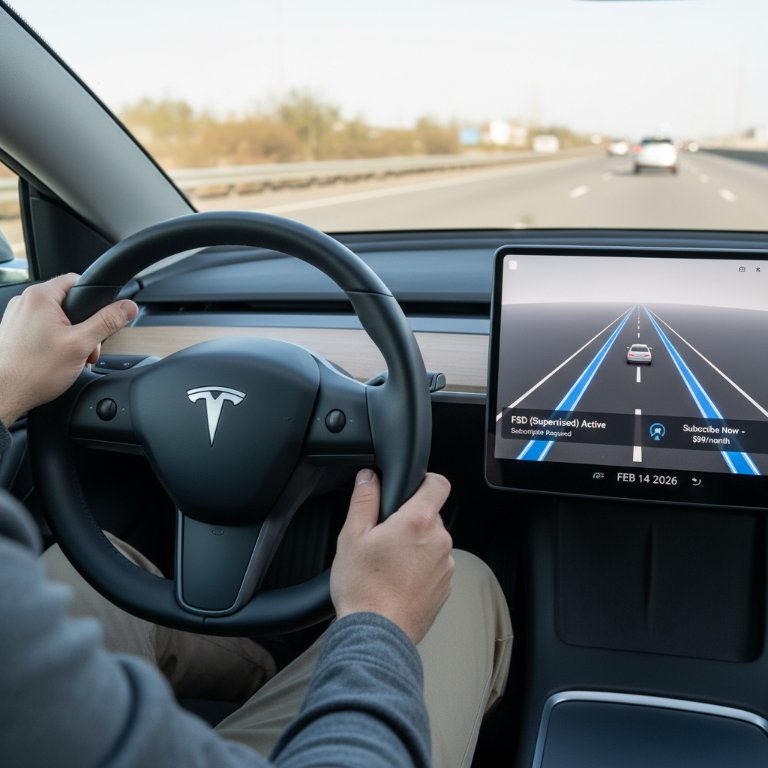
In a move poised to reshape the standard advanced driver-assist experience for its North American customers, Tesla has significantly altered its offering of Autosteer features. Effective February 14, 2026, core lane-centering assist capabilities, previously a standard inclusion, will now require a monthly subscription to the company's Full Self-Driving (Supervised) package. This strategic pivot, impacting new Model 3, Model Y, and Cybertruck deliveries in the U.S. and Canada, aims to bolster recurring revenue from software services.
Tesla’s advanced driver-assistance systems have a storied and often controversial history, with the company consistently pushing the boundaries of what vehicle automation entails. Since the initial release of Autopilot in October 2015, Tesla has offered various levels of assistance, ranging from basic adaptive cruise control and lane-keeping to the ambitious Full Self-Driving (FSD) suite. Standard Autopilot has long included Traffic-Aware Cruise Control and 'Autosteer,' which assists in steering within a clearly marked lane. The FSD package, on the other hand, has promised increasing levels of autonomy, including features like Navigate on Autopilot, automatic lane changes, and recognition of traffic lights and stop signs. However, the journey toward full autonomy has been prolonged, and the branding of 'Full Self-Driving' itself has drawn scrutiny, as the system currently operates at Level 2 automation, requiring constant driver supervision.
The Shift: What's Changing for North American Buyers
The most notable change for prospective Tesla owners in the U.S. and Canada is the removal of active lane-centering assist from the standard Autosteer bundle. This feature, which proactively keeps the vehicle centered within its lane through continuous steering adjustments, has been a cornerstone of Tesla's ADAS experience. Now, customers seeking this functionality will need to subscribe to the Full Self-Driving (Supervised) package for US$99 per month.
- Impacted Vehicles: New Model 3, Model Y, and Cybertrucks delivered in the U.S. and Canada.
- New Requirement: Lane-centering assist will now be exclusive to the FSD (Supervised) subscription.
- Effective Date: February 14, 2026.
End of the Upfront FSD Purchase and What Remains Standard
Coinciding with this change, Tesla has also eliminated the option to purchase the Full Self-Driving package as a one-time payment of US$8,000. This move solidifies Tesla's push towards a subscription-only model for its most advanced software features, aligning with its stated goal to boost recurring income. Historically, the price of FSD has fluctuated significantly, reaching as high as $15,000 in the U.S. and $19,500 in Canada before being cut to $8,000 (US) and $11,000 (CAD) in April 2024. The monthly subscription itself was also previously higher, at $199/month, before being reduced to its current $99/month.
While lane-centering assist is moving behind the FSD paywall, several critical safety and convenience features will remain standard on all new Teslas in North America, ensuring a baseline of advanced driver assistance. These include:
- Adaptive cruise control
- Autonomous emergency braking
- Lane-keeping assist
- Blind-spot monitoring
- Speed sign recognition
It is crucial to understand the distinction: lane-keeping assist provides corrective steering input if the vehicle begins to drift out of its lane. Lane-centering assist, however, actively and continuously keeps the vehicle in the middle of the lane, working in tandem with adaptive cruise control to offer a more hands-on driving experience. This redefinition of 'standard' means North American buyers will now pay a monthly fee for a feature many have come to expect as part of a premium EV experience.
Why This Matters:
Who Wins? Clearly, Tesla's financial division wins. The pivot to a subscription-only model for key ADAS features like lane-centering translates directly into predictable, recurring revenue, a highly valued metric in the financial markets. This strategy mirrors trends seen in other tech sectors and aims to unlock a new, consistent income stream, especially as vehicle hardware margins might face pressure. For existing FSD subscribers, their investment might feel more validated as previously standard features now require the premium package.
Who Loses? The immediate losers are new North American Tesla buyers. What was once a standard, expected convenience feature – the proactive lane-centering that makes highway driving significantly less fatiguing – now comes at an additional monthly cost. This could lead to a perception of 'nickel-and-diming' customers, potentially eroding goodwill and impacting brand loyalty. Buyers who had budgeted for a Tesla with a certain level of ADAS functionality might now find their expected experience diminished without an ongoing subscription.
What This Signals to the Market: Tesla is doubling down on its software-as-a-service (SaaS) model. This move sends a powerful signal to the broader automotive industry: software, and especially recurring software revenue, is the next frontier for profitability. Expect other OEMs, many of whom already offer subscription-based features, to observe Tesla's success (or backlash) closely and potentially adjust their own strategies. This could accelerate a broader industry trend where previously included features become optional, paid subscriptions, transforming the economics of car ownership. It also underscores Tesla's continued reliance on its software stack as a primary differentiator and revenue generator, even amidst ongoing challenges to achieve full autonomy.
Conclusion:
Tesla's decision to shift lane-centering assist into the FSD (Supervised) subscription in North America marks a pivotal moment for both the company and the EV market. While it promises a significant boost to Tesla's recurring revenue, it redefines the standard ADAS experience for new buyers. As this change takes effect, the industry will be watching intently to see how consumers react and whether this aggressive monetization strategy ultimately strengthens Tesla's position or pushes prospective buyers toward competitors offering more inclusive standard packages.