Tesla Pivots High-End EV Production to Chase Million-Unit Optimus Robot Dream
Tesla, long the vanguard of the electric vehicle revolution, has signaled a dramatic strategic pivot, announcing the imminent debut of its third-gener...
Editorial Team
World Of EV
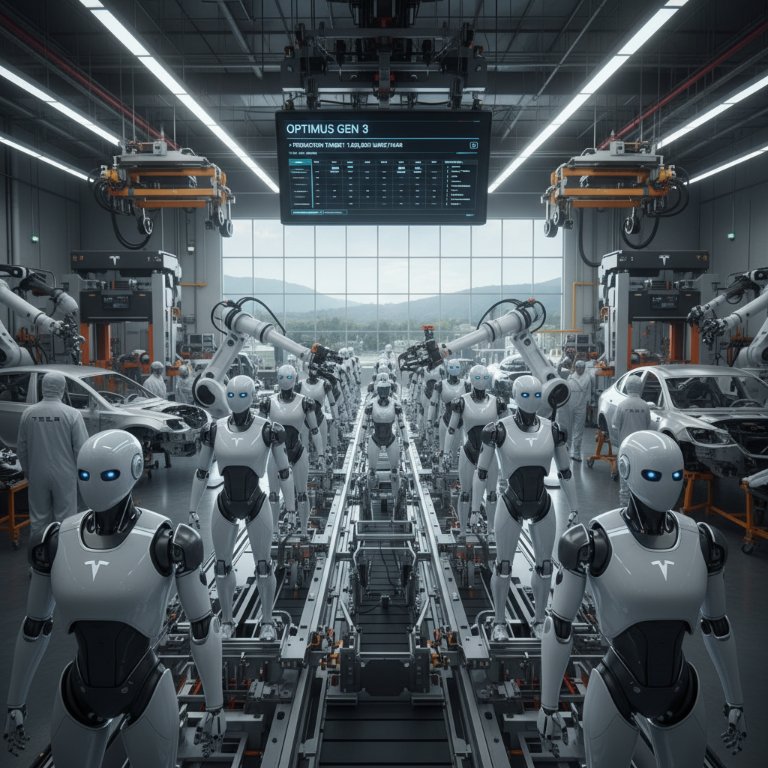
Tesla, long the vanguard of the electric vehicle revolution, has signaled a dramatic strategic pivot, announcing the imminent debut of its third-generation Optimus humanoid robot and an audacious plan to scale annual production to an astounding one million units. This isn't merely an expansion; it's a fundamental reorientation of manufacturing priorities, as the company has already begun re-tooling its iconic Fremont, California, factory to dedicate Model S and Model X vehicle lines exclusively to humanoid robot manufacturing. Mass production is slated to commence before the end of 2026, signaling a profound redirection of some of its most established high-end vehicle capacity towards a future dominated by advanced robotics.
The Third-Generation Optimus Arrives
After years of development and multiple iterations, including early prototypes that garnered both excitement and skepticism (famously featuring a human in a robot suit at its initial unveiling), Tesla is pushing forward with a sophisticated third-generation Optimus. The million-unit annual production target is an aggressive statement of intent, far surpassing current capacities for even some of the most popular consumer electronics, let alone complex bipedal robots. This ambitious goal underscores CEO Elon Musk's long-held vision of a future where humanoid robots tackle mundane, dangerous, or repetitive tasks, thereby alleviating labor shortages and fundamentally reshaping global economies.
Fremont's Radical Re-tooling
The decision to convert existing Model S and Model X production lines at Fremont is arguably the most telling aspect of this announcement. These are not merely secondary facilities; the Model S, in particular, was Tesla's flagship, demonstrating its ability to compete with luxury internal combustion engine vehicles. Diverting these established, high-volume EV lines signifies a deep commitment to Optimus. It suggests that Tesla sees the immediate future of its manufacturing prowess, and perhaps its greatest untapped market potential, lying squarely in robotics rather than solely in additional EV expansion at this particular site. This move could also hint at a strategic re-evaluation of demand or profitability within Tesla's highest-priced vehicle segments, or simply a belief that the robotics market dwarfs even the most optimistic projections for premium EVs.
Production Timeline and Ambition
The target for mass production to begin before the end of 2026 is exceptionally aggressive for a product of this complexity and scale. It implies that the third-generation Optimus is not only nearing design finalization but that the manufacturing processes themselves are already well-advanced. Such a rapid timeline suggests Tesla is leveraging its experience in highly automated vehicle production, aiming to replicate and even exceed the efficiencies it achieved with its Gigafactories for automotive assembly. The successful execution of this timeline would position Tesla as a formidable force in a burgeoning, but still largely theoretical, humanoid robotics market.
Why This Matters:
This announcement is far more than just news; it's a seismic tremor within both the automotive and technological landscapes. It represents a profound shift that could redefine Tesla's identity and have far-reaching implications for investors, competitors, and the future of labor itself.
Tesla's Strategic Reorientation: This is a clear signal that Tesla views itself less as an automotive company and more as an AI and robotics powerhouse. For an automotive journalist, it forces a re-evaluation of how we categorize and analyze the company. Is Tesla betting its future on a vision of universal basic income supported by robot labor more than on iterative EV improvements? It certainly appears to be the case. The diversion of premium EV lines suggests a deep commitment, possibly at the expense of future Model S/X volume or development.
Implications for the EV Market: While Tesla’s other Gigafactories continue to churn out Model 3, Y, and Cybertrucks, the re-purposing of Fremont's Model S and X lines raises questions about the long-term strategy for these luxury EVs. Does this signal a ceiling for high-end EV demand, or simply a prioritization of resources where Tesla sees greater, uncaptured market value? Competitors like Lucid and Mercedes-Benz, who also target the premium EV segment, might see this as an opportunity to gain market share, or perhaps a warning sign of a more fundamental shift away from pure automotive dominance.
The Robot Revolution – Real or Hype?: Skepticism around humanoid robots has been persistent, but Tesla's aggressive production targets challenge that narrative. If Tesla can deliver on its promises for a million units annually, the impact on manufacturing, logistics, and and even domestic life could be transformative. The initial 'wins' will likely be in highly structured environments like factories and warehouses, potentially displacing human labor in those sectors first. For consumers, the impact is less immediate but profound: a successful Optimus could lead to widespread automation, fundamentally altering employment landscapes.
Competitive Landscape: This move pits Tesla directly against established industrial robotics firms like Boston Dynamics (owned by Hyundai), Agility Robotics, and even tech giants like Google (with its AI/robotics research). Tesla's advantage lies in its vertically integrated approach, combining advanced AI, custom hardware, and large-scale manufacturing expertise. However, the reliability, dexterity, and cost-effectiveness of Optimus in real-world unstructured environments remain unproven at scale, presenting a massive challenge.
Tesla's audacious leap into mass humanoid robot production marks a pivotal moment, not just for the company, but for the future of technology and labor. By reallocating core EV manufacturing capacity, Tesla is making a clear statement: the future, as they see it, is less about driving electric cars and more about a world populated and served by intelligent machines. The success or failure of Optimus will undoubtedly define Tesla's legacy in the coming decade and dictate the pace of the global robotics revolution.