Tesla Mandates FSD Subscription: The End of Outright Ownership for Most
Tesla officially ended the outright purchase option for its Full Self-Driving (FSD) software on February 14, 2026, marking a significant shift in its ...
Editorial Team
World Of EV
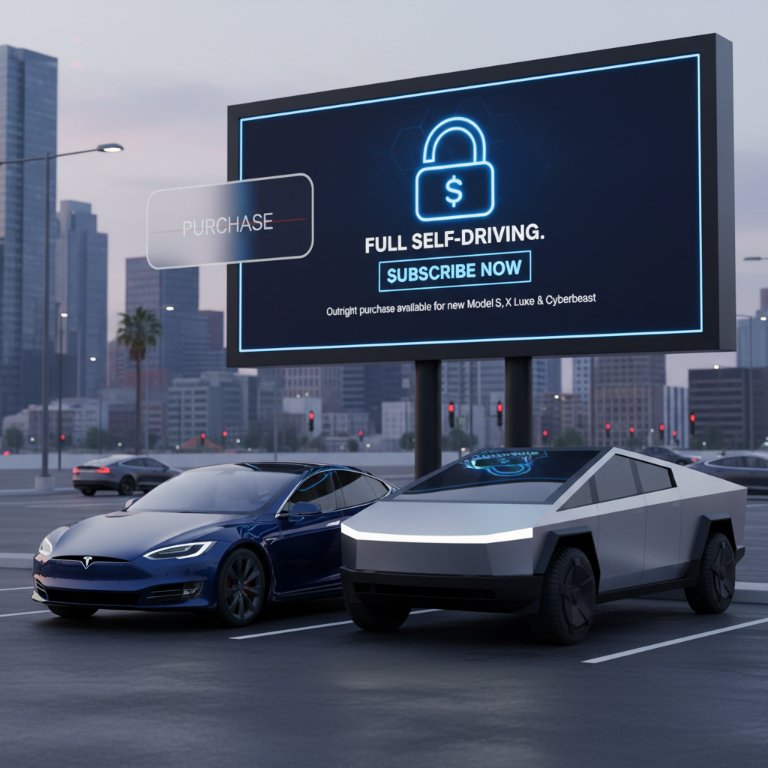
Tesla officially ended the outright purchase option for its Full Self-Driving (FSD) software on February 14, 2026, marking a significant shift in its monetization strategy. The move transitions FSD primarily to a $99 per month subscription model, fundamentally altering how most consumers will access Tesla's most advanced driver-assistance features.
This decision comes after years of a fluctuating pricing strategy and the ongoing development of a system that, despite its 'Full Self-Driving' moniker, still requires active driver supervision. For many prospective buyers and current owners, the change redefines the value proposition of Tesla's autonomous ambitions.
The FSD Subscription Mandate Arrives
Effective February 14, Tesla's Full Self-Driving (Supervised) software is predominantly available through a monthly subscription of $99. This means new Model 3 and Model Y buyers, as well as existing owners without FSD, must now opt for the recurring monthly payment to access features like Navigate on Autopilot, automatic lane changes, Autopark, Summon, and Traffic Light and Stop Sign Control.
However, the outright purchase option isn't entirely gone. Tesla continues to offer FSD as part of a premium 'Luxe Package' when purchasing new Model S, Model X, and the top-tier Cyberbeast variant of the Cybertruck. This bundled package for these higher-end vehicles also includes benefits such as free lifetime Supercharging, premium in-car connectivity, and an extended four-year premium service package. It's important to note that FSD obtained through the Luxe Package is non-transferable to subsequent owners or other vehicles.
A Look Back: The Road to Subscription
Tesla's FSD journey has been anything but linear, characterized by bold promises and evolving pricing. Initially positioned as an 'appreciating asset' that would dramatically increase a vehicle's value, the outright purchase price of FSD has seen a turbulent history, ranging from an early $5,000 to a peak of $15,000 in late 2022. Most recently, before its discontinuation, the one-time purchase option stood at $8,000 in the U.S. and C$11,000 in Canada.
For years, enthusiasts debated the financial wisdom of an outright purchase, especially as the software remained in 'beta' and regulatory approval for true unsupervised driving lagged behind Elon Musk's ambitious timelines. The subscription option itself was only introduced in July 2021 at $199/month, later reduced to $99/month in April 2024 for all users. This recent subscription price cut made the financial break-even point for an $8,000 outright purchase extend to nearly seven years, questioning the long-term value for many owners who typically cycle through vehicles more frequently.
Why This Matters:
For Tesla: The move to a subscription-first model promises more predictable, recurring revenue, an attractive prospect for investors. It de-risks the significant ongoing development costs of FSD by spreading them across a larger, more consistent revenue stream. This strategy could also lower the immediate barrier to entry for more customers to experience FSD, potentially boosting adoption rates, even if long-term costs accumulate. However, it also detaches FSD from the original narrative of a permanently purchased, appreciating asset, which might disappoint early adopters who invested heavily upfront.
For Consumers: The $99/month subscription offers flexibility. Drivers can activate FSD for specific periods (e.g., a long road trip) and cancel when not needed, avoiding a hefty upfront payment. However, for those who keep their vehicles for many years, the cumulative cost of a subscription will eventually surpass the former outright purchase price. For instance, at $99/month, the cost approaches the $8,000 former purchase price after nearly 6.75 years. The non-transferable nature of FSD in the Luxe Package further impacts resale value, as the feature will not carry over to a new owner.
For the Industry: Tesla, as a leader in EV and autonomy development, sets a potent precedent. Other automakers, some already experimenting with subscription features (like heated seats or advanced safety features), will closely watch the success of this FSD monetization model. It signals a future where advanced vehicle features are increasingly treated as software services rather than one-time purchases, potentially transforming the economics of car ownership across the board.
Conclusion
Tesla's pivot to a predominantly subscription-based model for Full Self-Driving marks the end of an era for outright FSD ownership for most customers. This strategic realignment aims to stabilize revenue and broaden accessibility, yet it forces a re-evaluation of FSD's long-term value proposition for consumers. As Tesla continues to refine its autonomous technology, the success of this subscription mandate will undoubtedly influence the trajectory of software-defined vehicles and their monetization strategies across the entire automotive landscape.