Tesla FSD's Sunshine Setback: Hardware Limitations Threaten Autonomy Dream
Tesla's Full Self-Driving (FSD) system, specifically version 14.2.2.4, recently encountered a significant hurdle when it failed to operate reliably wh...
Editorial Team
World Of EV
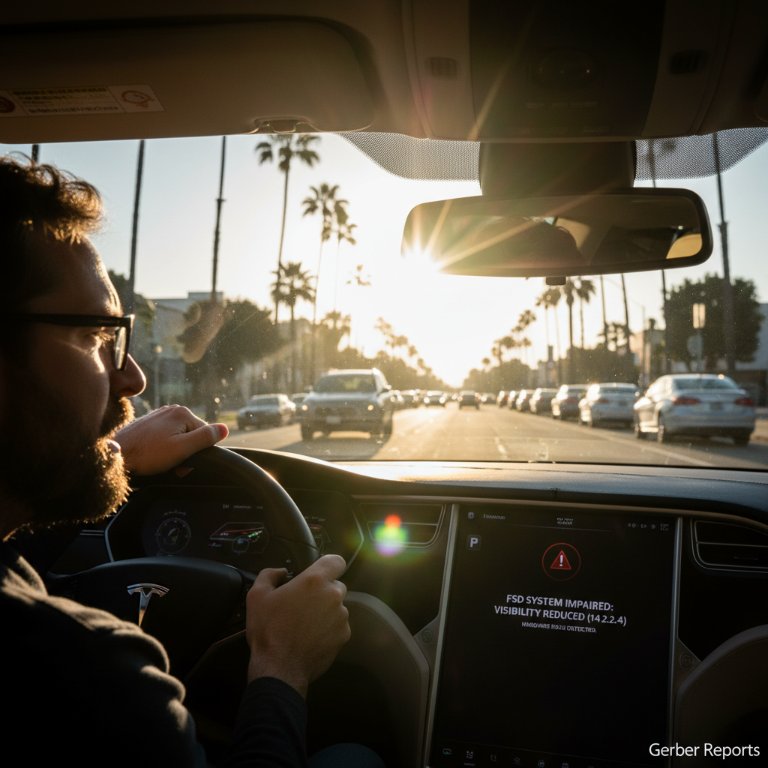
Tesla's Full Self-Driving (FSD) system, specifically version 14.2.2.4, recently encountered a significant hurdle when it failed to operate reliably while driving directly into sunlight in West Los Angeles. Prominent investor Ross Gerber, an influential voice often critical of Tesla's autonomous driving progress, reported the incident on X, suggesting a fundamental hardware-related issue is at play. This event casts a shadow on the company's long-standing vision-only approach to achieving true autonomy and highlights persistent challenges in its ambitious FSD rollout.
For years, Tesla has championed a camera-centric strategy for its FSD system, asserting that human drivers rely primarily on vision, and thus, an advanced neural network processing camera data should suffice for autonomous driving. This approach stands in stark contrast to most competitors, such as Waymo, which integrate a comprehensive suite of sensors including LiDAR and radar to build a more robust environmental perception. Tesla notably removed radar from its vehicles starting in 2021 and ultrasonic sensors in 2022, doubling down on its 'Tesla Vision' system.
The Direct Sunlight Dilemma
Gerber's experience involved the FSD system failing and issuing an "Autopilot Visibility Limited" warning, citing a "Front camera blocked or blinded" error. He explicitly stated the issue was not due to dirt or debris, but rather direct sunlight interfering with the system's sensors. This isn't an isolated incident; reports of FSD struggling in adverse conditions like heavy rain or direct sunlight have surfaced previously. Humans compensate for bright sunlight with visors and sunglasses, but current vision-only systems lack these adaptive capabilities, making such scenarios significant edge cases they struggle to handle safely.
Hardware's Role in Autonomy
Gerber's assertion that this is a hardware limitation is particularly critical. Tesla has iterated through several hardware versions (HW1, HW2.x, HW3, and currently HW4), with each generation promising enhanced capabilities for FSD. While HW4, introduced in 2023, boasts higher-resolution cameras, wider fields of view, and significantly more processing power, the issue reported by Gerber pertains to FSD v14.2.2.4, which is rolling out to vehicles including those with HW4. This suggests that even the latest hardware might not fully overcome fundamental optical challenges in certain lighting conditions, raising questions about the inherent limitations of a purely vision-based system.
Why This Matters:
Challenges Tesla's Vision-Only Stance: The recurring struggles with common environmental factors like direct sunlight (and rain, as also noted by Gerber) underscore the ongoing debate about the efficacy of a purely vision-based system for achieving Level 4 or Level 5 autonomy. Competitors employing multi-sensor suites (cameras, radar, LiDAR) often cite redundancy and performance in varied conditions as key advantages.
Consumer Trust and Expectations: Tesla has marketed FSD with ambitious timelines and promises of full autonomy, leading many customers to pay significant sums ($12,000-$15,000 or a monthly subscription) for the feature. Persistent limitations, especially those attributed to hardware, erode consumer confidence and fuel frustration over delayed delivery of promised capabilities. Historically, Elon Musk has even admitted that HW3 computers were not powerful enough for unsupervised operation, necessitating replacements for FSD buyers, a process he called "painful and difficult."
Regulatory Scrutiny: Safety concerns around autonomous driving systems are under intense scrutiny from regulators worldwide. Incidents where FSD struggles with basic driving conditions could lead to increased regulatory pressure and potentially hinder widespread deployment or even necessitate re-evaluations of system safety.
Competitive Landscape Shift: If hardware limitations prove systemic, it could signal a win for companies pursuing a more sensor-rich approach to autonomy. It may also force Tesla to re-evaluate its hardware strategy, potentially leading to costly retrofits or the integration of additional sensor types—a move that would contradict its long-held philosophy.
Conclusion:
Ross Gerber's recent experience with Tesla FSD v14.2.2.4 exposes a persistent Achilles' heel in Tesla's autonomous driving system: its vulnerability to direct sunlight, potentially rooted in hardware. This incident is not just a minor bug; it's a stark reminder that even with sophisticated AI, the physical limitations of sensors in real-world driving conditions can severely impede the path to true self-driving. For Tesla, consistently overcoming these environmental challenges is paramount to fulfilling its FSD promise, regaining full customer trust, and cementing its leadership in the autonomous vehicle race.