Tesla FSD (Supervised) Poised for European Rollout as RDW Greenlights Final Testing Phase
In a significant development for the autonomous driving landscape in Europe, Tesla Europe has confirmed the successful completion of the final vehicle...
Editorial Team
World Of EV
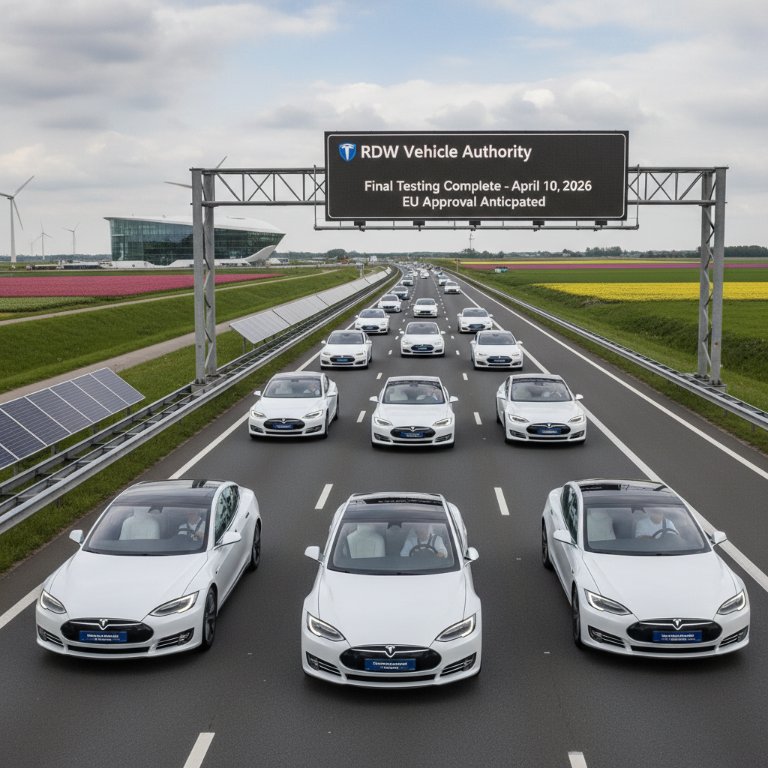
In a significant development for the autonomous driving landscape in Europe, Tesla Europe has confirmed the successful completion of the final vehicle testing phase for its Full Self-Driving (Supervised) technology. This crucial milestone was achieved in close collaboration with the Dutch vehicle authority, RDW, signaling a major step towards widespread availability across the continent.
After years of iterative development and rigorous testing in North America, bringing FSD (Supervised) to the complex and diverse regulatory environment of Europe has been a formidable challenge. This announcement marks a critical juncture, as Tesla officially submitted all necessary documentation for UN R-171 approval and crucial Article 39 exemptions. These regulatory hurdles are paramount for any advanced driver-assistance system seeking legal operation within the European Union, making this submission a tangible sign of progress.
Navigating the Regulatory Labyrinth
The path to autonomous vehicle deployment in Europe is paved with stringent regulations and varying national interpretations. The RDW's involvement as a leading vehicle authority is particularly noteworthy, given its influence and expertise in automotive safety and compliance. UN R-171 pertains to specific requirements for advanced driver assistance systems, while Article 39 exemptions are often critical for allowing innovative technologies to operate within existing frameworks, acknowledging their unique characteristics while ensuring safety.
- Collaboration with RDW: The Dutch authority's rigorous oversight ensures FSD (Supervised) meets European safety and performance benchmarks.
- Documentation Submitted: All papers for UN R-171 approval and Article 39 exemptions are now with the relevant bodies, a clear indication of readiness.
- Anticipated Dutch Approval: The Netherlands is expected to grant approval by April 10, 2026, a slight adjustment from the initial March 20 target. This minor delay is typical for such complex regulatory processes and doesn't diminish the achievement.
- EU-Wide Horizon: Following Dutch approval, the system's potential for EU-wide availability looms large, with industry analysts predicting approval across the Union possibly during summer 2026.
Why This Matters:
This announcement is not merely a procedural update; it represents a profound strategic victory for Tesla and a potential paradigm shift for European automotive technology. For years, Tesla's advanced driver-assistance capabilities have been limited in Europe compared to their North American counterparts, largely due to the continent's distinct regulatory environment. This successful testing phase and submission of documentation validate Tesla's persistent efforts to adapt and prove its technology within these parameters. It unequivocally positions Tesla at the forefront of autonomous development in Europe, challenging established players and signaling a significant expansion of its software-driven revenue streams.
For European consumers, this breakthrough means the imminent arrival of a highly anticipated, advanced driving experience. While labelled 'Supervised,' FSD offers capabilities far beyond conventional Level 2 ADAS, promising enhanced safety features and a more relaxed driving experience on compatible roads. For competing automakers like Mercedes-Benz, which has already secured Level 3 Drive Pilot approval in some regions, and others like BMW and Volkswagen investing heavily in their own autonomous solutions, Tesla's progress serves as a potent competitive catalyst. It will undoubtedly accelerate their timelines and strategies, pushing the entire industry towards more sophisticated and capable autonomous systems. This isn't a 'do-or-die' moment for Tesla, but it's a monumental validation, solidifying its technological leadership and potentially unlocking a substantial new market for its subscription services and future innovations.
The successful navigation of European regulatory hurdles by Tesla's FSD (Supervised) system marks a pivotal moment for the evolution of autonomous driving. With Dutch approval on the horizon and EU-wide deployment anticipated for summer 2026, European roads are on the cusp of experiencing a new era of advanced vehicle intelligence. This development not only bolsters Tesla's position but also accelerates the wider industry's drive towards a more autonomous future.