Tesla and SpaceX Unleash 'Terafab' Alliance: A Bold Bid for AI Chip Supremacy
In a strategic maneuver that redefines vertical integration in the tech world, Tesla and SpaceX have formally embarked on a collaborative 'Terafab' pr...
Editorial Team
World Of EV
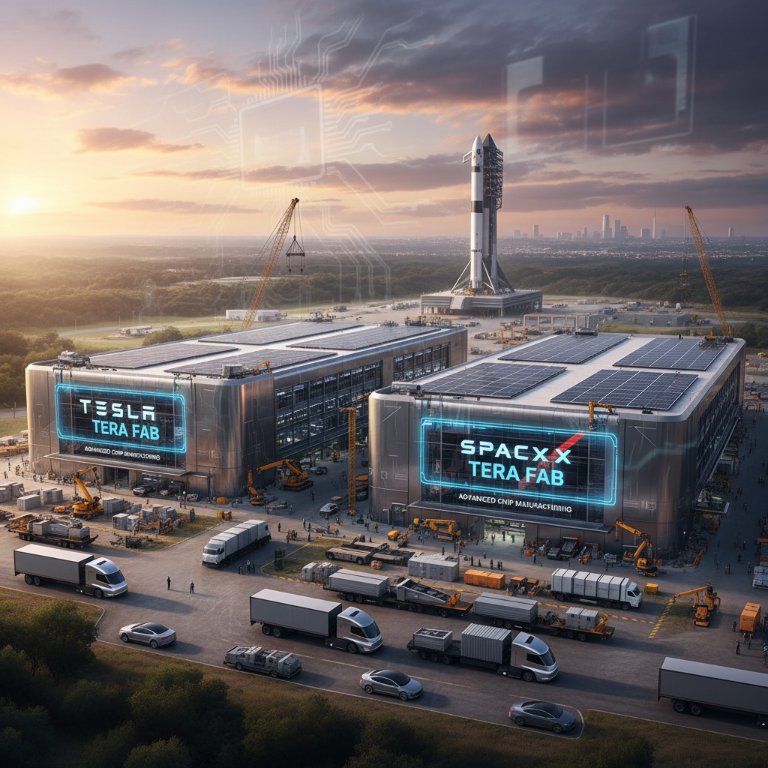
In a strategic maneuver that redefines vertical integration in the tech world, Tesla and SpaceX have formally embarked on a collaborative 'Terafab' project, establishing two state-of-the-art chip factories in Austin, Texas. This ambitious undertaking aims to secure the foundational silicon required for Tesla’s burgeoning ecosystem, from its next-generation electric vehicles and the anticipated Optimus robots to xAI’s groundbreaking AI data centers, poised for deployment in space. The move signals a critical step to not only alleviate immediate chip supply constraints but to fundamentally control the future of its AI ambitions, especially as Tesla’s AI training compute requirements are projected to more than double in the first half of 2026.
This isn't Tesla's first foray into chip design, with its highly successful D1 and HW3/4 chips already powering its FSD capabilities. However, the Terafab initiative represents a colossal leap from design to full-scale manufacturing, directly challenging the conventional reliance on third-party foundries that have historically dictated the pace of innovation and scalability for even the largest tech companies. It’s a bold declaration of independence in the silicon supply chain, echoing Elon Musk's long-held philosophy of end-to-end control.
The Terafab Vision: Building the Brains of Tomorrow
The 'Terafab' project isn't merely about producing chips; it's about engineering a self-sufficient pipeline for the most critical components of a rapidly expanding AI-driven empire. The two Austin-based factories are designed for:
- Securing Tesla's Automotive Future: Ensuring a dedicated supply of advanced semiconductors for upcoming vehicle platforms, enhancing features like Full Self-Driving (FSD) and power management, unburdened by external market fluctuations.
- Empowering Optimus Robotics: Providing the necessary processing power for the complex AI and real-world intelligence required by Tesla's humanoid robots, a critical component for their mass production and deployment.
- Fueling xAI's Cosmic Ambitions: Supplying the specialized chips vital for xAI's advanced AI data centers, including those destined for space, underscoring the intergalactic scope of this collaboration and its implications for distributed AI compute.
This integrated approach directly addresses the vulnerabilities exposed during global supply chain disruptions, where even minor component shortages could halt entire production lines. By vertically integrating chip manufacturing, Tesla aims to gain unparalleled control over design, production, and cost, accelerating its innovation cycles.
Why This Matters:
This Terafab alliance between Tesla and SpaceX is far more than a simple factory announcement; it’s a seismic shift with profound implications across multiple industries.
- Tesla's Unrivaled Control: Tesla gains unprecedented control over its destiny. It bypasses potential bottlenecks from external foundries, ensuring a consistent and optimized supply of custom silicon for its vehicles, robots, and AI operations. This level of vertical integration is almost unheard of among automotive manufacturers and positions Tesla as a true technology giant, rather than solely an automaker. This move solidifies Tesla's ability to rapidly iterate and scale its AI hardware, crucial for maintaining its lead in autonomous driving and robotics.
- A New Benchmark for EV and AI Industries: The Terafab project sets a daunting new standard for competitors. While many struggle with basic EV production and sourcing, Tesla is investing billions to control the very bedrock of future technology. Companies heavily reliant on external chip suppliers will face increased pressure to either innovate at an accelerated pace or risk falling further behind Tesla's self-sufficient ecosystem.
- xAI's Accelerated Trajectory: The collaboration is a direct accelerator for xAI's ambitious goals. Dedicated, optimized chips manufactured in-house provide a distinct advantage for developing and deploying cutting-edge AI, especially for resource-intensive applications like those envisioned for space-based data centers. This could significantly de-risk xAI's aggressive timeline for AI development and deployment.
- Market Signal of Self-Reliance: This isn't merely a tactical response to current chip shortages; it's a strategic declaration of intent for the long term. Tesla is signaling to the market that it intends to be a fully integrated technology conglomerate, controlling every critical aspect of its product stack. For external chip manufacturers like NVIDIA or AMD, while Tesla may still be a customer for some general-purpose chips, this move highlights the risk of losing high-value, custom silicon contracts to internal production. It underscores a growing trend where tech giants are increasingly taking chip design and manufacturing in-house. This is a do-or-die moment for Tesla's AI ambitions, as its future hinges on securing an almost unimaginable scale of compute, and relying on external players for that vital resource is simply not a viable long-term strategy.
The Terafab project represents a pivotal moment for Tesla and SpaceX, cementing their commitment to an integrated future where they control not just the software and hardware, but the very silicon that powers their revolutionary ambitions. This unprecedented collaboration is poised to accelerate advancements across electric vehicles, robotics, and artificial intelligence, potentially reshaping the competitive landscape for decades to come. The industry will be watching closely as Austin becomes the epicenter of this new era of silicon autonomy.