Tesla Accelerates AI Dominance with Cortex 2: FSD's Global Expansion Kicks Off in Japan
Tesla is doubling down on its ambitious AI future, with CEO Elon Musk confirming significant progress on Cortex 2, the company's next-generation AI su...
Editorial Team
World Of EV
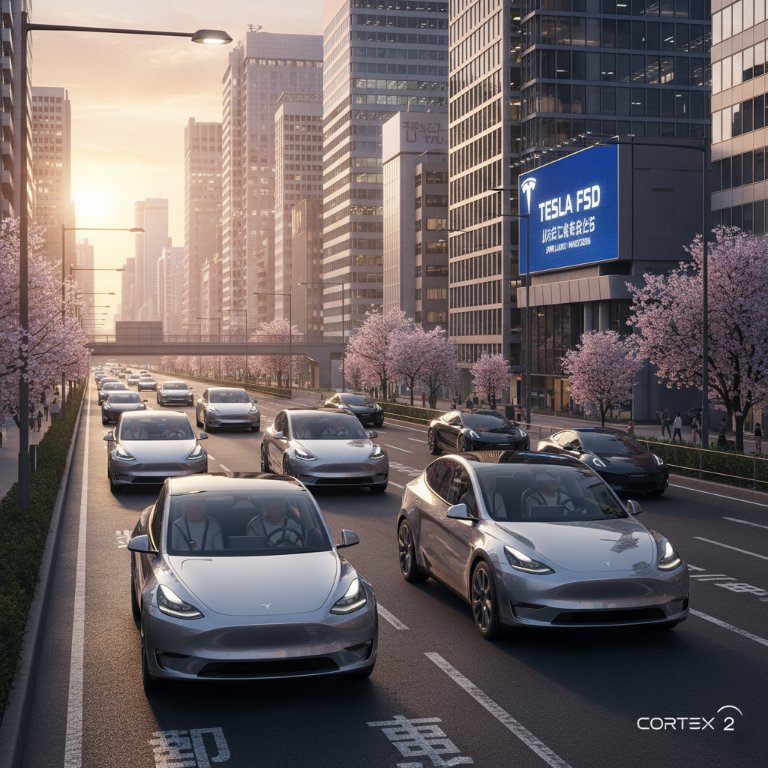
Tesla is doubling down on its ambitious AI future, with CEO Elon Musk confirming significant progress on Cortex 2, the company's next-generation AI supercomputing cluster at Giga Texas. This infrastructure build-out is not just an incremental step; it's a foundational leap designed to power the expansive visions of Full Self-Driving (FSD), the much-anticipated Robotaxi network, and the Optimus humanoid robot. Concurrently, Tesla's global FSD ambitions are taking concrete form, with public road testing for its FSD system, utilizing a right-hand drive Model Y, commencing in Japan in March 2026. This dual thrust – a massive computational backend coupled with strategic market entry – signals an unprecedented acceleration in Tesla's quest for autonomous and AI-driven leadership.
The Brains Behind Autonomy: Cortex 2's Unleashed Potential
Tesla's commitment to vertical integration extends far beyond vehicle manufacturing, deeply into the realm of artificial intelligence. Cortex 2, the latest iteration of Tesla's AI supercomputing cluster, represents an enormous investment in raw computational power. This isn't merely about faster processing; it's about providing the neural network training capacity required for true artificial general intelligence (AGI) in mobility and robotics.
- Massive Scale: Cortex 2 is engineered to process petabytes of real-world driving data from Tesla's global fleet, learning and refining the FSD software at an exponential rate.
- Foundation for Future Products: Beyond FSD, this supercomputing backbone is absolutely critical for the development and deployment of the Robotaxi service, which requires flawless autonomous operation, and the Optimus humanoid robot, demanding advanced perception, decision-making, and motor control.
- Strategic Giga Texas Hub: Locating Cortex 2 at Giga Texas reinforces the facility as Tesla's central hub for both advanced manufacturing and groundbreaking AI development.
FSD's Global Push: Japan Opens a Critical New Front
While FSD (Supervised) has seen extensive deployment across key Western and Asian markets, its entry into Japan marks a significant milestone. The initiation of public road testing for FSD using a right-hand drive Model Y in March 2026 demonstrates Tesla's adaptability and commitment to conquering diverse regulatory and driving environments.
- Key Markets Already Active: FSD (Supervised) is currently available in the U.S., Canada, Mexico, China, Australia, New Zealand, and South Korea.
- Targeting 40,000 Vehicles: Tesla aims to serve approximately 40,000 existing Tesla vehicles in the Japanese market, pending local certification. This considerable installed base presents a strong immediate opportunity.
- Right-Hand Drive Adaptation: The specific deployment of a right-hand drive Model Y for testing underscores the engineering effort required to adapt FSD's perception and planning systems to left-hand traffic rules and unique road infrastructure prevalent in countries like Japan, Australia, and the UK.
Why This Matters:
Accelerating the AI Race: Cortex 2 unequivocally signals Tesla's intent to maintain, and even widen, its lead in automotive AI. While competitors are developing their own autonomous systems, few possess the integrated hardware, software, and massive data collection capabilities that Tesla leverages. This supercomputing power means faster iteration, quicker bug fixes, and ultimately, a more robust FSD system. Those who lack this foundational AI investment will find themselves increasingly behind the curve.
De-risking Robotaxi and Optimus: The success of Robotaxi and Optimus hinges entirely on the sophistication of Tesla's AI. Cortex 2 is the engine that will make these ambitious projects viable. By accelerating FSD development through enhanced compute, Tesla is simultaneously de-risking its long-term vision and potential revenue streams beyond traditional car sales. The market is watching closely to see if these "moonshot" projects can transition from concept to widespread reality.
A Strategic Beachhead in Japan: Japan is a notoriously challenging market for foreign automakers, known for its stringent regulations, unique driving culture, and highly competitive domestic brands. Tesla's dedicated FSD testing and targeted rollout for 40,000 vehicles in Japan is not merely about sales; it's about proving FSD's adaptability and reliability in one of the world's most complex driving environments. Success here could unlock doors to other significant right-hand drive markets, validating FSD as a truly global solution. Conversely, any significant setbacks in Japan could cast a shadow on Tesla's claims of universal FSD capability.
Impact for the Consumer: For Tesla owners in Japan, this development means access to cutting-edge autonomous features, potentially enhancing safety and convenience, once certified. For the broader EV enthusiast, it signifies that the long-promised future of full autonomy is inching closer, albeit with continued regulatory hurdles to clear. This also puts pressure on other automakers to accelerate their own ADAS (Advanced Driver-Assistance Systems) development, benefiting consumers across the board with increasingly capable and safer vehicles.
Tesla's parallel advancements in AI supercomputing with Cortex 2 and the methodical expansion of FSD into critical markets like Japan underscore a singular, unwavering vision: to lead the world into an era of autonomous and AI-driven mobility. The road to true autonomy is complex and fraught with challenges, but with this latest push, Tesla is not just building cars; it's building the intelligence that it believes will redefine transportation and robotics for decades to come.