Solid-State Game Changer: Factorial's 745-Mile EQS Shatters EV Range Barriers, Targets 2027 Market Entry
For years, the promise of solid-state batteries has dangled like a futuristic carrot before the electric vehicle industry, perpetually 'five years awa...
Editorial Team
World Of EV
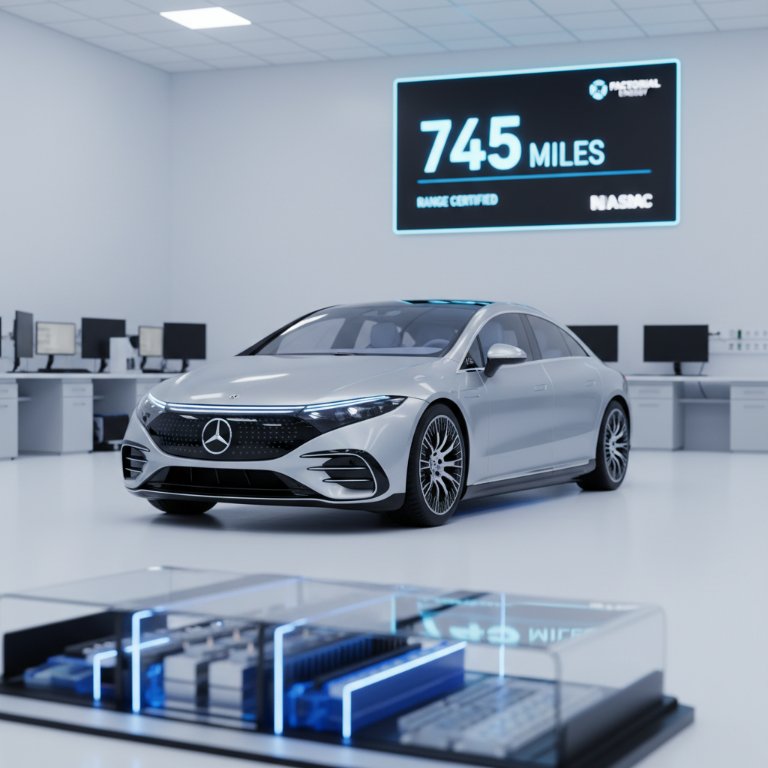
For years, the promise of solid-state batteries has dangled like a futuristic carrot before the electric vehicle industry, perpetually 'five years away.' Now, Boston-based Factorial is not just dangling the carrot but seems to be taking a significant bite, announcing a staggering 745-mile range achievement in lab-certified testing with a 'lightly modified' Mercedes-Benz EQS. This isn't just a marginal improvement; it's a monumental leap that promises to fundamentally reshape the conversation around EV range anxiety and battery performance, with market introduction slated for as early as 2027.
Factorial's Breakthrough: The 745-Mile EQS
The headline news from Factorial is undeniably the certified range test. Driving a Mercedes-Benz EQS — a vehicle already recognized for its substantial range among current EVs — to an astounding 745 miles on a single charge effectively doubles or even triples the practical range of many top-tier electric vehicles on the road today. This milestone, achieved with a 'lightly modified' vehicle, suggests a high level of integration and readiness, moving solid-state technology from theoretical promise to tangible reality. The implications for long-distance travel, commercial applications, and general consumer confidence are nothing short of revolutionary.
Beyond Range: Faster Charging and Extreme Durability
While the monumental range figure grabs immediate attention, Factorial's solid-state platform delivers a suite of additional benefits critical for widespread EV adoption. The company explicitly states its technology addresses key customer demands:
- Quicker recharging: Alleviating another major pain point for EV owners by significantly reducing charging times.
- Operation in extreme temperatures: Extending the practicality of EVs to colder climates where current lithium-ion batteries often see significant performance degradation.
- Lighter weight: Contributing to overall vehicle efficiency, handling, and potentially allowing for more interior space or increased payload capacity.
- Greater cost efficiency: A crucial factor in making advanced EV technology accessible to a broader market, driving down the total cost of ownership.
These combined advancements represent a holistic solution to many of the remaining challenges facing the mainstream adoption of electric vehicles.
Funding the Future: Capital Injection and Market Debut
Factorial’s technical achievements are now backed by substantial financial momentum. The company has secured an impressive $100 million in new capital investments, providing the necessary runway to accelerate development and scale production. Further underscoring its readiness for prime time, Factorial is also preparing to go public, slated to be traded on Nasdaq under the ticker symbol FAC. This dual thrust of technological innovation and robust financial backing positions Factorial as a formidable player, ready to transition its groundbreaking lab results into mass-market deployment.
Why This Matters:
This announcement from Factorial isn't just another incremental step in battery technology; it represents a potential inflection point for the entire automotive industry. For years, solid-state batteries have been the 'holy grail,' promising higher energy density, faster charging, and greater safety compared to the liquid electrolyte-based lithium-ion batteries, like Tesla's 4680 cells or BYD's Blade batteries, that currently dominate the market. While those technologies have pushed the boundaries of what's possible with current chemistry, Factorial's breakthrough signals a fundamental shift in the underlying technology itself.
Who Wins? Mercedes-Benz, as a key partner, stands to gain immense strategic advantage, potentially offering unparalleled range and performance in their luxury EVs. Other Factorial partners and licensees will also benefit. More broadly, the consumer wins, as range anxiety, a persistent psychological barrier to EV adoption, effectively disappears at 745 miles. This range enables true cross-country travel with minimal stops, akin to traditional internal combustion engine vehicles. The potential for lighter, more efficient, and safer batteries also opens doors for new vehicle designs and applications, from heavier-duty trucks to urban delivery fleets.
Who Loses? Current battery manufacturers who are heavily invested solely in traditional lithium-ion chemistries face increased pressure to accelerate their own solid-state programs or risk being left behind. Automakers without solid-state partnerships or in-house development could find their offerings quickly outclassed in terms of range and charging capabilities. This development could also challenge the need for extensive public fast-charging infrastructure in the same way, as cars will need to charge far less frequently.
What Does This Signal to the Market? This signals a clear acceleration in the timeline for truly disruptive EV battery technology. The 2027 market introduction is ambitious but credible given the lab-certified results and substantial funding. It suggests that the future of electric mobility, characterized by uncompromising range and convenience, is arriving much sooner than many anticipated, putting immense pressure on all industry players to innovate or acquire cutting-edge battery solutions.
Factorial's leap with its solid-state battery technology marks a pivotal moment, moving the industry closer to an electric future where range anxiety is truly a relic of the past. With a 745-mile EQS in its arsenal and a clear path to market by 2027, Factorial is not just promising the future; it's actively building it, setting a new benchmark for what's possible in electric vehicle performance and ushering in a new era of EV confidence and practicality.