Rivian's Georgia Gigafactory: A $5 Billion Bet on Localized EV Dominance
Rivian is making an audacious statement about its future and the landscape of North American electric vehicle manufacturing. The company's staggering ...
Editorial Team
World Of EV
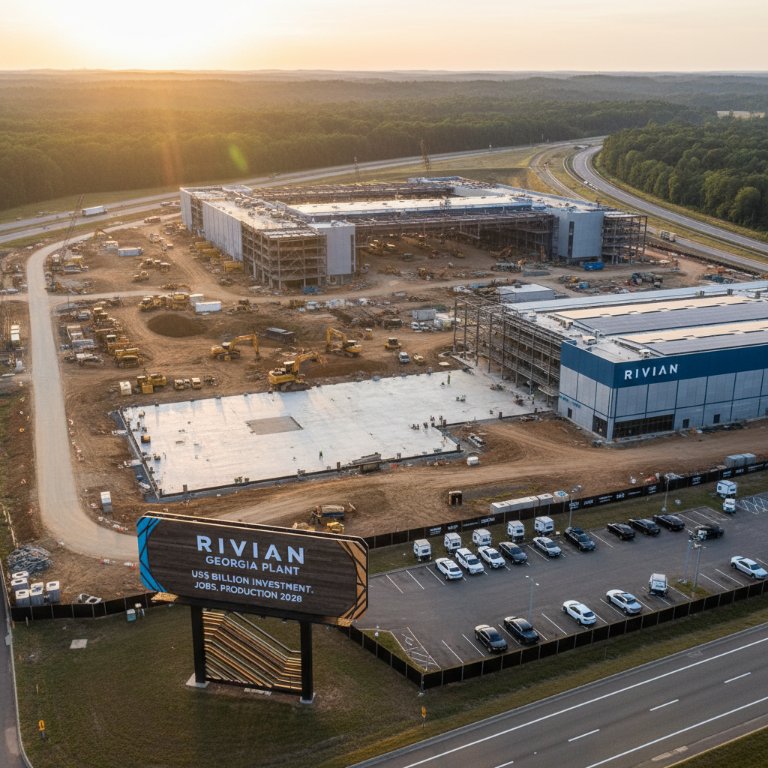
Rivian is making an audacious statement about its future and the landscape of North American electric vehicle manufacturing. The company's staggering US$5 billion investment in its new Georgia facility, with construction having commenced in 2026 and customer vehicle production slated for 2028, isn't merely an expansion; it's a strategic pivot designed to fundamentally reshape Rivian's operational capabilities and the broader EV supply chain. This move comes at a critical juncture for the premium EV manufacturer, which has, until now, relied solely on its Normal, Illinois plant to produce its highly acclaimed R1T pickup and R1S SUV.
This colossal investment signals a profound shift towards localizing North American operations for automotive manufacturers, a trend accelerated by recent global supply chain disruptions and evolving geopolitical dynamics. Beyond securing Rivian's future production capacity, the Georgia Department of Economic Development projects this facility will generate an impressive 7,500 long-term jobs by 2030, underscoring its significant economic impact on the region and the burgeoning domestic EV industry.
Scaling for the Future: A New Production Hub
Rivian's Georgia facility, often colloquially dubbed a 'Gigafactory' due to its immense scale and strategic importance, represents a multi-faceted approach to addressing several key challenges and opportunities for the burgeoning automaker. Key details include:
- Massive Capital Injection: A direct US$5 billion investment underscores Rivian's long-term commitment and financial resolve.
- Expansive Timeline: Construction initiated in 2026, with a clear target for initial customer vehicle production by 2028.
- Job Creation Engine: Projected to create 7,500 long-term jobs by 2030, significantly boosting the local economy and skilled labor force.
- Strategic Location: Positioned in Georgia, a state increasingly attractive for automotive manufacturing due to its logistics, workforce, and incentives.
This new plant is widely anticipated to be the primary production hub for Rivian's upcoming R2 and R3 models. These vehicles are critical for Rivian's aspirations to move beyond its current niche, premium offerings and into a more accessible, higher-volume segment of the EV market. The R2 platform, in particular, is seen as the linchpin for Rivian's mass-market strategy, and securing dedicated, high-capacity production for it is paramount.
Why This Matters:
This move is far more than a corporate announcement; it's a high-stakes play that will profoundly impact Rivian, its competitors, and the entire North American EV ecosystem. For the savvy EV enthusiast and prospective buyer, it means potentially more accessible and readily available Rivian vehicles in the coming years. For industry professionals, it signals a deeper commitment to regionalized manufacturing.
- Supply Chain Resilience: The COVID-19 pandemic brutally exposed the fragility of global supply chains. By localizing a significant portion of its manufacturing in Georgia, Rivian dramatically reduces its exposure to international shipping delays, geopolitical tensions, and volatile component pricing. This translates to more predictable production schedules and potentially more stable pricing for consumers.
- Cost Efficiency and Margins: While a $5 billion investment is substantial upfront, localized production can lead to significant long-term cost savings. Reduced logistics expenses, potential tax incentives, and the ability to more tightly integrate with a regional supplier network can improve Rivian's notoriously challenging profit margins. This is crucial for the company's path to sustained profitability and financial independence.
- IRA Qualification and Consumer Appeal: Domestic manufacturing is increasingly vital for vehicles to qualify for lucrative federal incentives, such as those offered under the Inflation Reduction Act (IRA). A Georgia-built R2 or R3 will likely meet these stringent requirements, making Rivian's future models more competitive on price and more appealing to a wider segment of the market.
- Competition Intensifies: This investment puts pressure on other EV manufacturers, particularly those still heavily reliant on overseas production or with less diversified manufacturing footprints. Rivian's proactive step in securing future capacity and supply chain control sets a new benchmark for strategic investment in the North American market. It sends a clear signal: future EV success is tied to robust, local manufacturing capabilities.
- A Do-or-Die Moment for Growth: For Rivian, this facility is unequivocally a 'do-or-die' moment for its long-term growth ambitions. Successfully launching and scaling the R2/R3 platform from Georgia is paramount to transitioning from a niche player to a mainstream EV powerhouse. Failure to execute effectively could have dire consequences, but success could cement Rivian's place as a leading automotive innovator.
Conclusion:
Rivian's $5 billion investment in its Georgia manufacturing facility transcends a mere factory build; it's a strategic blueprint for the company's future and a powerful statement about the evolving nature of the global automotive industry. As 2028 approaches, all eyes will be on Georgia, watching as Rivian attempts to transform its ambitious vision into a tangible reality, driving not only its own growth but also bolstering the entire North American electric vehicle ecosystem.