Rivian's Foundational Tech Prowess Earns Spot on Fortune's Most Innovative List
Rivian, the American electric vehicle manufacturer carving out a niche in the adventure and commercial EV segments, has achieved a significant milesto...
Editorial Team
World Of EV
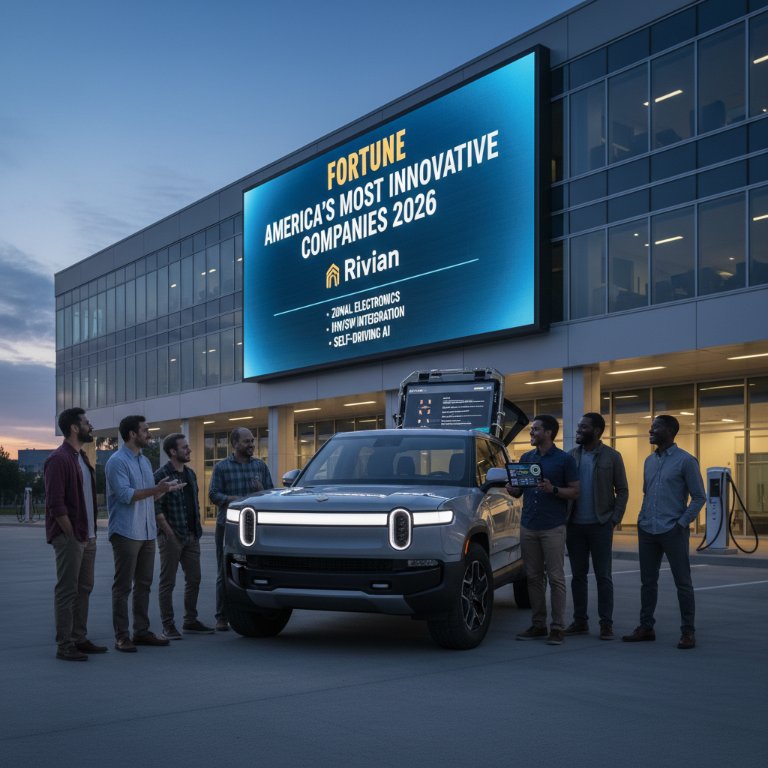
Rivian, the American electric vehicle manufacturer carving out a niche in the adventure and commercial EV segments, has achieved a significant milestone, earning its inaugural placement on Fortune's prestigious "America's Most Innovative Companies" list for 2026. This recognition isn't just a nod to its compelling vehicles; it's a powerful validation of the company's deep-rooted commitment to foundational technology. For an automaker still scaling production and navigating the complexities of a competitive EV market, this acknowledgment from a respected business authority underscores Rivian's strategic focus on the underlying architecture that defines next-generation mobility.
Architecting the Future: Zonal Electronics and Vertical Integration
Rivian's inclusion on the list stems from several key technological advancements, signaling a move beyond mere product design to profound engineering innovation.
- Zonal Electronics Architecture: This is a critical departure from traditional, domain-based vehicle electronics. Instead of scattering dozens of electronic control units (ECUs) throughout the vehicle for specific functions (e.g., infotainment, powertrain, ADAS), zonal architecture groups ECUs by physical location. This approach dramatically simplifies wiring harnesses, reducing their length by significant margins (up to 50% or 1.6 miles in Rivian's Gen 2 vehicles, saving around 44 pounds of weight), lowering costs, and enhancing reliability. For a company like Rivian, which is vertically integrating its development, this streamlines manufacturing and allows for more robust, scalable software-defined vehicle capabilities.
- Deeper Hardware and Software Integration: Rivian has emphasized a vertically integrated approach from its inception, designing both its hardware and a substantial portion of its software in-house. This tight integration allows for seamless over-the-air (OTA) updates, enabling Rivian to continually enhance vehicle features, improve performance, and fix issues remotely – making vehicles better over time, much like a smartphone. This strategic decision gives Rivian an agility advantage over many legacy automakers still grappling with complex supplier ecosystems and fragmented software development.
Laying the Groundwork for Autonomous Futures
The third pillar of Rivian's recognized innovation is its foundational work on a self-driving AI model. This isn't just about advanced driver-assistance systems (ADAS) available today; it's about building the core intelligence for future autonomy. Rivian's development includes a proprietary AI chip, the Rivian Autonomy Processor (RAP1), designed for vision-centric physical AI and capable of high-speed data processing. The company is training a 'Large Driving Model' (LDM) akin to a Large Language Model, which processes vast datasets to distill superior driving strategies. This long-term investment signals Rivian's intent to be a leader in the autonomous space, with plans extending to Level 3 and eventually Level 4 autonomous driving capabilities.
Why This Matters:
This recognition is more than just a pat on the back for Rivian; it's a critical signal to the market and a strong indicator of the company's long-term viability and strategic direction. In an EV landscape where many players, including some established automakers, have faced setbacks or scaled back ambitions, Rivian's focus on fundamental innovation validates its engineering-first approach.
- Enhanced Credibility: For a relatively young automaker, being named to Fortune's list provides immense credibility, attracting both investors and top-tier talent in an increasingly competitive industry. It underscores that Rivian isn't just building vehicles; it's building a technology platform.
- Competitive Edge: The advanced zonal architecture and deep hardware-software integration give Rivian a significant structural advantage. Reduced complexity and weight translate to better efficiency, potentially longer range, and lower manufacturing costs – crucial factors in an EV market focused on affordability and performance. This positions Rivian favorably against rivals who might still be relying on older, less efficient E/E architectures.
- Future-Proofing: By investing heavily in self-driving AI, including custom silicon, Rivian is actively future-proofing its vehicles and potentially creating new revenue streams as a software provider, as evidenced by its partnership with Volkswagen. This proactive stance ensures its vehicles can evolve with the rapid pace of technological advancement, offering customers a more enduring and capable product. This is a clear indicator that Rivian understands that the future of automotive is defined by software and AI, not just horsepower and battery size.
- Impact on Consumers: For prospective buyers, this translates to vehicles that are not only well-designed but also inherently more reliable, easier to update, and capable of integrating advanced features seamlessly over their lifespan. It offers the promise of a smarter, more integrated driving experience that can adapt and improve long after purchase.
In conclusion, Rivian's debut on Fortune's "America's Most Innovative Companies" list solidifies its position as a serious technological innovator in the automotive world. This isn't a fluke; it's a direct result of strategic investments in core architectural and AI capabilities. As the EV market matures, such foundational innovations will increasingly differentiate the leaders from the laggards, suggesting a robust and technologically advanced future for Rivian and its offerings.