Rivian Unleashes Mass-Market Offensive with R2 Reveal, Bolstered by Profitability and Volkswagen's Billions
Rivian is poised to fundamentally reshape its market position on March 12, 2026, with the full product reveal of its highly anticipated R2 mid-size SU...
Editorial Team
World Of EV
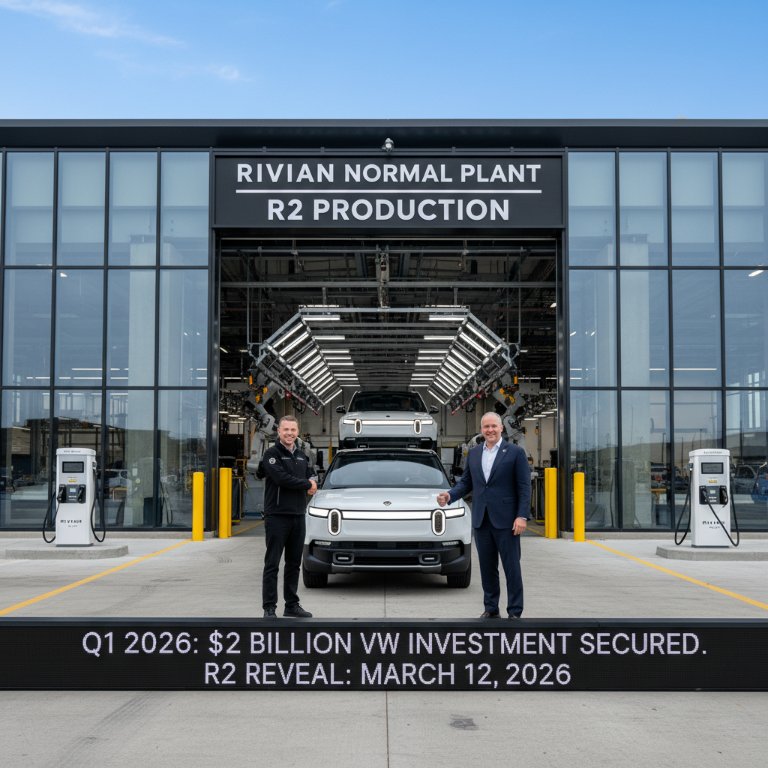
Rivian is poised to fundamentally reshape its market position on March 12, 2026, with the full product reveal of its highly anticipated R2 mid-size SUV. This pivotal moment signals Rivian’s aggressive pivot from its niche, premium adventure vehicle segment towards the high-volume mass market, targeting first customer deliveries in Q2 2026. This launch is not merely a new vehicle; it’s a strategic expansion backed by a newfound financial strength that underscores Rivian’s maturing operational capabilities.
R2: Rivian’s Mass-Market Offensive Takes Center Stage
The R2 represents Rivian's most ambitious play yet to capture a significant share of the burgeoning electric SUV market. Unlike its larger, more expensive R1T and R1S siblings, the R2 is engineered for broader appeal, promising the brand's signature blend of capability and innovative design in a more accessible package. This move is critical for Rivian, a company that, despite critical acclaim for its initial offerings, has faced the arduous challenge of scaling production and achieving sustainable profitability – a common hurdle for EV startups navigating capital-intensive manufacturing.
Financial Fortification: Gross Profit and Volkswagen's Strategic Infusion
Rivian’s strategic maneuvers are significantly bolstered by robust financial progress. The company proudly announced its first full year of positive gross profit in 2025, reaching an impressive $144 million. This achievement is a monumental milestone for any EV startup, demonstrating an improving efficiency in production and cost management after years of significant investment and ramp-up challenges. Compounding this financial strength, Rivian anticipates a crucial $2 billion cash injection in 2026 as part of a larger $5.8 billion consideration from its landmark joint venture with Volkswagen. This partnership, initially announced last year, provides not only substantial capital but also validates Rivian's advanced zonal electronics and software platforms, potentially setting the stage for broader industry collaboration and licensing opportunities.
Scaling for Success: The Normal Facility’s R2-Ready Expansion
To meet the anticipated demand for the R2, Rivian is aggressively expanding its Normal, Illinois, manufacturing facility. This expansion includes a significant 1.1 million square foot R2 body shop and a dedicated general assembly facility. This physical growth underscores Rivian's commitment to in-house production control and its confidence in the R2's market potential, aiming to avoid the production bottlenecks that have plagued many EV manufacturers in their early growth phases. The strategic investment in capacity ensures that the promise of the R2 can translate into timely deliveries for customers, a key differentiator in a competitive market.
Why This Matters:
This confluence of events – a mass-market product reveal, sustained profitability, and a substantial capital injection from an automotive giant – signals a profound inflection point for Rivian. For Rivian, this is a do-or-die moment, but one they appear to be tackling head-on with calculated strategy. The R2 is not just another vehicle; it is the cornerstone of Rivian's future growth, designed to dramatically expand its total addressable market beyond the affluent early adopters. Success with the R2 will firmly establish Rivian as a mainstream contender, challenging established players like Tesla's Model Y and Ford's Mustang Mach-E in a highly contested segment.
Who Wins? Consumers seeking a premium, technologically advanced mid-size EV SUV will likely be significant beneficiaries, gaining a compelling alternative in a segment often dominated by traditional OEMs. Rivian, if R2 sales take off, will consolidate its position as a credible long-term player in the EV landscape. The investment from Volkswagen also hints at a broader industry win, suggesting a greater willingness among legacy automakers to collaborate with and leverage the innovations of agile EV startups.
Who Loses? Competitors in the mid-size premium EV SUV space, particularly those with less compelling technology or slower production ramps, could face increased pressure. Furthermore, traditional ICE SUVs in this segment will find themselves under heightened threat as compelling EV options become more available and competitively priced. The influx of a well-executed Rivian R2 could accelerate the decline of internal combustion offerings in this category.
Market Signal: This signals a maturation of the EV market and a growing confidence in specialized EV manufacturers. Rivian's profitability is a critical indicator that the business model can indeed yield positive returns, while the VW partnership legitimizes their technological prowess. It also reinforces the idea that strategic alliances, rather than pure competition, may be the faster path to electrification for many legacy automakers.
The R2 launch, coupled with Rivian’s improved financial footing and bolstered production capabilities, paints a picture of a company transitioning from an ambitious startup to a formidable force in the global EV market. The world will be watching closely on March 12th to see if the R2 lives up to the immense expectations and truly propels Rivian into the mainstream.