Rivian R2 to Lead Global Connectivity Revolution with New eSIM Standard
Rivian, the burgeoning force in electric adventure vehicles, is poised to set a new industry benchmark with its forthcoming R2 electric SUV. The compa...
Editorial Team
World Of EV
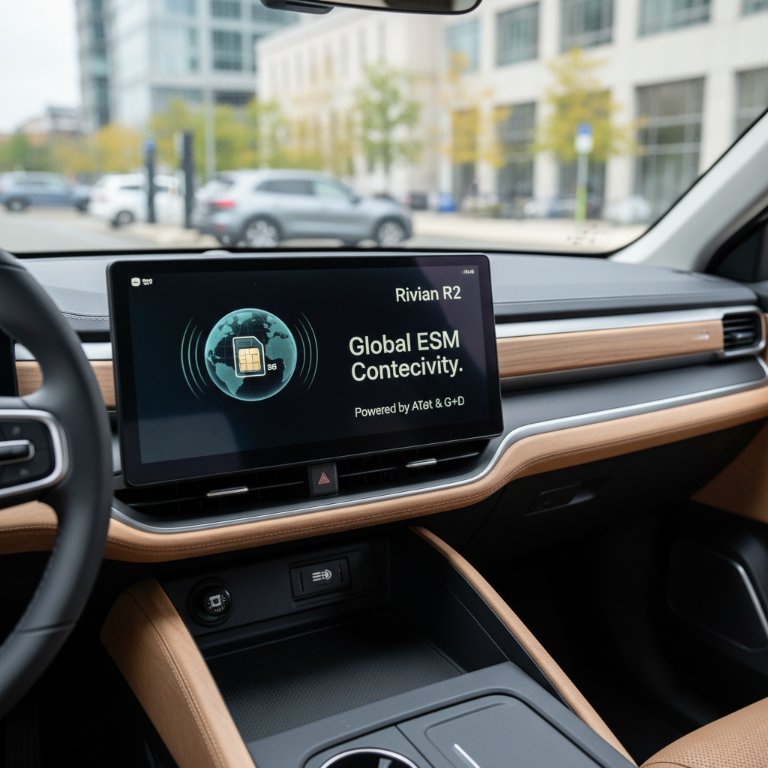
Rivian, the burgeoning force in electric adventure vehicles, is poised to set a new industry benchmark with its forthcoming R2 electric SUV. The company recently announced that the R2 will be among the first vehicles globally to launch incorporating the newly finalized GSMA SGP.32 eSIM standard designed specifically for automotive applications. This strategic move, a collaboration with German security technology firm Giesecke+Devrient (G+D) and AT&T, signifies a profound shift in how vehicle connectivity will be managed on a global scale.
This isn't just about faster downloads; it's about tearing down the complex, fragmented infrastructure that has long plagued global automotive deployments. For years, automakers navigating international markets have grappled with the logistical nightmare of managing diverse hardware, regional SIM cards, and a patchwork of carrier agreements. Rivian’s early adoption of SGP.32 positions the R2 not merely as a new EV, but as a pioneer in truly harmonized, software-defined global mobility.
A Global Standard for a Global EV
The GSMA SGP.32 standard represents a crucial evolution beyond previous eSIM iterations, offering enhanced security, robustness, and remote management capabilities specifically tailored for the demanding automotive environment. Unlike consumer-grade eSIMs, this standard addresses the long lifecycle, extreme temperature ranges, and mission-critical connectivity needs of vehicles. By embracing SGP.32, Rivian can deploy identical connectivity hardware across all R2 vehicles, regardless of their eventual market destination.
This standardization dramatically simplifies the entire supply chain and operational overhead associated with international vehicle launches. No longer will Rivian need to develop or adapt connectivity modules for specific regional requirements or pre-provision SIMs for each territory. Instead, the R2 will leverage universal hardware, with network profiles remotely downloaded and managed post-production, directly addressing the complexities of carrier relationships in different countries. G+D provides the robust, automotive-grade eSIM hardware and the crucial remote management infrastructure that underpins this flexibility.
Streamlined Connectivity, Enhanced Experience
For the end-user, the implications are equally significant, though often invisible. The primary benefit of this standardized eSIM approach is seamless, reliable connectivity. AT&T will serve as Rivian's initial mobile network provider in the United States, offering high-speed 5G connectivity for all in-vehicle services. This ensures that R2 owners will benefit from:
- Consistent In-Car Services: From navigation and infotainment to streaming and smart home integration, services will function reliably across regions.
- Robust Over-the-Air (OTA) Updates: Critical software updates, performance enhancements, and new features can be delivered efficiently and securely, keeping the vehicle current and secure throughout its lifespan.
- Future-Proofing: The architecture is inherently more adaptable to future network technologies and connectivity demands, reducing the risk of obsolescence.
Why This Matters:
This announcement is far more than a technical footnote; it's a strategic masterstroke for Rivian and a clear signal to the broader automotive industry. For Rivian, an OEM with clear global ambitions, early adoption of GSMA SGP.32 provides a formidable competitive advantage. It directly facilitates a more rapid, cost-effective, and less complex expansion into international markets, which is critical for scaling a startup automaker. By mitigating the logistical hurdles of global connectivity, Rivian can allocate more resources to product development and market penetration, rather than wrestling with disparate telecommunications infrastructures. This positions the R2 as a truly global platform from day one, not a vehicle that needs to be re-engineered for each new territory. This move signals confidence in Rivian's long-term vision and its ability to execute on complex technological integrations.
For the wider EV and automotive industry, Rivian is effectively setting a new bar. Traditional automakers, many of whom are still entrenched in proprietary or regionally segmented connectivity solutions, will face increased pressure to adopt similar global standards. The era of 'local' connectivity solutions for globally sold vehicles is rapidly fading. OEMs that cling to older paradigms risk higher operational costs, slower market entry in new regions, and a less seamless experience for their customers. This is a win for standardization and a clear indicator that the software-defined vehicle concept extends deeply into its foundational connectivity.
Rivian's proactive embrace of the GSMA SGP.32 eSIM standard for the R2 is a powerful demonstration of forward-thinking engineering and strategic foresight. It underscores the company's commitment to delivering a truly global, seamlessly connected electric vehicle experience, fundamentally reshaping the landscape of automotive connectivity for the years to come. The R2 is not just another EV; it's a blueprint for the globally connected car.