Rivian R2 Charges Towards Mass Market with Unprecedented Production Ramp
Rivian is making an audacious bet on its future, signaling one of the most aggressive production ramp-ups in U.S. electric vehicle history with the fo...
Editorial Team
World Of EV
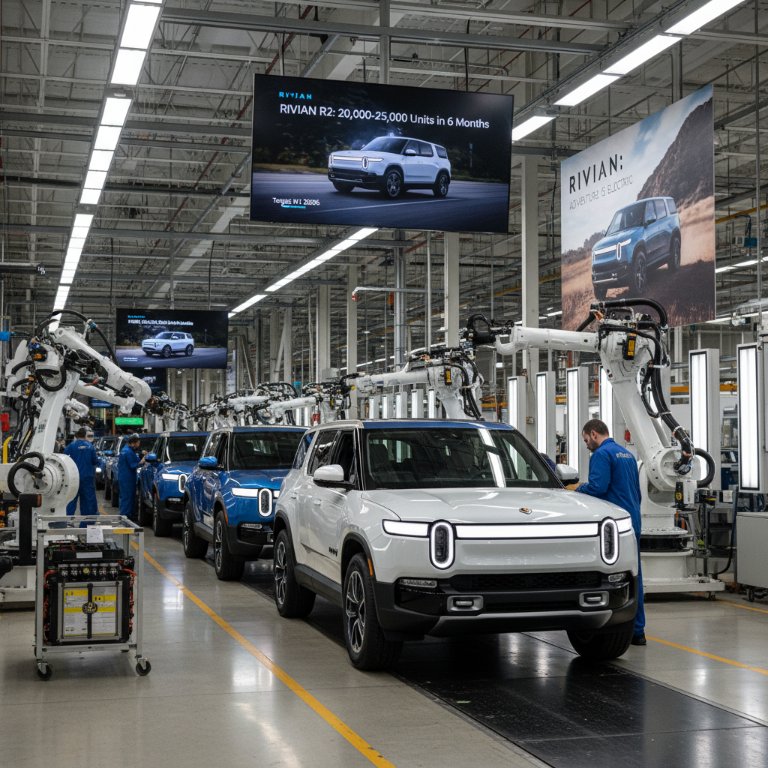
Rivian is making an audacious bet on its future, signaling one of the most aggressive production ramp-ups in U.S. electric vehicle history with the forthcoming R2 SUV. The company is targeting an impressive 20,000 to 25,000 R2 units delivered within just the first six months of production, with customer vehicles hitting roads in the first half of 2026. This ambitious schedule underscores Rivian's determination to move beyond its premium, low-volume R1 vehicles and firmly establish itself in the crucial mainstream EV market.
Since its inception, Rivian captivated the automotive world with its R1T pickup and R1S SUV, demonstrating a clear vision for adventure-ready electric vehicles. However, the journey has been fraught with the typical production scaling challenges faced by nascent automakers, coupled with the inherent difficulties of bringing complex EV technology to market. The R1 vehicles, while critically acclaimed, have remained a niche product due to their premium pricing, often starting above $70,000. The R2 represents Rivian's calculated pivot to volume, leveraging hard-won manufacturing experience from its Normal, Illinois, facility, where validation builds are already rolling off the line.
R2's Strategic Edge: Price, Power, and Autonomy
The R2 is poised to disrupt the burgeoning mid-size electric SUV segment with a compelling package designed for mass appeal. Key specifications and features include:
- Accessible Starting Price: Expected to begin around $45,000, although recent reports indicate that the initial launch configuration, a dual-motor variant, might carry a higher price tag between $50,000 and $60,000, with a base single-motor model arriving shortly after. This places it squarely in contention with market leaders like the Tesla Model Y and a growing wave of electric crossovers from established automakers.
- Advanced Battery Technology: Utilizing 4695 cylindrical battery cells, a newly developed battery format that offers greater energy density and improved thermal management compared to the 2170 cells used in the R1 models. These cells are 46 mm in diameter and 95 mm in height, packing over six times the energy capacity per cell.
- In-House Autonomous Driving Stack: Rivian is developing its own proprietary advanced driver-assistance system, including an in-house developed AI computer chip (Rivian Autonomy Processor or RAP1) and a third-generation autonomous computer module (ACM3) that can process 5 billion pixels of sensor data per second. This aims for a distinctive and integrated user experience, with plans for hands-free, eyes-off driving, and eventually point-to-point capabilities starting in late 2026.
The adoption of 4695 cylindrical cells is particularly significant. While Tesla pioneered the large format cylindrical cell with its 4680 cells, Rivian's choice of the 4695 variant, supplied by LG Energy Solution, suggests optimization for energy density, power delivery, and cost efficiency. This move demonstrates a clear commitment to proprietary battery innovation, a critical factor in controlling costs and maximizing performance in the highly competitive EV landscape.
Furthermore, developing an in-house autonomous driving stack is a monumental undertaking, reflecting Rivian's long-term vision for end-to-end control over its vehicle technology and user experience, much like Tesla's approach to its Full Self-Driving system.
Why This Matters:
This aggressive R2 production target is not merely a number; it is a declaration of intent and a make-or-break moment for Rivian. For the company, success here means unlocking significant economies of scale, improving profitability, and validating its sophisticated manufacturing processes. After years of operating in the red while establishing its brand and production capabilities, the R2 is the vehicle that must deliver substantial revenue and market share. Failure to meet these ambitious targets, however, could lead to significant financial strain and investor skepticism, underscoring the immense pressure on the Normal plant and its operational teams.
The move into the $45,000 price bracket, even with an initial higher-priced launch variant, positions Rivian to directly challenge the segment's dominant players and capture a much larger customer base, translating its unique 'adventure' brand identity into mass-market appeal.
For the broader EV market, the R2's arrival intensifies competition in the most critical volume segment. Consumers stand to win as more compelling and competitively priced options emerge. Rivian's commitment to large-format cylindrical cells and an in-house ADAS also signals a continued trend towards vertical integration and proprietary technology within the industry, pushing other manufacturers to accelerate their own development curves in these key areas.
It's a clear indicator that the EV battleground is shifting from simply launching electric vehicles to efficiently scaling their production and delivering advanced features at an accessible price point.
Rivian's R2 is poised to be far more than just another electric SUV; it represents a pivotal chapter in the company's story and a significant litmus test for its long-term viability. Its successful launch and rapid scaling could cement Rivian's position as a formidable player in the global EV market, fundamentally altering the competitive landscape for years to come. All eyes will be on Normal, Illinois, as the first half of 2026 approaches, eager to see if Rivian can deliver on its ambitious promises and navigate the demanding transition to high-volume production.