Red Lights Flashing: Ford's 69% EV Sales Plunge Signals Major Course Correction for Model e
Ford Motor Company's electric vehicle (EV) division, 'Model e,' just slammed the brakes, reporting a staggering 69% crash in January sales. This drama...
Editorial Team
World Of EV
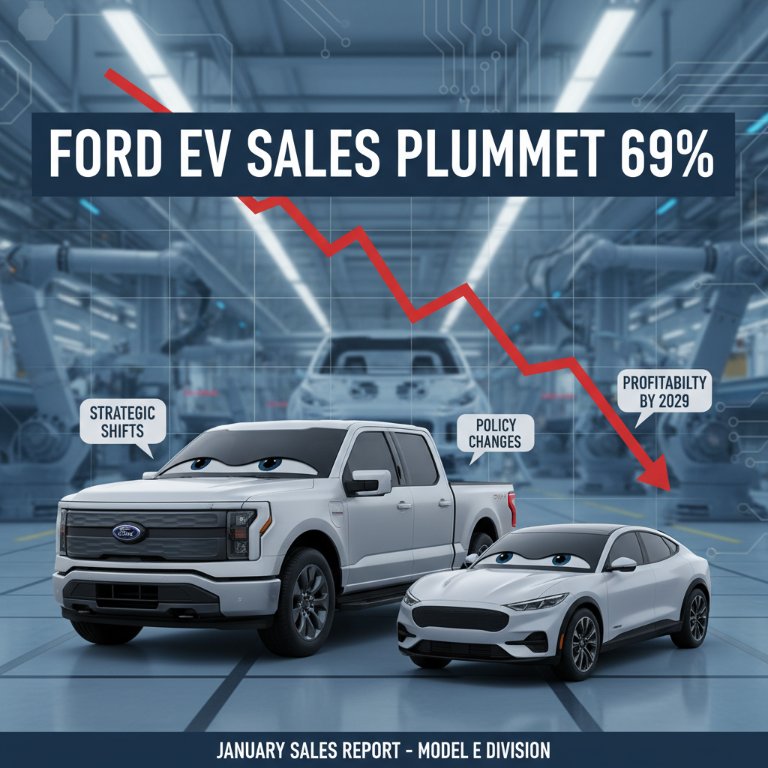
Ford Motor Company's electric vehicle (EV) division, 'Model e,' just slammed the brakes, reporting a staggering 69% crash in January sales. This dramatic decline follows a pivotal strategic shift from the automaker, attributed to ongoing policy and production adjustments as it rethinks its ambitious electrification plans.
This isn't merely a blip; it's a profound market signal coming on the heels of a substantial $19.5 billion impairment charge announced in December. Ford established its 'Model e' unit in 2022 with the aim of accelerating its EV development, seeking the agility of a startup within a legacy giant. However, the division has faced escalating annual losses, totaling approximately $13 billion since 2023, even before the latest write-down.
The January Plunge and Restructuring Reality
Ford sold a mere 1,743 electric vehicles in the United States in January, representing a 69.2% drop compared to 5,666 units sold a year ago, and a 68.6% decline from December's figures. This precipitous fall highlights the immediate impact of Ford's strategic pivot away from certain larger, lower-return EVs.
Key aspects of Ford's updated strategy include:
- Focus on Profitability: The 'Model e' division is now expected to achieve profitability by 2029, with improvements targeted to begin in 2026.
- Asset Rationalization: The $19.5 billion charge primarily relates to writing down the value of EV assets, including the discontinuation of the current F-150 Lightning EV and the cancellation of a next-generation electric truck and planned commercial vans.
- Shift to Hybrids and Affordable EVs: Ford is redirecting investment towards more profitable hybrids, extended-range EVs, and gasoline-powered vehicles, while focusing its pure EV development on a flexible Universal EV Platform for smaller, more affordable models, potentially targeting a $30,000 price point.
- Battery Strategy Rework: The company scrapped plans for direct battery production with a South Korean manufacturer, SK On, and will now focus on battery energy storage systems (BESS), repurposing underutilized U.S. EV battery capacity for data centers and grid infrastructure.
Why This Matters: A Sobering Reality Check for the EV Market
Ford's dramatic restructuring signals a profound recalibration of EV ambitions across the automotive industry. This is not simply a Ford story; it reflects a broader struggle by legacy automakers to profitably scale EV production amidst evolving consumer demand, infrastructure challenges, and a highly competitive, price-sensitive market.
- Who Wins? Hybrid technology emerges as a significant winner in Ford's revised outlook. Consumers seeking lower upfront costs and alleviating range anxiety are increasingly opting for hybrids, and Ford's renewed focus on these powertrains, alongside its profitable Ford Blue (ICE) and Ford Pro (commercial) divisions, aims to generate the capital needed for future EV investments.
- Who Loses? The notion of rapid, across-the-board electrification takes a hit. The cancellation of larger, less profitable EV programs, like the current F-150 Lightning, means a slower rollout of certain niche electric vehicles. This also underscores the immense financial pressure on automakers who invested heavily in EV-only platforms that haven't met sales or profitability projections.
- Market Signal: Ford's actions send a clear message: profitability trumps pure volume in the current EV landscape. It suggests that the aggressive timelines for EV adoption projected just a few years ago are proving unrealistic for many mainstream buyers. The expiration of federal EV tax credits in late 2025 also likely contributed to the slowing demand.
- Do-or-Die Moment: For Ford, this is a critical juncture. The $19.5 billion impairment and the revised 2029 profitability target for Model e illustrate the immense financial strain and the imperative to make these strategic adjustments work. The company must now deftly navigate its transition, balancing current revenue streams with sustainable future growth in an increasingly diversified powertrain market.
Conclusion
Ford's staggering 69% EV sales drop in January is a stark indicator of a broader shift in the electric vehicle market. The company's decisive move to scale back ambitious EV plans, absorb significant financial charges, and re-prioritize hybrids and affordable electric models reflects a pragmatic, albeit painful, acknowledgment of current market realities. While the road to full electrification remains Ford's long-term vision, its immediate future demands a focus on profitability and meeting diverse consumer preferences, setting a precedent for other legacy automakers navigating their own EV transitions.