Reality Check: Ford Rethinks EV Strategy Amid Plummeting Mach-E Sales and Industry Headwinds
Ford's electric vehicle ambitions have hit a significant roadblock in the first quarter of 2026, as its best-selling Mustang Mach-E experienced a stag...
Editorial Team
World Of EV
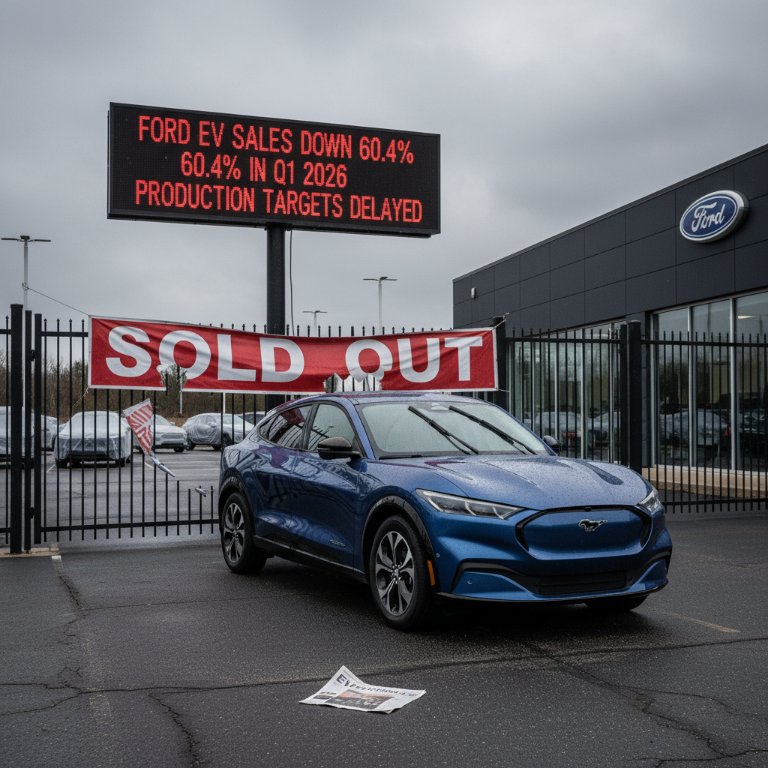
Ford's electric vehicle ambitions have hit a significant roadblock in the first quarter of 2026, as its best-selling Mustang Mach-E experienced a staggering 60.4% year-over-year sales decline. The automaker, citing sluggish adoption rates, has consequently announced a delay in its ambitious electric vehicle production targets, signaling a profound adjustment to its future strategy in a rapidly evolving EV market.
This setback comes despite Ford's aggressive push into electrification, marked by the establishment of its dedicated Model e division. The company had initially set bold targets, investing billions into developing a full lineup of EVs, including the much-hyped Mach-E and the F-150 Lightning. However, the enthusiasm surrounding these early models appears to be cooling, reflecting a broader recalibration within the EV industry. Ford's Model e unit is projected to face substantial losses, with expectations of a $4 billion to $4.5 billion deficit for 2026, even as the company aims for breakeven by 2029.
The Sharp Decline and Broader Market Trends
The drastic 60.4% drop in Mustang Mach-E sales for Q1 2026 is a stark indicator of shifting consumer sentiment and intensifying market pressures. This is not an isolated incident for Ford; its total electric vehicle sales plummeted 71% in February, with the F-150 Lightning and E-Transit also experiencing significant declines. Concurrently, sales of the traditional, gasoline-powered Mustang surged by over 50% in Q1 2026, outselling its electric counterpart by more than triple in January alone.
This trend aligns with a broader deceleration in new EV sales across the U.S. market. New battery-electric vehicle sales in Q1 2026 fell by 28% year-over-year, to 212,600 units, following the expiration of the $7,500 federal EV tax credit in September 2025. This policy change significantly altered the affordability equation for many prospective buyers. The market has also seen new EV inventory balloon to a 130-day supply, far exceeding that of gasoline cars and pushing automakers towards aggressive discounts.
Strategic Adjustments and Consumer Hesitation
Ford's decision to delay production targets is a direct response to these 'sluggish adoption rates.' It reflects a growing industry recognition that the path to widespread EV adoption is less linear than initially projected. Legacy automakers, including Ford, are now recalibrating their strategies, with many delaying EV models and expanding hybrid offerings to meet evolving consumer demand.
Key factors influencing consumer hesitation include:
- Affordability: High EV prices, particularly without federal incentives, remain a significant barrier for many buyers.
- Charging Infrastructure Concerns: While public charging infrastructure has expanded, issues such as reliability, inconsistent maintenance, unclear pricing, and payment friction continue to deter potential owners. Many consumers still lack home charging options, making public charging a necessity rather than a convenience.
- Range and Charge Anxiety: Despite improvements in battery technology, concerns about range and the hassle of charging (often dubbed 'charge anxiety') persist, particularly for longer journeys or in areas with less developed infrastructure.
Why This Matters:
This significant setback for Ford, and the broader trends it reflects, signals a critical inflection point for the entire automotive industry. It's a stark reminder that the 'EV gold rush' mentality, characterized by aggressive production targets and high-volume assumptions, has given way to a more pragmatic, and often painful, market correction.
- Who Wins? Consumers, in the short term, are likely to benefit from increased incentives and a greater focus on more affordable EV options as automakers fight for market share. Competitors with established charging networks (like Tesla) or robust hybrid portfolios (which are seeing a resurgence in demand) may also gain an advantage. The used EV market is booming, with sales up 12% in Q1 2026, suggesting consumers are seeking more affordable entry points into electrification.
- Who Loses? Automakers like Ford, who have invested heavily in dedicated EV platforms and manufacturing, face immense pressure to justify these investments amidst slower growth and continued profitability challenges in their EV divisions. This also places pressure on suppliers within the EV ecosystem.
- Market Signal: This moment signals that the market is maturing beyond early adopters. Sustainable EV growth now hinges on addressing core consumer pain points: price, seamless charging experiences, and a clear value proposition. It pushes automakers to prioritize 'sustainable execution' over 'rapid production,' demanding innovation in cost reduction, battery technology, and charging solutions.
In conclusion, Ford's Q1 2026 performance with the Mustang Mach-E is a sobering reality check. It underscores that while the long-term trajectory for electrification remains positive, the journey will be punctuated by market adjustments driven by consumer preferences and economic realities. The industry's focus must now shift from simply building EVs to making them accessible, affordable, and practical for the mainstream buyer. The ability of companies like Ford to pivot effectively and address these fundamental challenges will define their success in the coming years.