Price Shock Threatens Thailand's EV Future: Charging Hike Erodes Economic Advantage
Thailand’s ambitious push towards an electric vehicle future faces a significant roadblock. The nation, which has actively courted EV manufacturers an...
Editorial Team
World Of EV
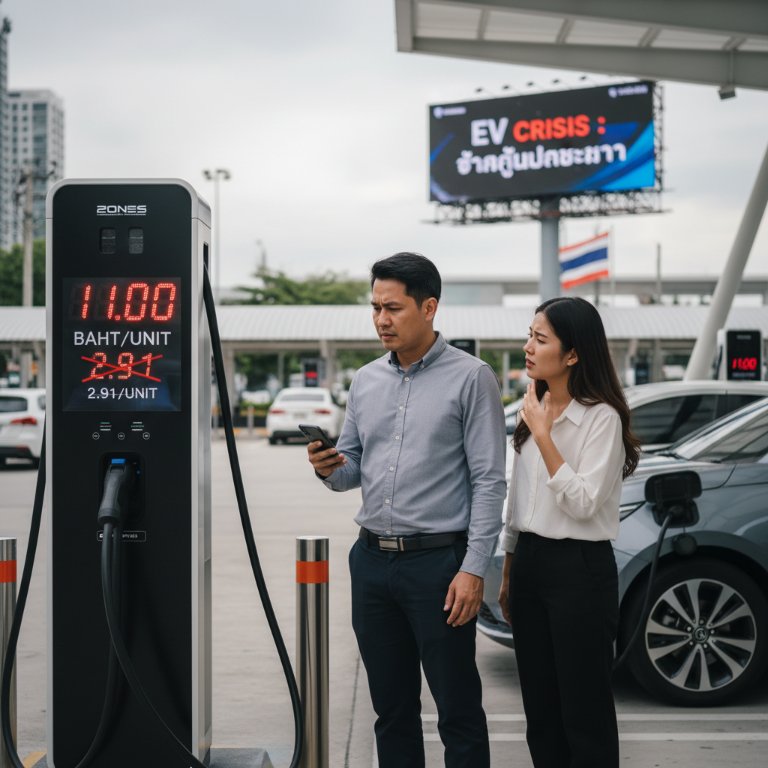
Thailand’s ambitious push towards an electric vehicle future faces a significant roadblock. The nation, which has actively courted EV manufacturers and incentivized adoption, is now confronting a proposed quadrupling of public EV charging costs. This dramatic price hike threatens to dismantle the core economic advantage EVs hold over traditional petrol cars, potentially slamming the brakes on widespread adoption and jeopardizing the country's environmental commitments.
For years, Thailand has positioned itself as a regional EV hub, attracting major investments and setting aggressive targets for electrification. A key pillar of this strategy has been the promise of lower running costs for EV owners, largely driven by affordable electricity. However, the Ministry of Energy's new directive to reflect true procurement and grid maintenance costs is set to redefine this landscape, pushing public charging tariffs to unprecedented levels.
The Steep Price Surge Explained
The proposed changes are stark. Public EV charging, currently enjoying a highly subsidized rate of approximately 2.91 baht per unit, is slated to jump dramatically. Experts suggest retail prices at public charging stations could soar to between 9.5 and 11 baht per unit. This surge isn't arbitrary; it stems from a Ministry of Energy mandate to ensure charging tariffs accurately reflect the actual costs involved in electricity generation, transmission, and the significant investment required to maintain and upgrade the national grid for increased EV demand.
- Current Rate: Approximately 2.91 baht per unit
- Proposed Rate: 9.5 – 11 baht per unit
- Driving Factor: Ministry of Energy order to reflect true procurement and grid maintenance costs
For many prospective EV buyers, the allure of an electric vehicle lies not just in its environmental benefits, but fundamentally in its cheaper running costs. A 2.91 baht per unit tariff made charging an EV significantly more economical than filling up a petrol tank. This cost differential was a powerful motivator, especially for high-mileage drivers. At 9.5 to 11 baht per unit, that advantage largely evaporates. Suddenly, the total cost of ownership (TCO) calculation for an EV becomes far less compelling, directly challenging the fundamental value proposition for consumers considering the switch. This shift could easily lead to consumer hesitation and a slowdown in the EV transition that the government has worked hard to foster.
Why This Matters:
Who Wins? The Ministry of Energy and grid operators stand to gain, as tariffs will better cover operational and investment costs, potentially reducing the strain on state subsidies. Traditional fossil fuel industries might also see a temporary reprieve as the economic incentive to switch to EVs diminishes. This could also be a short-term win for the government's budget, by reducing the need for direct energy subsidies.
Who Loses? Foremost are current and prospective EV owners, who will face substantially higher running costs. This directly impacts their household budgets and erodes the promised savings. EV manufacturers, who have invested heavily in establishing production and sales networks in Thailand based on favorable policy, could see sales targets become harder to hit. Crucially, Thailand’s environmental targets for reduced emissions and increased EV adoption will undoubtedly suffer, potentially setting back its clean energy transition by years. The nascent charging infrastructure industry might also face reduced utilization and slower expansion if demand falters.
What Does This Signal? This move signals a potential prioritization of fiscal responsibility and infrastructure cost recovery over aggressive consumer incentives for EV adoption. It also highlights the challenges of transitioning to a new energy paradigm, where the true costs of infrastructure and energy generation become unavoidable. For the broader automotive market, it could create uncertainty around government policies and future incentives, potentially making Thailand a less predictable market for EV investments compared to neighboring countries that maintain strong EV support.
Is This a 'Do-or-Die' Moment? While not a complete death knell, this is undoubtedly a make-or-break moment for the pace of Thailand's EV adoption. If implemented without accompanying measures to soften the blow—such as renewed purchase incentives or targeted subsidies for lower-income EV owners—it risks severely dampening consumer enthusiasm and slowing the momentum that has been painstakingly built. It forces a fundamental re-evaluation of Thailand's commitment to its EV future.
The proposed hike in EV charging costs presents a significant test for Thailand's commitment to electric mobility. While balancing grid costs and energy policy is crucial, sacrificing the economic advantage of EVs risks derailing the nation's ambitious environmental and industrial goals. The path forward will require careful consideration to ensure sustainable growth without stifling the nascent EV market.