Pay-Per-Mile Road Charging Threatens EV Adoption Amidst Widespread Cost Confusion
A groundbreaking new survey from Electrifying.com and the AA has sent a clear warning shot to policymakers: implementing pay-per-mile road charging co...
Editorial Team
World Of EV
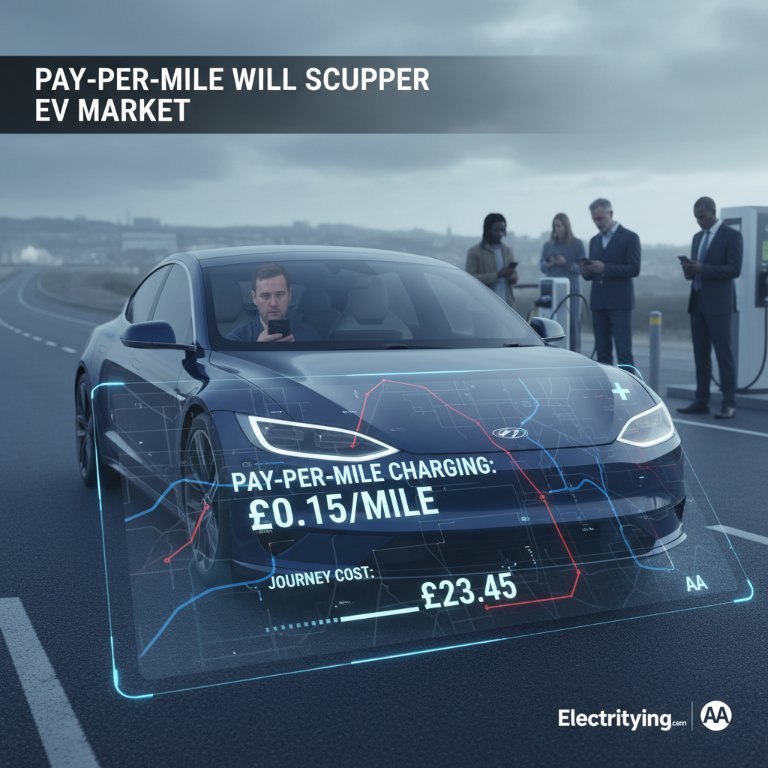
A groundbreaking new survey from Electrifying.com and the AA has sent a clear warning shot to policymakers: implementing pay-per-mile road charging could severely derail the UK's transition to electric vehicles. In a comprehensive study involving approximately 12,000 motorists, a staggering 55% indicated they would be less inclined to switch to an EV if such a charging scheme were introduced. This pivotal research emerges as government ministers grapple with the looming challenge of plummeting fuel duty revenues, a direct consequence of the accelerating shift towards zero-emission transport.
Beyond the immediate deterrent of a new charging mechanism, the survey also starkly illuminated a profound lack of confidence in the fundamental financial benefits of EVs. A mere 14% of respondents genuinely believe that the overall running costs of an electric car are lower than their petrol or diesel counterparts. This perception gap is critical, especially when expert analyses consistently demonstrate that EVs typically boast significantly reduced fuel and maintenance expenses over their lifespan. Adding to this disconnect, only a quarter (25%) of drivers were aware of the substantial savings offered by off-peak tariffs for cheaper overnight charging, a cornerstone of affordable EV ownership.
Pay-Per-Mile Threatens Transition Pace
The notion of a pay-per-mile system, while a seemingly logical answer to dwindling fuel tax income, appears to strike at the heart of the EV value proposition for many drivers. The public's hesitation is understandable; after years of encouragement to go electric for environmental and perceived financial benefits, the introduction of a new direct charge is seen by many as a punitive measure rather than a fair revenue replacement. This creates significant uncertainty for prospective EV buyers, potentially leading them to cling to internal combustion engine (ICE) vehicles longer than necessary. For a government committed to ambitious decarbonization targets, this finding presents a formidable obstacle that demands a nuanced and carefully communicated strategy.
EV Cost Savings Remain a Mystery to Many
The revelation that only 14% of motorists recognize the inherent cost advantages of EVs is a damning indictment of current public information campaigns. Despite robust data consistently highlighting lower 'fuel' costs (electricity vs. petrol/diesel) and reduced maintenance thanks to fewer moving parts, this message is clearly not resonating with the wider driving public. This isn't merely a minor oversight; it's a fundamental misunderstanding that prevents potential buyers from seeing the long-term economic rationale for making the switch. The initial higher purchase price of many EVs, without a clear understanding of subsequent savings, continues to be a major barrier, exacerbated by this perception gap.
Awareness Gap on Affordable Charging
Compounding the financial uncertainty is the widespread ignorance surrounding off-peak charging tariffs. Only 25% of drivers know about these cheaper electricity rates, which are often significantly lower than peak-time charges. For an EV owner, smart charging during off-peak hours can slash running costs dramatically, making daily commutes and longer journeys far more economical than an equivalent petrol car. This lack of awareness points to a critical failing in educating the public on how to optimize EV ownership. Energy providers, charging network operators, and even EV manufacturers must do more to highlight and simplify access to these cost-saving opportunities.
Why This Matters:
This survey isn't just a collection of statistics; it's a powerful and urgent signal to the entire EV ecosystem. For the government, it's a stark reminder that balancing the national budget cannot come at the expense of climate goals. Rushing a pay-per-mile scheme without addressing the underlying confidence issues and educating the public on EV benefits risks alienating the very drivers they need to convert. The automotive industry, including manufacturers and charging infrastructure providers, also faces a critical challenge: they must redouble efforts to demystify EV running costs and simplify the charging experience, particularly by promoting off-peak tariffs.
Who loses? Ultimately, a slow EV transition hurts everyone. Consumers lose out on long-term savings, the environment suffers from continued emissions, and the UK risks falling behind in the global race to electrification. Implementing a poorly received road charging scheme could undermine years of progress and investment. Who wins? In the short term, petrol and diesel vehicles might see an extended lease on life, but this is a pyrrhic victory. The real winners will be those policymakers and industry leaders who heed these warnings, prioritize education, and craft integrated strategies that make EV ownership undeniably appealing and financially accessible.
The findings from Electrifying.com and the AA underscore a critical juncture for the UK's EV strategy. The path forward demands a delicate balance: robust policies to secure future road funding must be meticulously crafted alongside aggressive, clear public education campaigns that demystify EV costs and empower drivers with the knowledge to maximize their savings. Failure to address these intertwined issues risks not just a slowdown, but a significant backpedal in the nation's journey towards a zero-emission future.