Nissan's Solar Ariya Concept Unveils a 'Life Hack' for Extended EV Autonomy
Nissan is taking a bold step towards an even more autonomous future for electric vehicles, showcasing a groundbreaking Ariya concept car fitted with i...
Editorial Team
World Of EV
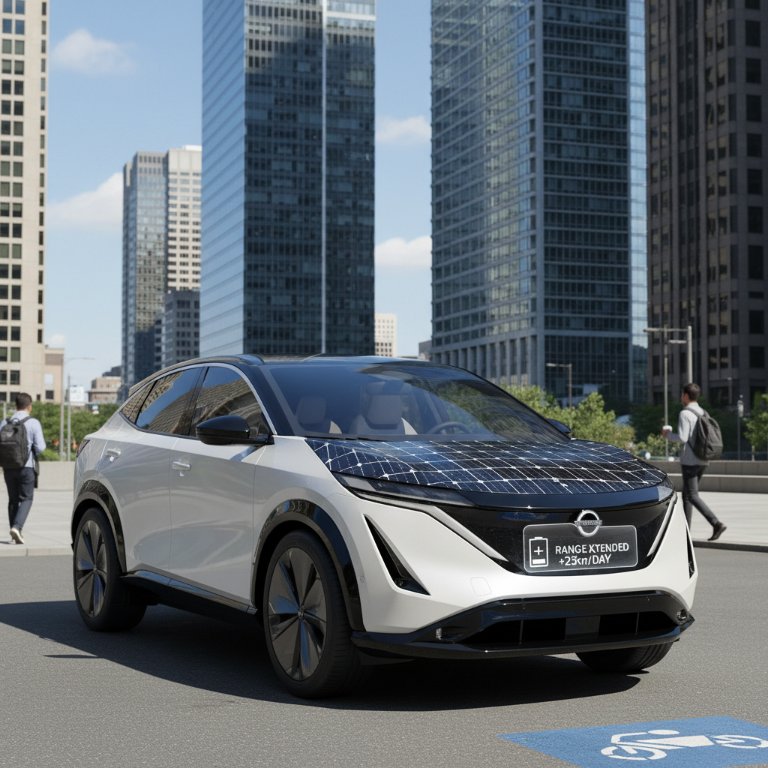
Nissan is taking a bold step towards an even more autonomous future for electric vehicles, showcasing a groundbreaking Ariya concept car fitted with integrated solar panels. This innovative approach promises to redefine convenience for EV owners, offering a compelling 'life hack' that extends driving range, reduces charging frequency, and ultimately lowers the cost of ownership by directly harnessing the sun's energy.
Nissan's move comes at a critical time when range anxiety, while diminishing, remains a psychological barrier for some prospective EV buyers. By integrating solar technology directly into the vehicle's upper surfaces, the Japanese automaker aims to offer a practical, always-on solution for supplementary power, distinguishing itself in an increasingly competitive market focused on maximizing efficiency and convenience.
Harnessing the Sun: The Ariya Solar Concept Unpacked
The core of Nissan's latest concept centers on seamlessly integrating photovoltaic cells across the Ariya's upper surfaces. This isn't merely an aesthetic addition; it's a functional energy harvesting system designed to passively charge the vehicle's battery. The engineering challenge lies in creating panels robust enough for automotive use while maintaining aerodynamic efficiency and visual appeal. Nissan's choice of the Ariya, a vehicle already lauded for its sleek design and advanced technology, serves as an ideal canvas for this forward-thinking integration.
Real-World Implications: A Daily Boost of 23km
Initial real-world testing of this solar integration has yielded impressive results, validating Nissan's vision for practical solar energy use in EVs. The company asserts that the system can deliver up to 23 kilometers (approximately 14.3 miles) of additional range per day. This isn't about replacing traditional charging entirely, but rather:
- Extending Charging Intervals: For many daily commuters, 23km can significantly push back the need for a grid charge, especially on days with shorter trips.
- Enhancing Autonomy: Owners gain greater flexibility and peace of mind, knowing their vehicle is continuously topping up, whether parked at work, home, or even while driving under sunlight.
- Reducing Reliance on Infrastructure: While not a complete off-grid solution, it lessens the dependency on public charging networks for routine top-ups.
Beyond the Charger: A Cost-of-Ownership Game Changer?
The potential for lower cost-of-ownership is a compelling argument for Nissan's solar concept. By continuously generating free energy, the vehicle can reduce its demand on the electrical grid, translating directly into savings for the owner. This aspect is particularly appealing in regions with higher electricity rates or for drivers who prioritize energy independence. It effectively turns the car into a micro-generator, utilizing an abundant and free energy source that would otherwise go untapped.
Why This Matters:
Nissan's solar-powered Ariya concept is more than just a technological showcase; it's a significant indicator of the industry's direction towards holistic energy solutions for EVs. This isn't a radical departure like the full-solar vehicles from companies like Lightyear or the defunct Sono Motors, which aimed for primary propulsion from solar. Instead, Nissan's approach is a pragmatic, supplementary solution, fitting neatly into the existing EV ecosystem.
Who Wins? EV owners stand to gain immense practical benefits, enjoying extended range, reduced charging hassles, and lower running costs. Nissan, by being an early mover in integrating practical, impactful solar charging, positions itself as an innovator in sustainable mobility. This could be a differentiator in a market increasingly commoditized by range and performance figures.
Who Loses? Perhaps no direct 'losers' exist, but traditional charging infrastructure providers might see a slight reduction in daily peak demand from some users. More broadly, manufacturers who lag in exploring such integrated energy solutions might find themselves playing catch-up in convenience features.
This move signals to the market that continuous, passive energy harvesting is a viable and valuable feature. It encourages a shift in mindset from solely grid-dependent charging to a more distributed energy model. For Nissan, this isn't a 'do-or-die' moment, but rather an intelligent evolution of their EV strategy, building on the foundation laid by the original Leaf and the more recent Ariya, by addressing nuanced user needs beyond just raw battery capacity.
Nissan's Ariya solar concept car presents a tangible vision for enhancing the daily EV ownership experience. By offering a meaningful boost to daily range through passive solar charging, Nissan is demonstrating a future where EVs are not just emission-free but also significantly more self-sufficient and economical to operate. This development marks an exciting frontier in making electric mobility even more seamless and appealing to the masses.