Nissan Abandons Entry-Level Leaf S: A Crushing Blow to Affordable EV Hopes in the US
Nissan has delivered a significant setback to budget-conscious electric vehicle (EV) buyers in the United States, confirming its decision against laun...
Editorial Team
World Of EV
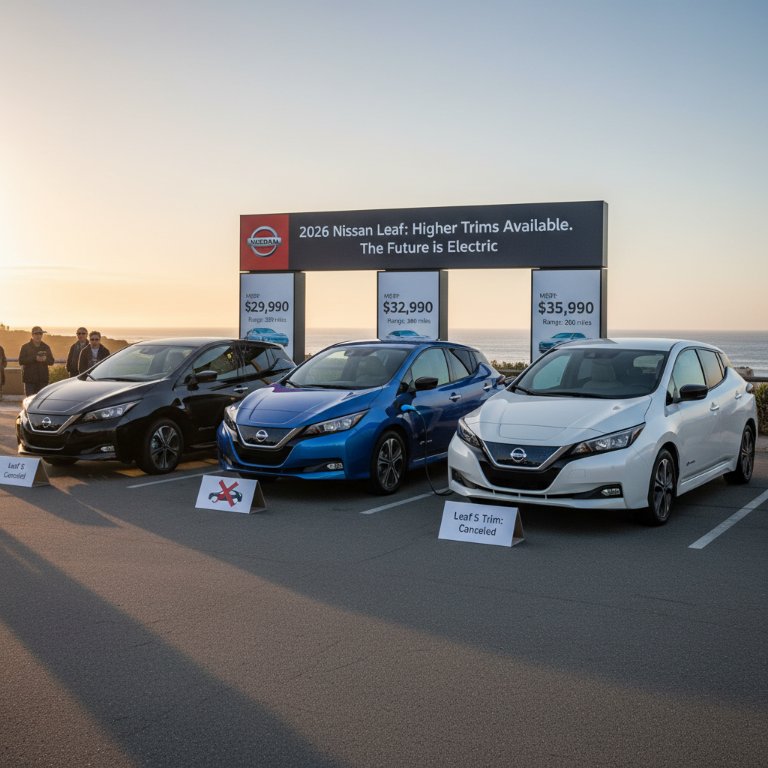
Nissan has delivered a significant setback to budget-conscious electric vehicle (EV) buyers in the United States, confirming its decision against launching the entry-level 2026 Nissan Leaf S with a 52-kWh battery. This move eliminates what was anticipated to be one of the most accessible all-electric cars featuring a North American Charging Standard (NACS) DC fast-charging port.
The Nissan Leaf holds a unique place in EV history, having been a pioneer in mass-market electrification since its debut over a decade ago. However, its journey has been marked by challenges, including an aging platform, slower charging speeds, and reliance on the now-outmoded CHAdeMO charging standard in a market increasingly dominated by CCS and rapidly transitioning to NACS. This latest strategic pivot by Nissan raises critical questions about its commitment to broad EV adoption and its positioning within a fiercely competitive market.
The Affordable EV Dream Deferred
The cancellation of the 52-kWh Leaf S means that prospective owners eyeing a budget-friendly entry into EV ownership will need to look elsewhere. Nissan's official statement attributes the decision to continually evaluating market trends, customer preferences, and the evolving EV landscape. The base Leaf S was projected to be priced well under $28,000, potentially even undercutting the upcoming 2027 Chevrolet Bolt's anticipated starting price of $28,995, had it launched. Its absence leaves a void for truly entry-level NACS-equipped options.
Consequently, customers in the US are now limited to three higher trims: the S+, SV+, and Platinum+, all exclusively equipped with a larger 75-kWh battery. These models begin at an MSRP of $29,990, rising to $31,485 including the destination charge.
- Starting MSRP (with destination): $31,485
- Available Trims: S+, SV+, Platinum+
- Battery Capacity: 75-kWh
- EPA Combined Range: 259 to 303 miles
- DC Fast-Charging Capability: Replenishes over 6 miles of range per minute, approximately twice as fast as previous generations.
While these remaining models offer improved range and charging performance, the higher entry price point fundamentally alters the Leaf's value proposition. The integrated NACS DC fast-charging port is a significant upgrade, offering access to a rapidly expanding charging network. However, this crucial feature is now confined to more premium configurations, effectively moving it out of reach for the most price-sensitive buyers.
Why This Matters:
Who Loses?
- Budget-Conscious Consumers: This is the most direct and hardest hit segment. The promise of an affordable, NACS-equipped EV from a mainstream brand has been withdrawn, leaving fewer options for those unwilling or unable to spend over $30,000.
- Nissan's Image as an EV Democratizer: The Leaf pioneered affordable EV ownership. This move undermines that legacy, suggesting a struggle to profitably produce truly entry-level EVs with modern features.
- Broader EV Adoption: Affordability remains a significant barrier to wider EV adoption. Removing a promising low-cost option slows the overall transition to electric mobility for a crucial segment of buyers.
Who Wins?
- Competitors with Affordable Offerings: Rivals like the redesigned Chevrolet Bolt (returning in 2027 with a sub-$30k starting price) and the upcoming Kia EV3 now face less direct competition in the value segment.
- Nissan's Profit Margins (Potentially): One likely reason for the cancellation is the challenge of profitability at the lowest price points, especially for imported vehicles subject to tariffs. By focusing on higher trims, Nissan might aim to improve per-unit profitability, although at the risk of losing market share.
What Does This Signal to the Market?
Nissan's move underscores the ongoing struggle for legacy automakers to balance the high costs of EV production (especially batteries and new tech like NACS integration) with the demand for affordable vehicles. It suggests that while Nissan is committed to electrification (as evidenced by its 'Ambition 2030' plan and investments in solid-state batteries), it's prioritizing profitability and feature-rich models over entry-level accessibility, at least in the US market. The fact that the 52 kWh Leaf is available in other markets, like Germany, further emphasizes market-specific profitability challenges in the US.
This is not a 'do-or-die' moment for Nissan as a whole, given its broader electrification strategy. However, for the Leaf nameplate, it represents a critical juncture. The decision effectively cedes the truly budget-friendly segment to others and places immense pressure on Nissan's remaining EV offerings to justify their higher price tags against increasingly fierce competition. The future success of the Leaf, and indeed Nissan's overall EV standing in the US, will hinge on how well its premium-priced models resonate with consumers who now have more choices than ever.
In conclusion, Nissan's decision to discontinue the entry-level 2026 Leaf S is a significant strategic retreat from the affordable EV segment in the US. While the remaining higher trims offer compelling improvements in range and charging, the increased price point creates a substantial barrier for many, ultimately dampening hopes for widespread, accessible EV adoption and challenging Nissan's long-held role as a pioneer in electric mobility.