NHTSA Clears Tesla Smart Summon: OTA Updates Vindicated in Zero-Injury Probe
The U.S. National Highway Traffic Safety Administration (NHTSA) has officially closed its 15-month preliminary evaluation into Tesla's 'Actually Smart...
Editorial Team
World Of EV
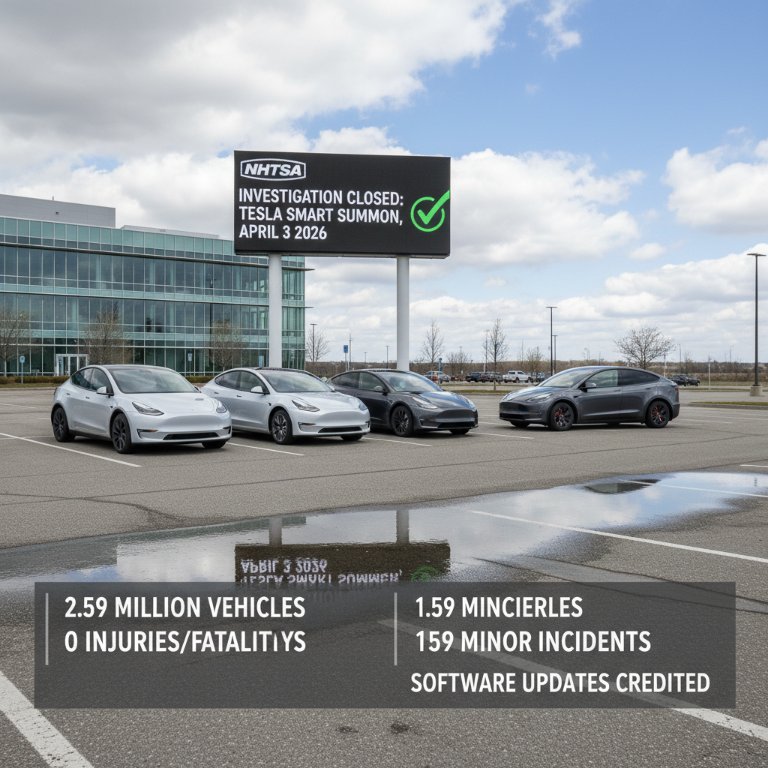
The U.S. National Highway Traffic Safety Administration (NHTSA) has officially closed its 15-month preliminary evaluation into Tesla's 'Actually Smart Summon' feature, marking a significant regulatory victory for the EV giant. Concluding its probe on April 3, 2026, the agency found zero injuries or fatalities across millions of Summon sessions, a critical validation of Tesla's advanced driver-assistance systems (ADAS) amidst ongoing scrutiny of autonomous driving technologies.
This decision comes as a crucial development for Tesla, which has consistently faced intense public and regulatory examination of its autonomous features, including Autopilot and Full Self-Driving (FSD). The preliminary evaluation, initiated in January 2025, encompassed approximately 2.59 million vehicles, including Model S, X, 3, and Y produced between 2016 and 2025.
NHTSA's Comprehensive Evaluation Concludes
NHTSA's Office of Defects Investigation (ODI) rigorously assessed the performance of 'Actually Smart Summon,' a short-distance, SAE Level 2 system that allows drivers to move their vehicles remotely via a smartphone app in parking lots and private property.
The findings were compelling:
- Scope: Approximately 2.59 million Tesla Model S, X, 3, and Y vehicles from 2016-2025 were covered.
- Incidents: A total of 159 reported incidents of minor property damage were identified out of millions of Summon sessions.
- Severity: Nearly all incidents involved minor property damage, such as impacts with parking gates, adjacent parked vehicles, or bollards.
- Safety Record: Critically, the probe confirmed zero reported injuries, fatalities, vulnerable road user involvement, airbag deployments, or vehicle tow-aways linked to the feature.
NHTSA's analysis noted that incidents typically occurred early in a Summon session, often due to limitations in the system's or user's situational awareness, such as when navigating reversing near obstacles or with obstructed cameras.
Over-the-Air Updates Prove Pivotal
The agency explicitly credited Tesla's proactive over-the-air (OTA) software updates for addressing issues identified during the investigation. Tesla deployed six OTA updates between January and November 2025, targeting critical areas such as obstacle detection, camera blockages (including environmental factors like snow), and responses to dynamic objects like gate arms.
This highlights a distinct advantage of Tesla's software-defined vehicle architecture, allowing for rapid iteration and deployment of safety enhancements without the need for traditional, often cumbersome, physical recalls. This agile response mechanism stands in contrast to the industry's historical reliance on slower, more costly conventional recall processes.
Why This Matters:
This decision is a resounding vindication for Tesla, particularly regarding the safety of its advanced driver-assistance systems. For savvy EV enthusiasts and prospective buyers, it offers a significant confidence boost in the maturity and responsiveness of Tesla's software capabilities. The absence of injuries or fatalities, despite millions of uses, is a powerful statistic that undercuts persistent FUD (fear, uncertainty, and doubt) surrounding Tesla's autonomous ambitions.
For the broader automotive industry, NHTSA's acknowledgment of OTA updates as a legitimate and effective method for addressing safety concerns sets a crucial precedent. It signals that regulators are increasingly recognizing the dynamic nature of software-defined vehicles and the potential for real-time improvements to mitigate risks. This could empower other automakers investing heavily in OTA capabilities to adopt more agile safety strategies. However, it also underscores the growing chasm between legacy automakers struggling with complex software integration and pioneers like Tesla who have built their systems from the ground up with OTA in mind. The ability to push critical safety patches remotely and efficiently will become a defining competitive advantage, potentially leaving those with traditional hardware-centric development cycles at a disadvantage.
While this specific probe is closed, it's crucial to remember that regulatory scrutiny of Tesla's broader Full Self-Driving (FSD) system remains intense. NHTSA recently escalated an engineering analysis into FSD's ability to detect when its system is degrading or not performing properly, covering approximately 3.2 million vehicles. This ongoing investigation, which includes concerns about FSD's performance in reduced visibility conditions and driver attention monitoring, indicates that regulators are keenly focused on the overall safety architecture of Tesla's more advanced autonomous driving features.
Conclusion: The closure of the Smart Summon investigation without a finding of a safety-related defect is a pivotal moment, validating Tesla's approach to iterative software development and its capacity to address safety concerns proactively. While the journey toward fully autonomous vehicles is long and fraught with ongoing regulatory challenges, this outcome reinforces Tesla's position as a leader in deploying and continuously refining advanced driver-assistance technologies. The focus will undoubtedly shift to the continued evolution and regulatory oversight of FSD, but today, Tesla can celebrate a significant nod of approval from a key safety authority.