Musk's Hard Truth: Tesla Hardware 3 Owners Face 'Painful' FSD Upgrade Imperative
In a candid admission, Tesla CEO Elon Musk has publicly acknowledged that a significant number of existing Tesla vehicles equipped with the company's ...
Editorial Team
World Of EV
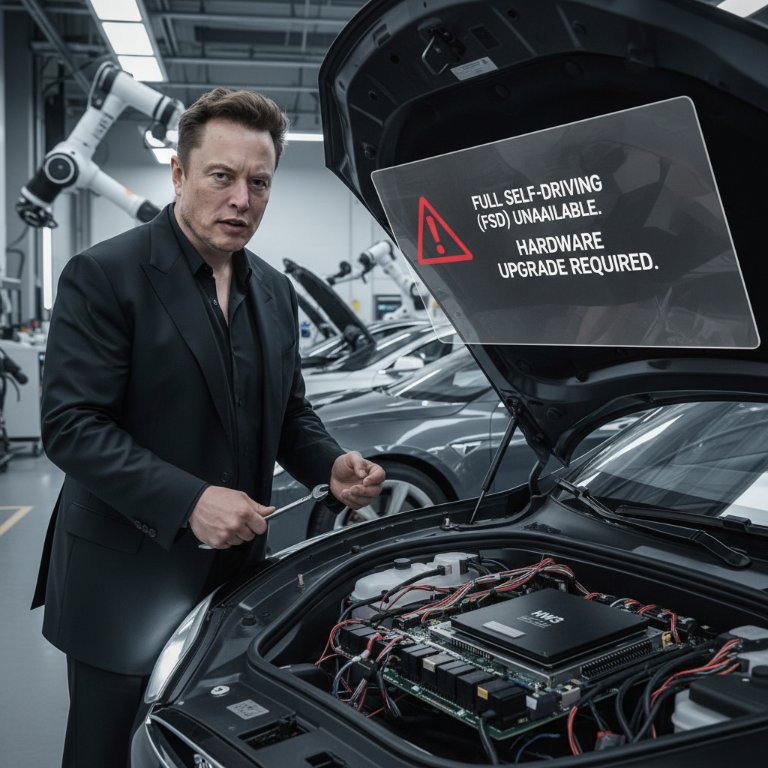
In a candid admission, Tesla CEO Elon Musk has publicly acknowledged that a significant number of existing Tesla vehicles equipped with the company's Hardware 3 (HW3) computer will be unable to run the forthcoming generation of its Full Self-Driving (FSD) software as initially promised. This revelation means a mandatory, and potentially costly, hardware upgrade awaits these customers, a process Musk himself described as “painful and difficult,” yet absolutely essential for future FSD capabilities.
This isn't just a technical glitch; it's a profound moment of reckoning for Tesla's long-standing FSD ambitions and its legions of early adopters. For years, Tesla has championed its software-centric approach, promising that vehicles purchased with the FSD package would continuously improve through over-the-air updates, rendering them future-proof. This latest announcement directly challenges that foundational promise, particularly for owners who invested substantial sums into the FSD package under the assumption their hardware was sufficient for the journey to true autonomy.
The Hardware 3 Revelation
Musk's statement confirms what many industry analysts and even some Tesla enthusiasts had quietly speculated: the processing power of Hardware 3, while revolutionary at its introduction, simply won't cut it for the advanced computational demands of the next-generation FSD stack. While specific details on the exact 'next-generation' software remain under wraps, the implication is clear: a fundamental leap in algorithmic complexity and real-time data processing necessitates a more robust computing platform. This isn't merely about a few extra frames per second; it points to a paradigm shift in how Tesla's autonomous system will perceive, predict, and react to the world.
A History of Promises and Pivots
Tesla's journey with Full Self-Driving has been marked by ambitious timelines and technological evolution. From the initial Autopilot system to the introduction of Enhanced Autopilot and then the Full Self-Driving Capability package, the company has consistently pushed the boundaries of what's possible in consumer vehicles. When Hardware 3 – or the 'FSD Computer' – was rolled out in 2019, it was touted as the custom-designed, purpose-built solution that would enable true autonomy. Tesla even offered free upgrades from earlier hardware (HW2/2.5) to HW3 for FSD purchasers, reinforcing the idea of a perpetual software-defined vehicle. This latest announcement, however, creates a new precedent, shifting the burden of future upgrades back onto the customer, at least in terms of the 'painful and difficult' process.
Why This Matters:
Erosion of Customer Trust: For many who paid for FSD based on the promise of a future-proof system, this necessitates an additional, unforeseen commitment of time and potentially money. It chips away at the 'buy once, upgrade forever' narrative that has been a cornerstone of Tesla's FSD value proposition. The 'painful and difficult' nature of the upgrade also suggests potential dealership visits and downtime, adding to customer inconvenience.
Financial and Logistical Burden for Tesla: While the upgrade cost may fall on consumers, Tesla still faces the immense logistical challenge of performing these upgrades at scale. This involves manufacturing and distributing new hardware, scheduling service appointments, and managing customer expectations globally. It represents an operational overhead that the company likely didn't anticipate to this degree for HW3 users.
Competitive Landscape: As other automakers like Mercedes-Benz (with its DRIVE PILOT) and Waymo make steady, albeit more conservative, progress in certified autonomous driving, Tesla's latest hardware hurdle underscores the monumental difficulty of achieving Level 4/5 autonomy. It signals that even the most aggressive players are still grappling with the sheer computational demands.
Software-Defined Vehicle Paradigm Under Scrutiny: Tesla has been a leader in proving the power of software-defined vehicles. However, this situation highlights that hardware, even purpose-built hardware, can still become a bottleneck. It's a reminder that even the most brilliant software requires robust, evolving underlying silicon.
Looking Ahead
Tesla's admission about Hardware 3 is a stark reminder of the immense challenges on the road to full autonomy. While it may be a 'painful' step, it underscores the company's commitment to delivering a truly capable self-driving system, even if it means re-evaluating past promises and requiring significant effort from its customer base. The coming months will reveal how seamlessly Tesla manages these upgrades and, critically, how its next-generation FSD software truly performs on the more advanced hardware. The industry, and Tesla owners, will be watching closely to see if this difficult pivot ultimately delivers on the long-held promise of autonomous driving.